Mastering Feynman Integrals
Introduction to Quantum Field Theory
Fields Come First
In classical physics, we think of fields and particles as separate things. A field is a property of space itself, like the magnetic field around a bar magnet or the gravitational field holding Earth in orbit. Particles are tiny, distinct objects moving through these fields. Quantum Field Theory (QFT) turns this idea on its head.
QFT says that fields are the most fundamental things in the universe. Everything, including every particle you've ever heard of, is just a vibration or an excitation in a field. There's an electron field that fills all of space. When this field gets a little jolt of energy at a certain location, we see that jolt as an electron. The same goes for every other particle. A photon is an excitation of the electromagnetic field, and a quark is an excitation of a quark field.
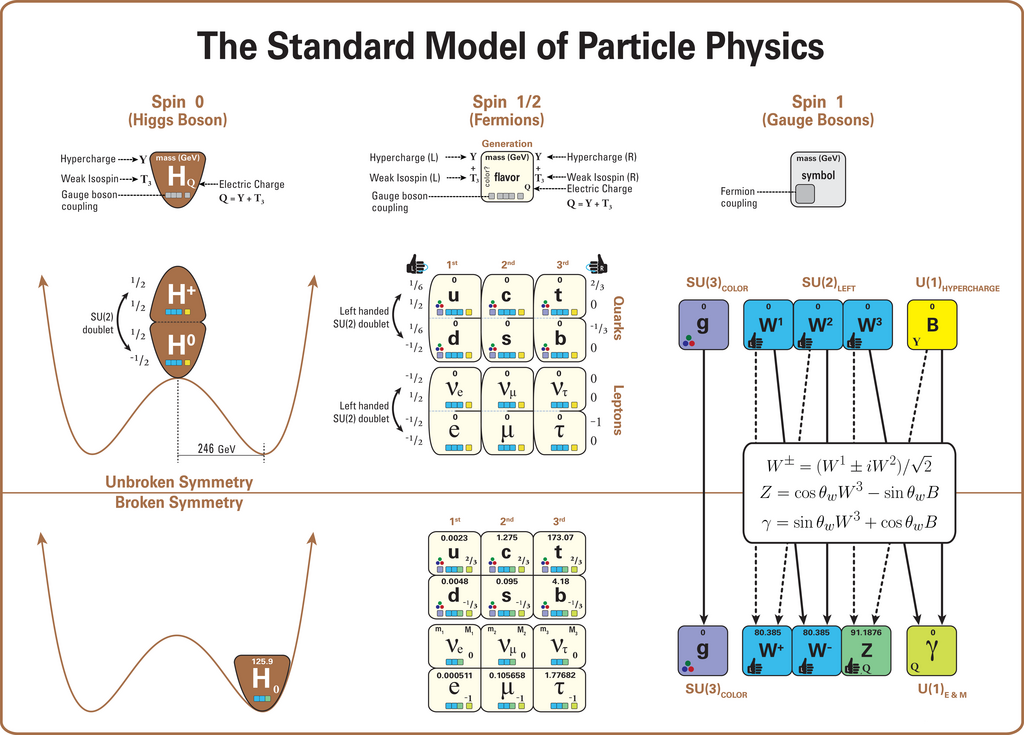
This process of treating a field as a quantum object whose excitations are particles is called quantization. It solves a big problem from early quantum mechanics. In the old view, particles could not be created or destroyed, only moved around. But we know from experiments that particles can be created from pure energy and can annihilate into energy. For instance, an electron and its antiparticle, a positron, can collide and disappear, leaving behind two photons.
Particle creation and annihilation is simply the field gaining or losing energy. Adding enough energy to a field creates a particle; a particle losing its energy is it disappearing back into the field.
So, the universe isn't an empty stage with actors (particles) on it. It's a collection of overlapping, interacting fields. The seemingly empty vacuum of space is actually buzzing with the potential of all these fields, waiting for a little energy to spring to life as a particle.
Symmetry is Everything
Why do fields interact in the specific ways they do? The answer lies in one of the most beautiful ideas in physics: symmetry. A symmetry means that if you change something about a system, its physical laws remain the same. For example, if you conduct an experiment, then rotate your entire lab and do it again, you'll get the same result. This is called rotational symmetry, and it's linked to the conservation of angular momentum.
In QFT, symmetries are even more powerful. They don't just lead to conservation laws; they actually dictate the existence of forces. These are called gauge symmetries. A gauge symmetry is a kind of mathematical transformation you can perform on a field that leaves the physics unchanged. It's like changing the key of a song—the notes are different, but the melody is the same.
A German mathematician named Emmy Noether proved that for every continuous symmetry in nature, there is a corresponding conserved quantity.
In QFT, requiring that the equations describing a particle field (like the electron field) obey a gauge symmetry forces you to introduce a new field—a force field. The symmetry of the electron field, for example, demands the existence of the electromagnetic field. The particle associated with this new field is the force carrier. For electromagnetism, that's the photon.
In short: Symmetries demand forces. The fundamental forces of nature are not arbitrary add-ons; they are a necessary consequence of the universe's underlying symmetries.
How Particles Interact
Now we can understand particle interactions. They aren't tiny billiard balls bouncing off each other. An interaction is an exchange of energy between different fields, mediated by a force-carrying particle.
Imagine two electrons approaching each other. As they get closer, one electron creates a disturbance in the surrounding electromagnetic field. This disturbance is a virtual photon. The other electron then absorbs this photon. This exchange of a photon is what we measure as a repulsive force between the two electrons. They never actually "touch"; they influence each other by trading a messenger particle through their shared field.
This is the basic model for all fundamental forces. The strong nuclear force is an exchange of gluons between quarks. The weak nuclear force, responsible for radioactive decay, is an exchange of W and Z bosons. Each force arises from a symmetry and is carried by its own special particle.
According to Quantum Field Theory, what is the most fundamental component of the universe?
In Quantum Field Theory, the idea that a specific symmetry in the laws of physics requires the existence of a corresponding force is known as a _______ symmetry.
This framework, where fundamental reality is described by quantized fields governed by symmetries, is the foundation of the Standard Model of Particle Physics. It provides the language and tools to calculate the outcomes of particle interactions with incredible precision.