Mastering FAIR Research Data Management
Introduction to FAIR Principles
The Library of Scientific Data
Imagine trying to find a specific fact in a massive library where books have no titles, are shelved in no particular order, and are written in a thousand different languages, some of which are long forgotten. It would be nearly impossible. A lot of scientific data used to be like that—locked away in personal computers, poorly labeled, and in formats that became obsolete. Valuable information was often lost or couldn't be used by other researchers.
In 2016, a group of scientists and researchers came together to solve this problem. They created a set of guiding principles to make data management more effective. They called them the FAIR principles.
FAIR is an acronym that stands for Findable, Accessible, Interoperable, and Reusable.
These principles aren't strict rules or standards but rather a set of goals to aim for when sharing research data. The idea is to make data as useful as possible for everyone, including computers, paving the way for more efficient and collaborative science.
Breaking Down FAIR
Let's look at what each principle means.
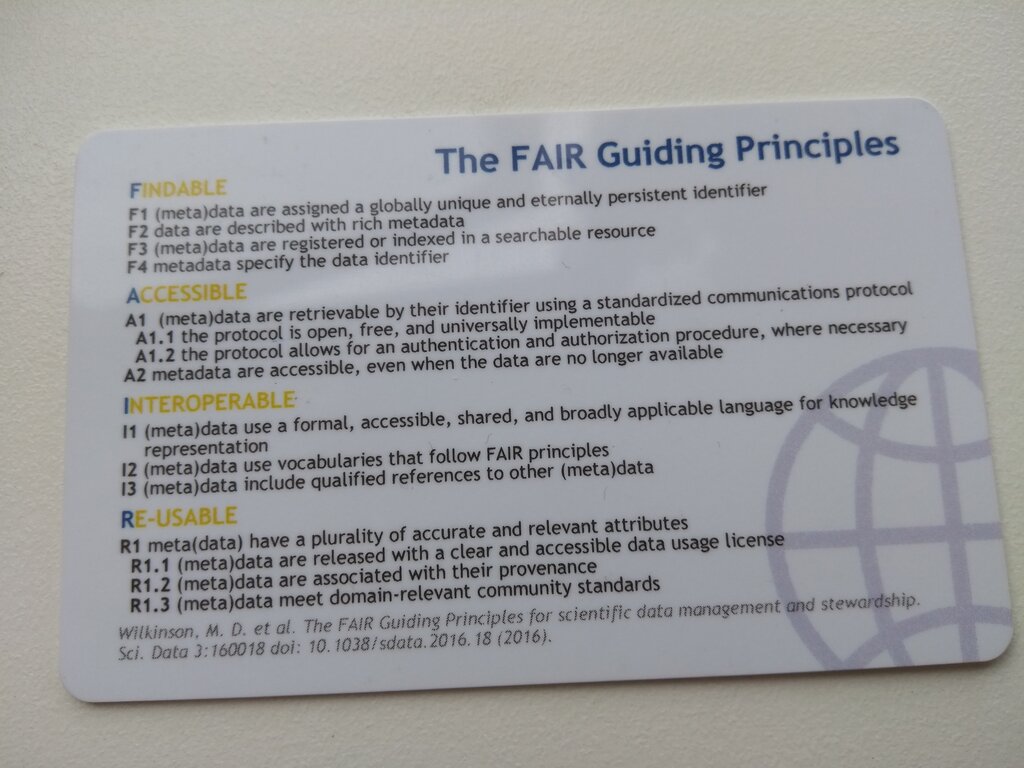
Findable The first step is making sure people can discover your data in the first place. For data to be findable, it needs a unique and permanent identifier, like a digital object identifier (DOI). It also needs rich metadata—data about the data—that clearly describes what it is, who created it, and what it's about. Think of it like a library card catalog entry for a dataset. It tells you everything you need to know to decide if it's what you're looking for.
metadata
noun
A set of data that describes and gives information about other data.
Accessible Once you've found the data, you need to know how to access it. Accessible doesn't necessarily mean open to everyone, no questions asked. It means the conditions for access are clearly stated. The data might be freely downloadable, or you might need to request permission or log in. The key is that the process is straightforward and the metadata remains accessible even if the data itself is not.
Accessible data means there are no surprises. You know exactly what the rules are for getting ahold of it.
Interoperable Data needs to be able to work with other data and systems. Interoperability means using standard formats and vocabularies that different applications and workflows can understand. It’s like ensuring your new phone charger uses a USB-C connector instead of some strange, custom plug that only works with one device. When data is interoperable, researchers can easily combine datasets from different sources to uncover new insights.
Reusable The ultimate goal of FAIR is to make data reusable. For data to be truly reusable, it must be well-described with detailed information about how it was collected and processed. It also needs a clear license that tells others what they are allowed to do with it. Good documentation helps other researchers replicate the original experiment or use the data for entirely new studies.
Why FAIR Matters
Adopting the FAIR principles has huge benefits. It makes research more efficient by reducing the time scientists spend trying to find and clean up data. It increases transparency and makes it easier to verify research findings, which builds trust in science. It also opens the door for new discoveries by allowing data to be combined in novel ways.
Epidemiological practices that follow FAIR principles can address these barriers by making resources (F)indable with the necessary metadata , (A)ccessible to authorized users and (I)nteroperable with other data, to optimize the (R)e-use of resources with appropriate credit to its creators.
By making data findable, accessible, interoperable, and reusable, researchers ensure their work has a life beyond its original publication. It becomes a lasting resource that can contribute to knowledge for years to come.
What is the primary goal of the FAIR principles?
According to the FAIR principles, which of these is essential for making data 'Findable'?