Mastering Factorization
Introduction to Factorization
Breaking Numbers Down
Think of any whole number. Let's say, 12. Can you write it as a product of other whole numbers? You could write it as . Or maybe . You could even write it as . All of these are ways of "factoring" the number 12. When we factor a number, we break it down into numbers that can be multiplied together to get the original number.
factor
noun
A number that divides into another number exactly and without leaving a remainder.
Factoring is like finding the ingredients in a recipe. If the final dish is the number 12, then 2 and 6 are ingredients that combine (through multiplication) to make it. So are 3 and 4. The process of finding these ingredients is called factorization.
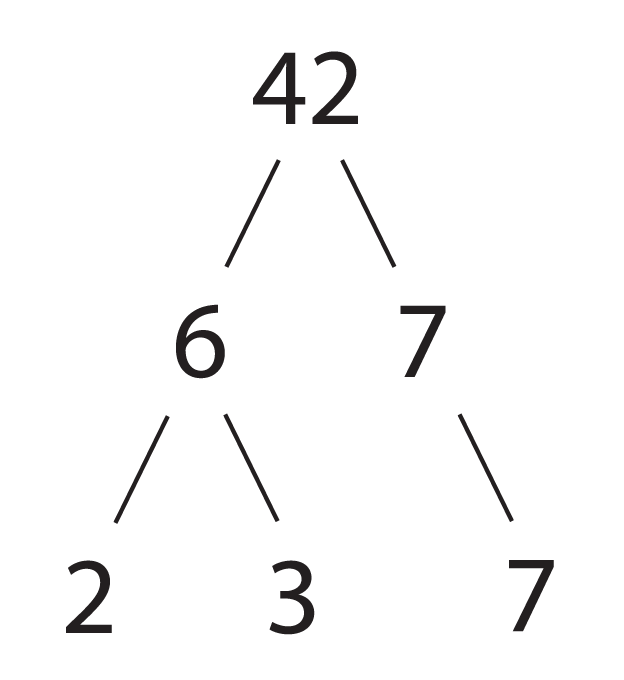
The Building Blocks of Numbers
If we keep breaking numbers down, we eventually hit a wall. For example, we can factor 6 into . But can we factor 2 or 3 any further (without using the number 1)? No. Numbers like 2, 3, 5, 7, and 11, which can only be divided by 1 and themselves, are special. They are the fundamental building blocks of all other numbers.
prime number
noun
A whole number greater than 1 whose only factors are 1 and itself.
This leads to one of the most important ideas in all of mathematics: The Fundamental Theorem of Arithmetic. It sounds complicated, but the idea is simple. It says that any whole number greater than 1 is either a prime number itself or can be broken down into a product of prime numbers in exactly one way. The order of the factors doesn't matter, but the set of prime factors is unique.
Every number has a unique "fingerprint" made of prime numbers. No two numbers share the same prime fingerprint.
Let’s look at the number 36. We could start by factoring it into . We can then break those down further. The 4 becomes , and the 9 becomes . So, the prime factorization of 36 is .
What if we started with instead? The first 6 becomes , and the second 6 becomes . We still end up with the same prime factors: two 2s and two 3s. No matter how you begin, the fundamental building blocks are always the same.
Why Does This Matter
So, why do we care about breaking numbers down into their prime factors? Factorization is a fundamental tool used throughout mathematics. It's essential for simplifying fractions. To simplify , we can look at their prime factors:
We can cancel out the common factors () from the top and bottom, leaving us with . This process is far more reliable than just trying to guess a common divisor.
Factoring is a powerful algebraic problem solution pathway, particularly useful for simplifying expressions, solving quadratic equations, and working with rational expressions.
Factorization also helps us understand the relationships between numbers, such as finding the greatest common factor or the least common multiple. It is a key that unlocks deeper patterns in numbers and is a critical first step for tackling more advanced topics like algebra. Understanding how numbers are built helps us learn how to work with them more effectively.
What does it mean to 'factor' a whole number?
Which of the following is the correct prime factorization of the number 36?
Grasping these core ideas is the first step toward mastering more complex mathematical skills.