Mastering Evolutionary Genetics
Introduction to Evolutionary Genetics
The Genetic Recipe for Change
Evolution isn't just about fossils and dinosaurs. At its core, it's about changes in the genetic makeup of populations over generations. To understand how a species changes over time, we need to look at its collective genetic information, known as the gene pool.
Gene Pool
noun
The complete set of unique alleles (variants of a gene) in a species or population.
Think of the gene pool as a giant library of all possible genetic traits for a population. Evolution occurs when the frequency of certain traits in that library changes. Four main forces drive these changes: mutation, natural selection, genetic drift, and gene flow. Let's explore how they work.
Where Variation Comes From
All evolutionary change begins with genetic variation. If every individual in a population were genetically identical, there would be no traits for nature to select from. The ultimate source of this crucial variation is mutation.
Mutations play a crucial role in generating genetic diversity within populations, contributing to the process of natural selection and driving evolutionary changes over time.
A mutation is simply a change in an organism's DNA sequence. It can happen due to errors during DNA replication or exposure to environmental factors like UV radiation. Crucially, mutations are random. They don't arise because an organism needs a new trait to survive. Most of the time, they are either harmful or have no effect at all (neutral). But every so often, a mutation creates a new allele that proves to be beneficial.
A random change in the DNA recipe can result in a new trait. This new trait is then tested by the environment, not created by it.
This constant, slow trickle of new genetic information from mutations provides the raw material for evolution to act upon.
The Forces of Evolution
Once variation exists, other forces determine which traits become more or less common in a population.
Natural Selection
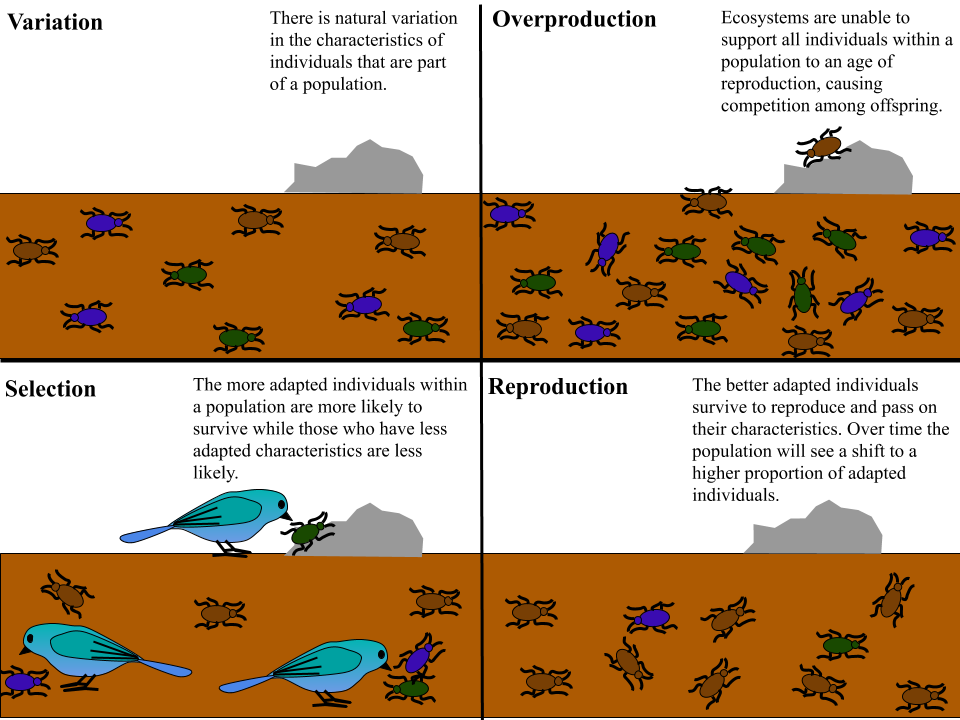
This is the mechanism Charles Darwin famously described. The idea is simple: individuals with inherited traits that make them better suited to their environment are more likely to survive, reproduce, and pass those advantageous traits to their offspring. Over time, these beneficial traits, or adaptations, become more frequent in the population.
Imagine a population of beetles living on dark soil. Due to mutation, some beetles are light green and some are dark brown. Birds can easily spot the green beetles against the dark soil, so they eat them more often. The brown beetles are better camouflaged, survive longer, and have more offspring. After many generations, the beetle population will be composed almost entirely of brown individuals. The environment didn't create brown beetles, it simply selected for them.
Genetic Drift
Natural selection isn't the only driver of change. Sometimes, gene frequencies shift due to pure chance. This is called genetic drift. It's like flipping a coin; you might get heads five times in a row just by random luck. In population genetics, this can happen when a random event, like a natural disaster, wipes out individuals irrespective of their traits.
Genetic drift has a much stronger effect in small populations. If a population of 100 beetles is reduced to 10 by a random rockslide, the gene pool of the survivors might look very different from the original population, simply by chance.
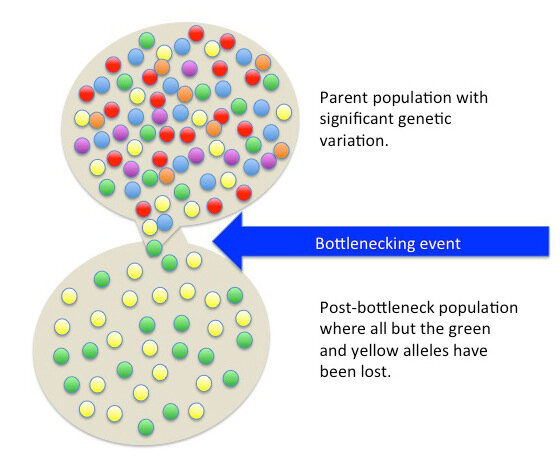
From a genetic perspective, evolution is a “change in allele frequency from one generation to the next” and can occur randomly by gene flow and genetic drift.
Gene Flow
Gene flow, or migration, is the movement of genes from one population to another. When individuals from one population move to another and interbreed, they introduce their alleles into the new population's gene pool. This process can increase the genetic variation within a population but tends to reduce the genetic differences between populations. If two populations exchange genes freely, they will become more genetically similar over time.
A Null Hypothesis for Evolution
How do we know if a population is evolving? To find out, we need a baseline for comparison. This baseline is the Hardy-Weinberg equilibrium principle. It describes a hypothetical, non-evolving population where allele and genotype frequencies remain constant from generation to generation.
The Hardy-Weinberg equilibrium is a mathematical model for a population that is not evolving.
For a population to be in this state of equilibrium, five conditions must be met:
- No new mutations: The gene pool is not being modified.
- Random mating: Individuals mate without any preference for particular genotypes.
- No natural selection: All traits have an equal chance of survival and reproduction.
- A very large population size: This prevents random chance (genetic drift) from altering allele frequencies.
- No gene flow: There is no migration of individuals into or out of the population.
In the real world, these five conditions are almost never met. That's what makes the principle so useful. When scientists observe that a population's allele frequencies are changing, they can infer that at least one of these evolutionary forces is at work. The Hardy-Weinberg principle provides the tool to measure the rate of evolutionary change.
The equation used to test this equilibrium is , where is the frequency of one allele and is the frequency of the other. The terms represent the frequencies of the three possible genotypes.
Let's test your understanding of these core concepts.
What is a population's gene pool?
Which of the following statements about mutations is true?
These four forces, along with the baseline provided by Hardy-Weinberg, form the foundation of evolutionary genetics, explaining how life diversifies and adapts.