Mastering Equivalent Fractions
Understanding Fractions
Parts of a Whole
Imagine you have a pizza and you want to share it with friends. You cut it into equal slices. A fraction is simply a way to talk about those slices. It tells you how many pieces of a whole you have. Instead of saying "one of four equal slices," you can just say you have $1/4$ of the pizza.
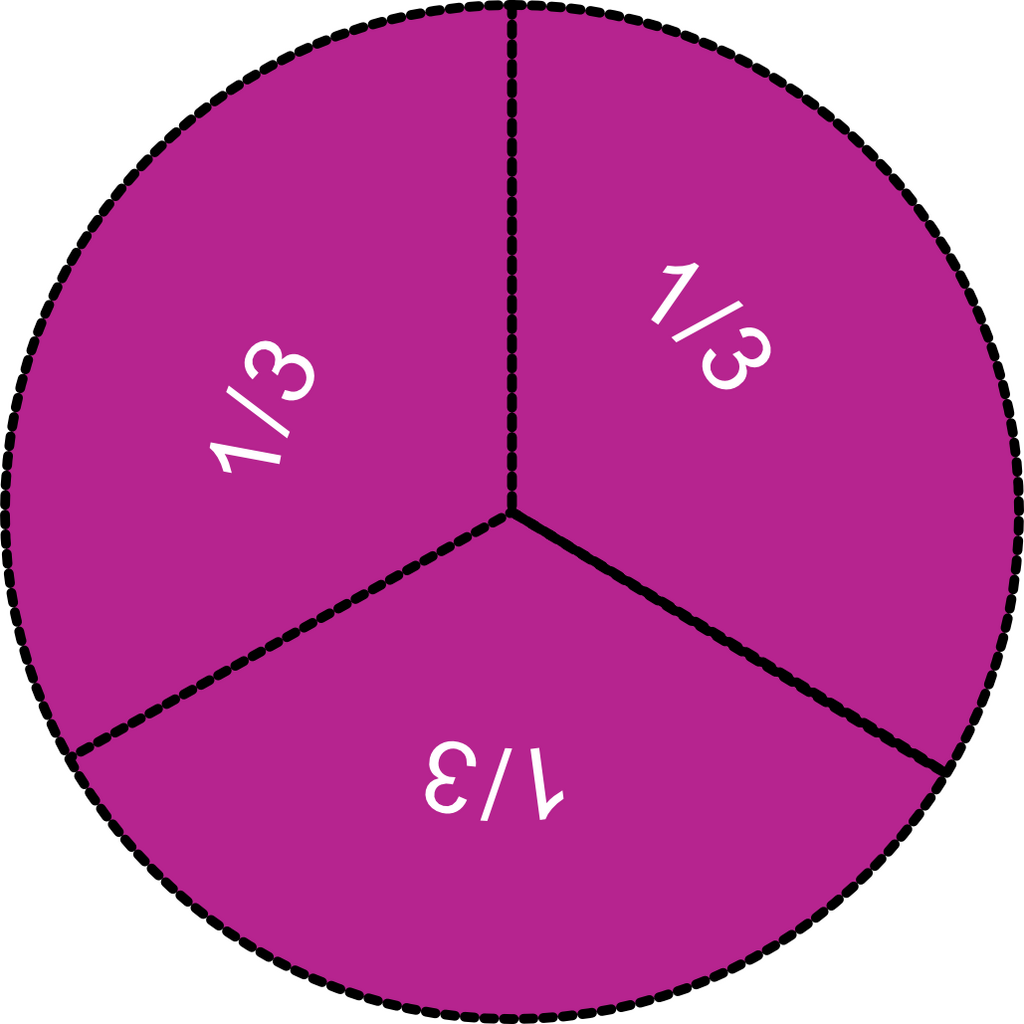
Every fraction has two parts: a top number and a bottom number, separated by a line.
The Numerator and Denominator
The bottom number is the denominator. It tells you how many equal pieces the whole has been divided into. Think of it as the name of the fraction. If the denominator is 4, we're talking about "fourths." If it's 8, we're talking about "eighths."
The top number is the numerator. It tells you how many of those pieces you actually have. If you have three out of four slices of a pizza, the numerator is 3 and the denominator is 4. Your fraction is $3/4$.
So, if a recipe calls for $1/2$ a cup of sugar, the denominator (2) tells you the cup is divided into two equal parts, and the numerator (1) tells you to use just one of those parts.
Fractions on a Number Line
Fractions aren't just for objects. They are numbers, and they have their own place on the number line. They live in the spaces between the whole numbers. For example, the fraction $1/2$ is exactly halfway between 0 and 1.
Seeing fractions on a number line helps you understand their size relative to each other and to whole numbers. You can see that $3/4$ is greater than $1/4$ because it's further to the right, closer to 1.
In a fraction, what does the top number tell you?
A pizza is cut into 8 equal slices. You eat 3 of them. What fraction represents the slices you ate?