Mastering Enterprise Resource Planning Systems
ERP Fundamentals
The Central Nervous System of Business
Imagine a business as a living organism. It has different parts doing different jobs: the finance team manages the money, the warehouse handles inventory, and the sales team brings in customers. For the organism to function, all these parts need to communicate seamlessly. An Enterprise Resource Planning (ERP) system acts as the central nervous system, connecting all these disparate functions into a single, cohesive unit.
Enterprise Resource Planning (ERP) refers to a type of software system designed to help organizations manage and automate core business processes across various departments.
At its core, an ERP integrates everything. Instead of having separate software for accounting, human resources, and supply chain management, an ERP provides one shared database. When a salesperson enters a new order, the system automatically checks inventory levels, alerts the production floor, updates the financial records, and schedules the shipment. This creates a single source of truth, eliminating data silos and ensuring everyone works with the same, up-to-date information.
From Factory Floors to the Cloud
ERP systems didn't appear overnight. Their story begins in the 1960s with inventory control systems, which evolved into Material Requirements Planning (MRP) systems in the 1970s. MRPs were focused solely on manufacturing: calculating the materials and components needed to produce a product. By the 1980s, they expanded into Manufacturing Resource Planning (MRP II), which incorporated factory-wide functions like scheduling and capacity planning.
The term ERP was coined in the 1990s as these systems grew to include other business functions like finance and human resources. Today, modern ERPs are often cloud-based, offering more flexibility, mobile access, and powerful analytics capabilities. They've moved from a niche manufacturing tool to a foundational technology for businesses of all sizes and industries.
Streamlining Work and Decisions
The primary benefit of an ERP is efficiency. By automating routine tasks and streamlining workflows, it frees up employees to focus on more valuable activities. Consider the process of fulfilling a customer order. Without an ERP, it involves a chain of manual handoffs: a salesperson emails the order to the warehouse, someone there checks stock levels, another person creates an invoice in the accounting system, and so on. Each step is a potential point of delay or error.
An ERP system automates this entire flow. The initial order entry triggers a cascade of actions across all relevant departments without manual intervention. This not only speeds up the process but also reduces the chance of human error.
This integration provides a real-time, big-picture view of the entire business operation. Managers no longer have to wait for weekly or monthly reports to see how the company is performing.
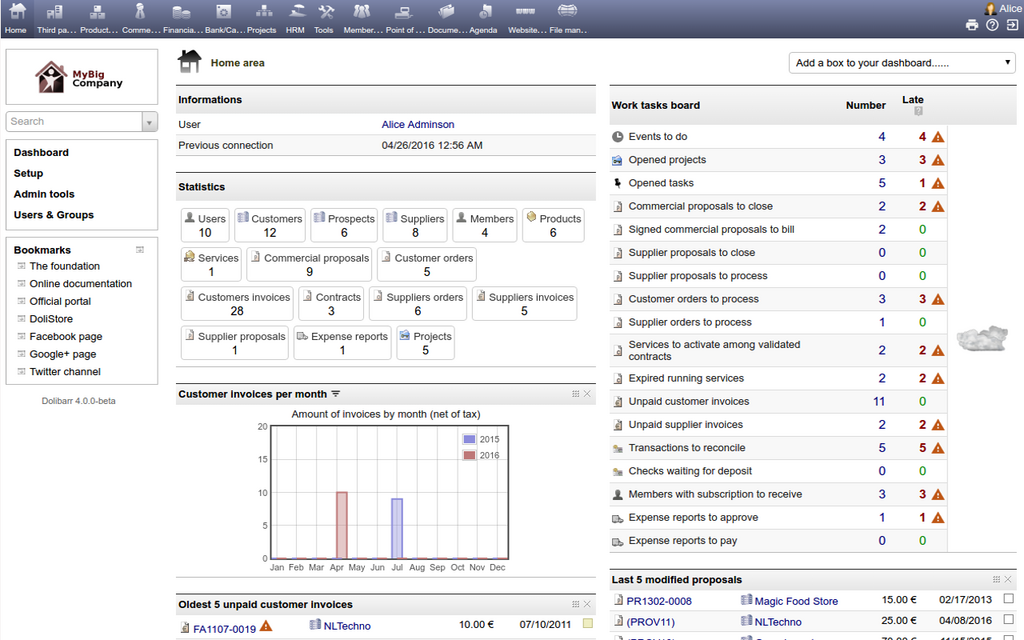
With access to live data, decision-makers can spot trends, identify potential problems, and react to market changes much faster. If a dashboard shows that a particular product's sales are spiking, the company can quickly ramp up production and marketing efforts. If inventory levels for a key component are running low, the system can automatically flag it for reorder. This ability to make informed decisions on the fly is a critical competitive advantage.
Ready to test your knowledge?
What is the primary function of an Enterprise Resource Planning (ERP) system?
The text compares an ERP system to a living organism's "central nervous system." What does this analogy primarily highlight?
An ERP system provides the foundational structure that allows a modern business to operate with clarity and agility.