Mastering Enterprise Resource Planning
ERP Fundamentals
What Is an ERP System?
Think of a business as a collection of different teams. You have finance managing money, sales talking to customers, and operations making sure products get delivered. In a small company, these teams might communicate by shouting across the room or sending emails. But as a business grows, that gets messy. Information gets lost, and teams start working from different sets of data.
Enter Enterprise Resource Planning, or ERP. An ERP system is a software platform that acts like a central nervous system for a company. It pulls all the different functions of a business together into one unified system. Instead of each department having its own separate software, everyone uses the same platform. This means everyone is looking at the same information, in real time.
It brings together multiple core business functions—like accounting, customer relationship management (CRM), inventory, and order processing—into one unified platform.
When the sales team logs a new order, the inventory team immediately sees the stock level change. The finance department sees the revenue projection update automatically. There's no need for manual updates or waiting for end-of-week reports. Everything is connected.
The Core Components
ERP systems are typically modular, meaning businesses can choose the components they need. While the specific modules can vary, most ERPs are built around a few core functions that nearly every company needs.
| Module | What It Does |
|---|---|
| Finance & Accounting | Manages the general ledger, accounts payable/receivable, and financial reporting. It’s the financial heart of the business. |
| Human Resources (HR) | Handles everything related to employees, from payroll and benefits to onboarding and performance tracking. |
| Supply Chain Management (SCM) | Tracks goods from manufacturing to the customer's doorstep. This includes inventory management, purchasing, and logistics. |
| Customer Relationship Management (CRM) | Manages interactions with current and potential customers. It stores contact info, tracks sales, and helps with customer service. |
These modules all talk to each other within the ERP. For example, when an HR manager hires a new employee in the HR module, the system automatically creates a payroll record in the finance module.
Why Use an ERP?
The main goal of an ERP is to make a business run more smoothly. By integrating all these different processes, companies gain significant advantages.
First, it creates a single source of truth. With all data in one place, there are no more arguments over which spreadsheet is correct. Everyone from the CEO to a warehouse clerk is working with the same up-to-date information, which leads to better, faster decisions.
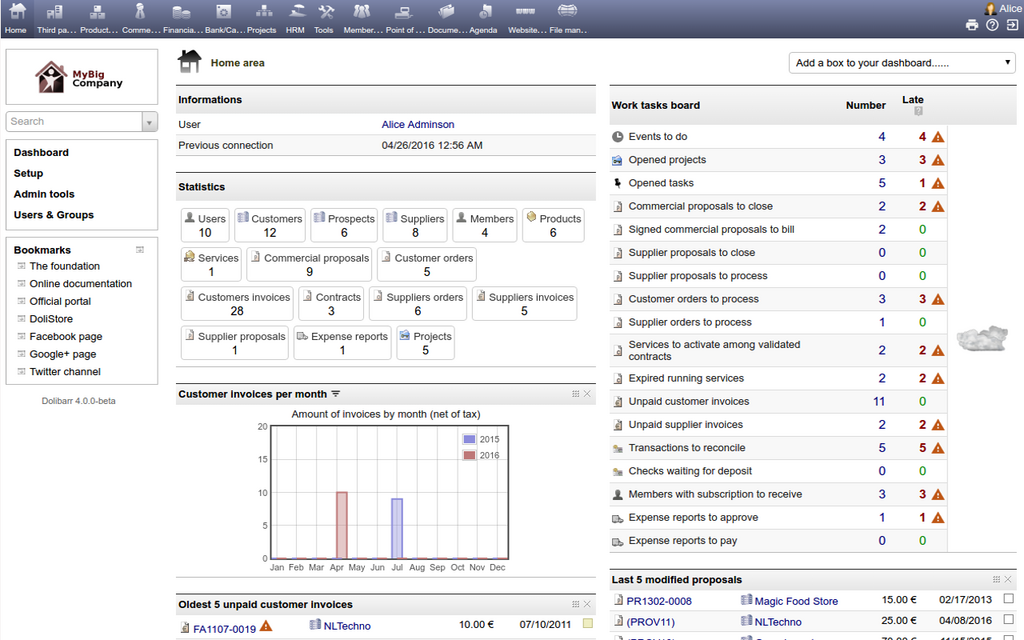
An ERP system provides live dashboards with up-to-date insights on sales, revenue, inventory, and expenses.
Second, it boosts efficiency. Many routine tasks, like creating invoices or updating inventory counts, can be automated. This frees up employees from tedious manual work and reduces the chance of human error. The system connects workflows seamlessly, from the moment a customer places an order to the final delivery.
Finally, an ERP system is built to scale. As a company grows, adds new products, or opens new locations, the ERP can grow with it. A well-designed system supports the business's needs today and provides a foundation for future expansion.
Ready to test your knowledge? Let's see what you've learned about ERP fundamentals.
What is the primary function of an Enterprise Resource Planning (ERP) system?
The term 'single source of truth' in the context of an ERP means that all departments are working from different, specialized databases.
In short, an ERP system helps a business manage its resources—its money, people, and materials—in a more organized and intelligent way.