Mastering English Grammar
Parts of Speech
The Building Blocks of Language
Every word in the English language belongs to a category, depending on the job it does in a sentence. These categories are called the parts of speech. Think of them as the different types of bricks you use to build a house. Each one has a specific purpose.
To start expanding your grammar knowledge, it’s helpful to begin with an understanding of the eight traditional parts of speech that make up our sentences: nouns, pronouns, verbs, adjectives, adverbs, prepositions, interjections, and conjunctions.
Understanding these eight categories is the first step toward writing and speaking with clarity and confidence. Let's break them down.
Naming Things
Noun
noun
A word used to identify any of a class of people, places, or things.
A noun is simply a naming word. It can be a person (Maria, doctor), a place (Paris, kitchen), a thing (book, sun), or even an idea (love, freedom).
Nouns are everywhere. Look around you. The chair you're sitting on, the screen you're looking at, and the air you're breathing are all nouns.
Pronoun
pronoun
A word that can function by itself as a noun phrase and that refers either to the participants in the discourse or to someone or something mentioned elsewhere.
Pronouns are shortcuts. Instead of repeating a noun over and over, you can substitute a pronoun. Imagine how clunky sentences would be without them:
Maria went to the store because Maria needed milk.
Using a pronoun makes it flow better:
Maria went to the store because she needed milk.
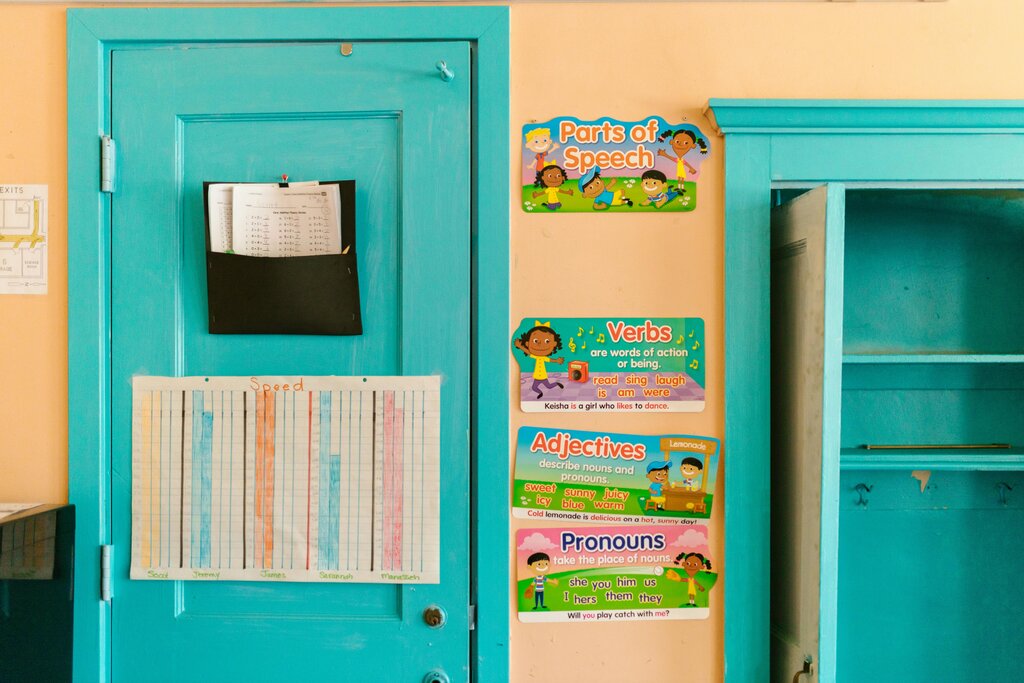
Common pronouns include I, you, he, she, it, we, they, me, him, her, us, and them.
Actions and Descriptions
Verb
verb
A word used to describe an action, state, or occurrence.
Verbs provide the action in a sentence. They tell you what the noun is doing. Words like run, think, create, and sing are all action verbs.
Verbs can also express a state of being. These are words that link the subject to a description. The most common ones are forms of "to be," such as am, is, are, was, and were. In the sentence "The sky is blue," the verb is links the sky to its color.
Adjective
adjective
A word naming an attribute of a noun.
Adjectives add detail to nouns and pronouns. They answer questions like "which one?" or "what kind?" If a verb adds action, an adjective adds color and texture.
Notice the difference: The dog ran. The big, fluffy dog ran.
Adjectives like big and fluffy give you a much clearer picture.
Adverb
adverb
A word or phrase that modifies an adjective, verb, or other adverb, expressing a relation of place, time, circumstance, manner, cause, degree, etc.
If adjectives modify nouns, adverbs modify verbs, adjectives, or even other adverbs. They answer questions like "how?", "when?", "where?", or "to what extent?" Many adverbs end in "-ly," but not all of them do.
Here are some examples: *She ran quickly. (modifies the verb ran) *He is very tall. (modifies the adjective tall) *It happened too suddenly. (modifies the adverb suddenly)
Connectors and Emotions
Preposition
preposition
A word governing, and usually preceding, a noun or pronoun and expressing a relation to another word or element in the clause.
Prepositions show relationships between words, often related to time, space, or direction. They connect a noun or pronoun to another part of the sentence.
Think of a box. You can be on the box, in the box, under the box, beside the box, or go around the box. All those bolded words are prepositions. Common prepositions include of, to, for, with, on, and at.
Conjunction
conjunction
A word used to connect clauses or sentences or to coordinate words in the same clause.
Conjunctions are joining words. They link words, phrases, and sentences together.
You can remember the most common ones with the acronym FANBOYS: For, And, Nor, But, Or, Yet, So.
I wanted to go, but it was raining. She is smart and kind.
Interjection
interjection
An abrupt remark, made especially as an aside or interruption. An exclamation.
Interjections are short words or phrases that express strong emotion. They aren't grammatically connected to the rest of the sentence. They often stand alone, followed by an exclamation point.
Examples include words like Wow!, Ouch!, Hey!, and Oh no!
Now that you've seen all eight parts of speech, let's test your knowledge.
In the sentence "The very happy dog ran quickly across the green grass," which word is the adverb?
A word that expresses a strong, sudden emotion, like "Ouch!" or "Wow!", is called a what?
Knowing these eight parts of speech is the foundation of grammar. Once you can identify them, you're ready to start building stronger, more effective sentences.