Mastering Electrostatic Fields and Charge Distributions
Electric Charge Fundamentals
The Nature of Charge
At the heart of electricity and magnetism is a fundamental property of matter: electric charge. It's not something we can see, but we observe its effects everywhere. Just as objects have mass, the elementary particles that make up atoms—protons and electrons—possess electric charge. Protons are designated as having a positive charge, while electrons have a negative charge of the exact same magnitude.
The fundamental rule is simple: like charges repel, and opposite charges attract.
An object's overall, or net, charge is determined by the balance of its protons and electrons. Most objects are electrically neutral because they contain an equal number of both. However, if an object gains extra electrons, it develops a net negative charge. If it loses electrons, the remaining protons outnumber the electrons, and it takes on a net positive charge.
Two Unbreakable Rules
Electric charge follows two fundamental laws of nature. The first is the law of conservation of charge.
The conservation of charge is a fundamental law of physics stating that the total electric charge in an isolated system does not change over time.
This means charge isn't created or destroyed, only transferred. When you rub a balloon on your hair, you're not making new charge. You are simply moving electrons from your hair to the balloon. Your hair becomes positively charged, and the balloon becomes negatively charged, but the total charge of the hair-balloon system remains zero.
The second rule is that charge is quantized. It exists in discrete packets, not as a continuous fluid. The smallest unit of free charge ever observed is the elementary charge, denoted by .
An electron has a charge of , and a proton has a charge of . Any net charge on a macroscopic object is just the sum of the elementary charges of its excess or deficit electrons. You can have an object with a charge of or , but you can never have one with a charge of .
Conductors and Insulators
Why do some materials, like metals, allow charge to move easily, while others, like rubber or glass, do not? The difference lies in their atomic structure. In materials known as conductors, the outermost electrons of the atoms are not tightly bound. They are free to move throughout the material, forming a sort of "sea" of mobile electrons. This mobility is what allows electric current to flow.
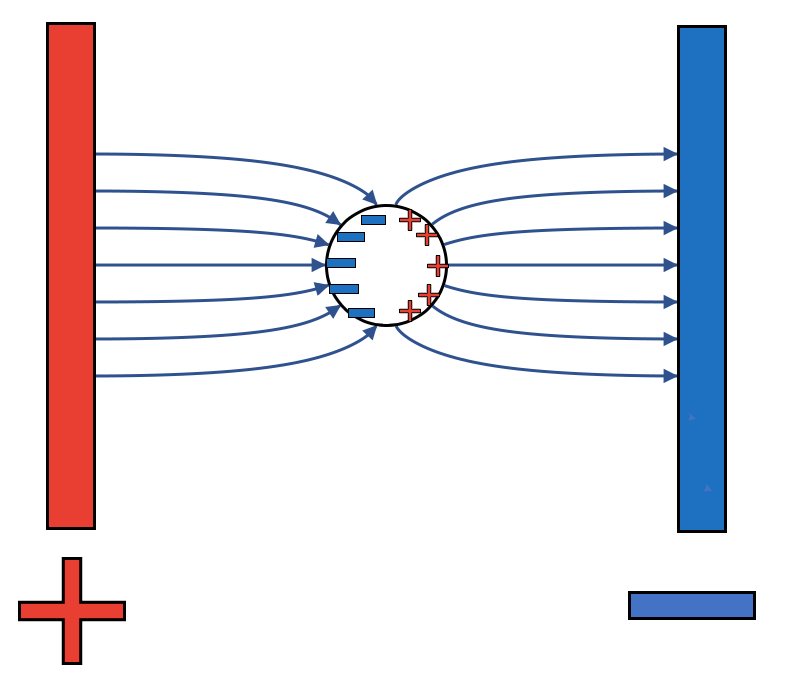
In insulators, the electrons are held tightly to their respective atoms. They can't wander freely. When an insulator is charged, the excess charge tends to stay in one place. That's why you can charge a spot on a balloon, and the charge doesn't spread across the entire surface.
This distinction is crucial for understanding how charges are transferred and manipulated.
Charging Objects
There are two main ways to give an object a net charge: conduction and induction. Charging by conduction is straightforward—it's charging by direct contact. If you touch a negatively charged rod to a neutral metal sphere, some of the excess electrons from the rod will flow onto the sphere, giving it a net negative charge.
Charging by induction is more subtle because it involves no direct contact. Imagine bringing a negatively charged rod near a neutral metal sphere. The free electrons in the sphere are repelled by the rod and move to the far side of the sphere. This leaves the side of the sphere closer to the rod with a net positive charge. This separation of charge is called polarization.
The sphere is still neutral overall, its charge has just been redistributed. But if you then provide a path for the repelled electrons to escape—for example, by connecting a wire from the far side of the sphere to the ground—the electrons will flow away. If you then remove the wire and then the rod, the sphere is left with a net positive charge.
This is a key concept: you induced a positive charge on the sphere using a negatively charged rod, all without any physical contact between them.
It's important to remember the difference between an object's net charge and its total internal charge. A neutral copper sphere has a net charge of zero, but it contains a tremendous amount of charge—trillions upon trillions of protons and electrons. The net charge is just the tiny imbalance in these vast quantities.
Ready to check your understanding?
What fundamental property do electrons and protons possess that gives rise to electrical phenomena?
If you rub a balloon on your hair, the balloon gains a net negative charge. According to the law of conservation of charge, what is the net charge of your hair after this process?
Understanding these fundamental properties of charge sets the stage for exploring the forces they exert and the fields they create.