Mastering Electron Configuration and Atomic Stability
Quantum Mechanical Orbitals
Beyond Orbits
The old picture of an atom, with electrons circling the nucleus like tiny planets, is a helpful starting point, but it's not the whole story. Electrons don't follow neat, predictable paths. Instead, they exist in a state of , behaving as both particles and waves simultaneously. This means we can't pinpoint an electron's exact location at any given moment.
So, if we can't know exactly where an electron is, what can we know? We can determine the region of space where it's most likely to be found. Think of it like a cloud of probability. This three-dimensional region is called an orbital.
An orbital is a 3D space around the nucleus where there is a high probability (typically 90%) of finding an electron.
These probability maps are derived from a complex mathematical formula known as the Schrödinger equation, which describes the wave-like behavior of electrons in an atom. Solving this equation gives us a set of solutions, each corresponding to a specific orbital with a unique shape, size, and energy.
An Atom's Address System
To organize these orbitals, scientists use a system of . They work like an address, telling us an electron's energy level and the shape of its orbital.
The first number, the principal quantum number (), describes the main energy level, or shell. It can be any positive integer: and so on. A higher value of means the electron is, on average, farther from the nucleus and has more energy.
Each energy level () is divided into one or more sublevels, or subshells. The azimuthal quantum number () defines the shape of the orbitals within that sublevel. The value of can range from 0 up to . Each value of corresponds to a specific type of orbital, denoted by a letter.
l Value | Orbital Type | Shape |
|---|---|---|
| 0 | s | Spherical |
| 1 | p | Dumbbell |
| 2 | d | Cloverleaf |
| 3 | f | Complex |
So, the first energy level () only has an s-orbital (). The second energy level () has s- and p-orbitals (). The third () has s-, p-, and d-orbitals (), and so on.
Orbital Shapes and Capacities
The shapes of these orbitals are not arbitrary. They are direct visual representations of the probability clouds predicted by the Schrödinger equation.
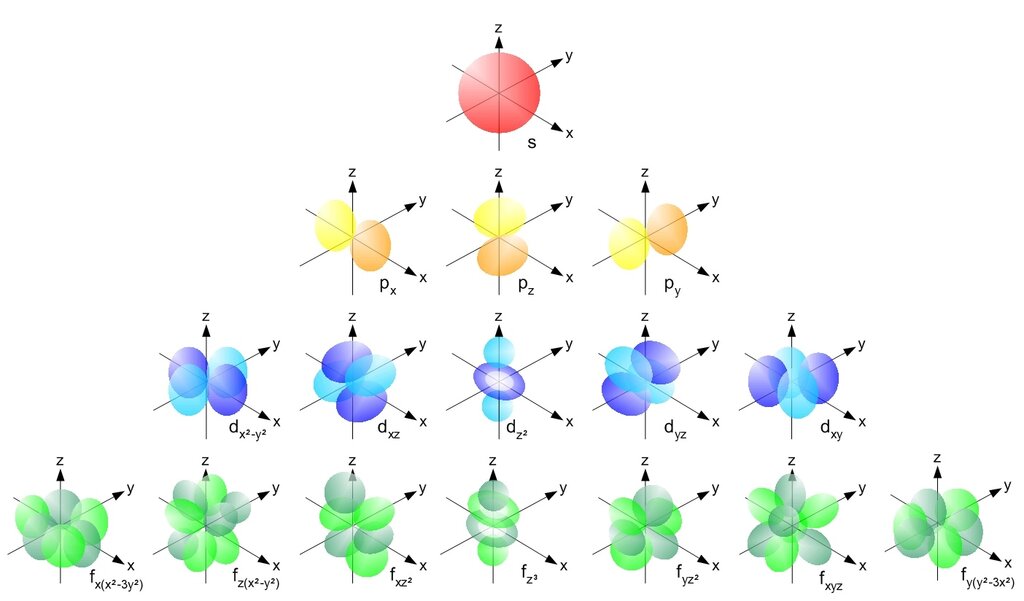
s-orbitals () are spherical. For any given energy level, there is only one s-orbital. Since every orbital can hold a maximum of two electrons, any s-subshell can hold 2 electrons.
p-orbitals () are dumbbell-shaped. They come in sets of three, oriented along the x, y, and z axes. With three orbitals, a p-subshell can hold a total of electrons.
d-orbitals () have more complex shapes, often described as cloverleafs. They come in a set of five, allowing a d-subshell to hold electrons.
f-orbitals () are even more intricate. They appear in sets of seven, so an f-subshell holds up to electrons.
The number of orbitals in a subshell is given by the formula $2l + 1$. The total electron capacity is double that: $2(2l + 1)$.
This organizational structure is the foundation of the periodic table. As we add more protons and electrons to build different elements, we are essentially filling these orbitals according to a specific set of rules, creating the chemical properties that define our world.
Ready to check your understanding?
What does an atomic orbital represent?
Which quantum number defines the main energy level (or shell) of an electron?
Understanding this 'seating chart' for electrons is key to predicting how atoms will interact and form bonds.