Mastering Electrolysis and Electrochemical Applications
Electrolytic Cell Setup
Forcing a Reaction
In chemistry, some reactions happen all on their own, like iron rusting. These are called spontaneous reactions. Others need a push to get going; they are non-spontaneous. Think of it like a boulder at the bottom of a hill. It won't roll up by itself. You need to supply energy to move it.
An electrolytic cell is a device that provides that push using electricity. It takes electrical energy from a direct current (DC) power source, like a battery, and uses it to drive a chemical reaction that wouldn't normally occur. This process is called electrolysis and is fundamental to many industrial processes, such as refining metals and producing chlorine gas.
Electrolysis is the passage of a direct electric current through an ionic substance that is either molten or dissolved in a suitable solvent, resulting in chemical reactions at the electrodes and separation of materials.
The DC power source acts like a pump for electrons. It pulls electrons away from one electrode and forces them onto another, creating a powerful electrical potential that kick-starts the desired chemical change.
The Cell's Anatomy
An electrolytic cell has a few essential components working together. First, you have two electrodes submerged in a substance called an electrolyte. The electrolyte is typically a molten ionic compound or an aqueous solution containing ions. These mobile ions are crucial because they carry the charge within the solution, completing the electrical circuit.
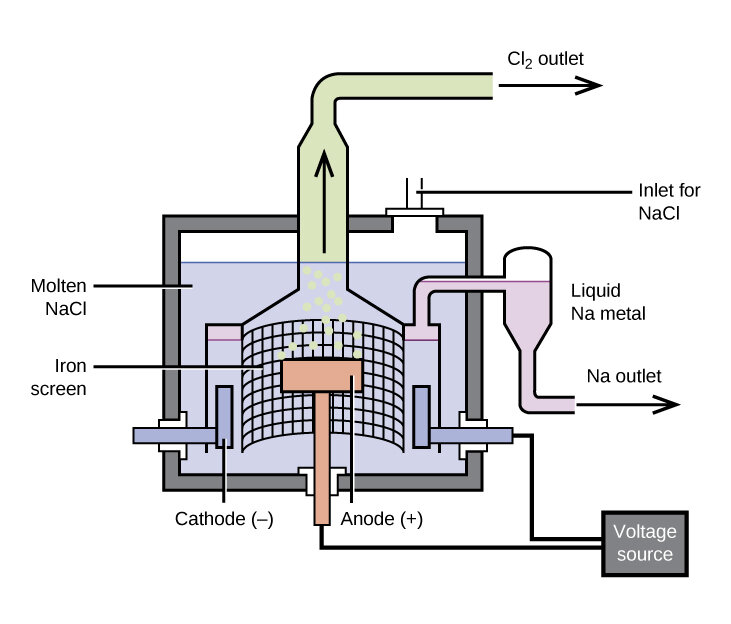
The electrodes are where the action happens. The electrode connected to the positive terminal of the DC power source is the anode. Since the power source pulls electrons away from it, oxidation (loss of electrons) occurs here. The electrode connected to the negative terminal is the cathode. The power source pumps electrons to it, so reduction (gain of electrons) occurs at the cathode.
This is a critical point: in an electrolytic cell, the anode is positive (+) and the cathode is negative (–). This is the reverse of what you see in a galvanic cell, which generates electricity instead of consuming it.
| Cell Type | Anode Polarity | Cathode Polarity | Energy Flow |
|---|---|---|---|
| Electrolytic | Positive (+) | Negative (–) | Consumes Energy |
| Galvanic | Negative (–) | Positive (+) | Produces Energy |
Within the cell, the flow of charge is maintained by the ions. Negatively charged anions migrate towards the positive anode, where they lose electrons. Positively charged cations migrate towards the negative cathode, where they gain electrons. This movement of ions through the electrolyte, coupled with the movement of electrons through the external wire, completes the circuit.
Active vs. Passive Electrodes
The material of the electrodes can significantly affect the outcome of electrolysis. Electrodes are broadly classified into two types: inert and reactive.
, such as platinum or graphite, do not participate in the chemical reaction. They simply provide a surface on which oxidation and reduction can occur and act as the electrical connection to the electrolyte. They are chosen when you want the components of the electrolyte to be the only substances reacting.
Reactive electrodes, on the other hand, are made of metals like copper, zinc, or silver that can be oxidized themselves. In these cases, the anode can actually dissolve into the electrolyte as its atoms lose electrons and become positive ions. This principle is the basis for , where a layer of one metal is deposited onto another.
Understanding these components, the flow of charge, and the role of the electrode materials is the key to predicting and controlling the products of any electrolytic process.
What is the primary function of an electrolytic cell?
In an electrolytic cell, the anode is positive (+) and the cathode is negative (–).