Mastering Electricity Units
Electric Charge
The Heart of Electricity
At the core of all electrical phenomena is a fundamental property of matter called electric charge. It's an intrinsic quality, much like mass. The tiny particles that make up atoms, specifically protons and electrons, carry this charge. Protons have a positive charge, while electrons have a negative charge. Most objects are electrically neutral because they contain an equal number of protons and electrons, balancing each other out.
electric charge
noun
A fundamental property of matter that causes it to experience a force when placed in an electromagnetic field.
When this balance is disturbed, an object can have a net positive or negative charge. This is where things get interesting. Charged objects interact with each other through forces. The rule is simple and absolute: like charges repel each other, while opposite charges attract.
Two positive charges will push each other away. So will two negative charges. But a positive charge and a negative charge will pull toward each other.

This attraction and repulsion is the basis for how electricity works. But the effect of charge depends heavily on the material it's in. Not all materials treat charge the same way.
Flow and Resistance
Imagine trying to walk through a crowded room. If people can move out of your way, you can pass through easily. If everyone is glued to the floor, you're not going anywhere. Electrons moving through materials face a similar situation.
In some materials, called conductors, electrons are not tightly bound to their atoms. They are free to move around. Metals like copper, aluminum, and silver are excellent conductors. This freedom of movement is what allows electric current to flow.
Other materials, known as insulators, hold onto their electrons very tightly. The charges are essentially locked in place and cannot move freely. Rubber, glass, and plastic are good insulators. This is why electrical wires are coated in plastic—to keep the moving charges contained and prevent them from going where they shouldn't.
Measuring the Force
We know that charges exert forces on each other, but how strong are these forces? In the 18th century, physicist Charles-Augustin de Coulomb figured it out. His finding, now known as Coulomb's Law, quantifies the electrostatic force between two stationary charges.
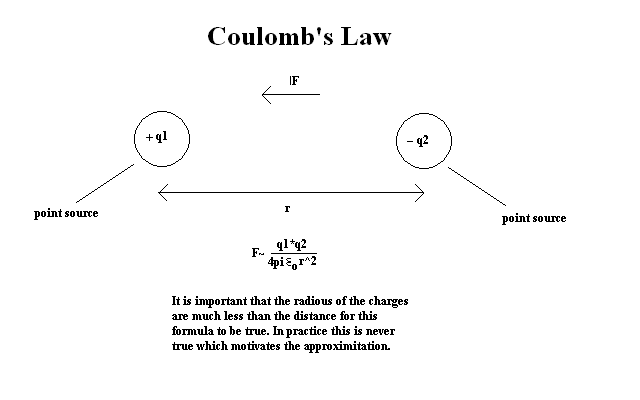
The law states that the force is directly proportional to the product of the two charges and inversely proportional to the square of the distance between them. In mathematical terms, it looks like this:
Here, is the electric force, and are the amounts of charge, and is the distance separating them. The letter is a constant of proportionality. The most important part of this relationship is the in the denominator. This is an inverse-square law. It means that if you double the distance between two charges, the force between them drops to one-quarter of its original strength. If you triple the distance, the force weakens to one-ninth.
The further apart two charges are, the weaker their influence on each other becomes, and it weakens very quickly.
This fundamental law governs everything from the static shock you get from a doorknob to the forces holding atoms together.
Time to check your understanding.
If two positively charged particles are brought near each other, what will happen?
Materials that allow electric charge to move freely are called _______.
Understanding charge is the first step. With this foundation, we can explore how these forces create fields, drive currents, and power our world.