Mastering Electrical Systems and Circuit Analysis
Advanced Circuit Theorems
Beyond Ohm's Law
Simple series and parallel circuits can only take us so far. Real-world electrical systems are complex networks of loops and branches that can't be boiled down with basic formulas. To analyse these, we need more powerful tools. This is where Kirchhoff's Laws come in.
Developed by in the mid-1800s, these two laws provide a systematic way to understand how current and voltage behave in any circuit, no matter how complicated. They are extensions of the fundamental laws of conservation of charge and energy.
The Law of Junctions
Kirchhoff's Current Law (KCL) deals with how current splits and combines at nodes, which are points where multiple components connect. The law is simple but profound: the total current entering a node must equal the total current leaving it. No charge is lost or created at a junction.
Think of it like water flowing through pipes. The amount of water flowing into a junction of pipes must be the same as the amount flowing out. The pipes don't store water, and neither do circuit nodes store charge.
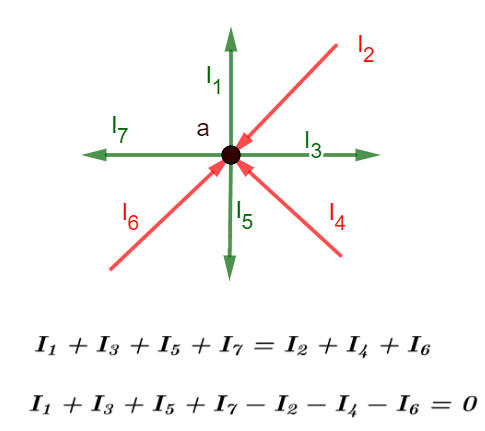
Mathematically, we can state this by saying the algebraic sum of all currents at a node is zero. We use a sign convention, typically defining currents entering the node as positive and currents leaving as negative.
The Law of Loops
Kirchhoff's Voltage Law (KVL) applies to any closed loop within a circuit. It states that the sum of all voltage drops across components in a loop must equal the sum of all voltage sources in that same loop. In other words, if you trace a path back to your starting point, the net change in electrical potential is zero.
Imagine walking up and down a series of hills and returning to your starting altitude. The total elevation you gained must exactly cancel out the total elevation you lost. KVL is the electrical equivalent of this journey.
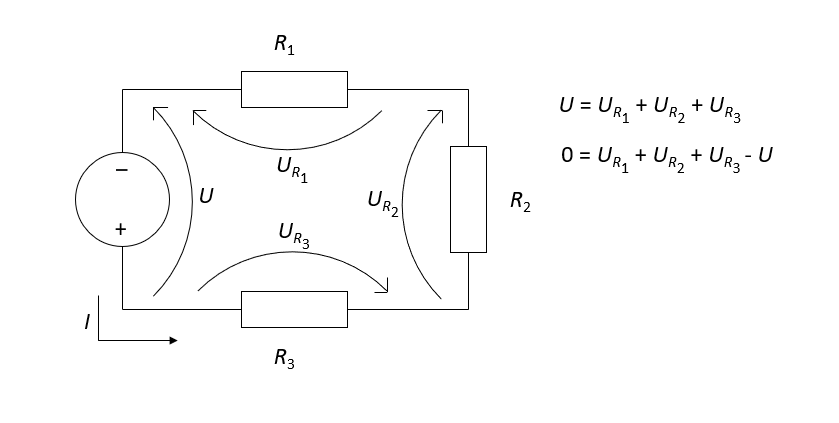
When applying KVL, we trace a path around a loop, adding voltage rises (from sources) and subtracting voltage drops (across resistors or other loads). The total must equal zero. This principle is a direct consequence of the conservation of energy.
Together, KCL and KVL allow us to write a system of equations for any circuit. By solving these equations, we can find the unknown currents and voltages. Two structured methods for this are Nodal Analysis, which uses KCL, and Mesh Analysis, which uses KVL.
Simplifying with Equivalents
While Kirchhoff's Laws can solve any circuit, the process can become tedious for very complex networks. This is where equivalent circuit theorems are invaluable. They allow us to simplify a large, complicated part of a circuit into a very simple one.
states that any linear electrical network with two terminals can be replaced by an equivalent circuit consisting of a single voltage source () in series with a single resistor (). This is incredibly useful for analysing how a circuit will behave with different loads, as you don't need to re-analyse the entire complex network each time.
Similarly, Norton's theorem allows us to replace that same complex network with an equivalent current source () in parallel with a single resistor ().
Conveniently, the Thévenin resistance and Norton resistance are identical (). The two equivalent circuits are related by Ohm's Law: . This means you can easily convert between them. The choice of which to use often depends on whether the rest of your circuit is primarily series (favouring Thévenin) or parallel (favouring Norton).
Thévenin’s and Norton’s theorems provide powerful tools for simplifying complex circuits.
A crucial application of these theorems is the It states that, for a DC voltage source with an internal resistance, the maximum power will be delivered to a load when the load's resistance is equal to the source's internal resistance. Using Thévenin's theorem, we can model any complex source circuit with its and , making it simple to find the load resistance that will draw the most power.
Kirchhoff's Current Law (KCL) is a direct consequence of which fundamental principle?
According to Kirchhoff's Voltage Law (KVL), the algebraic sum of all voltages around any closed loop in a circuit is equal to what?
These advanced theorems are the backbone of professional circuit analysis, enabling engineers to model, simplify, and predict the behaviour of real-world systems with confidence.