Mastering Electrical Engineering Systems
Advanced Circuit Analysis
Systematic Circuit Analysis
Ohm's Law and basic series-parallel rules get you far, but they fall short with complex networks. When a circuit has multiple sources or interconnected loops, guessing which resistors are in series or parallel becomes impossible. We need systematic methods to find any voltage or current, anywhere in the circuit.
The two workhorses of advanced circuit analysis are Nodal Analysis, based on Kirchhoff's Current Law (KCL), and Mesh Analysis, which uses Kirchhoff's Voltage Law (KVL). These techniques turn a circuit diagram into a set of linear equations that we can solve systematically.
Nodal Analysis
Nodal analysis is all about finding the voltage at each connection point, or node, relative to a single reference node (often called ground, or 0V). Once you know all the node voltages, you can find any other value in the circuit, like the current through a specific resistor, using Ohm's Law.
The process involves applying KCL at every non-reference node. KCL, as you know, states that the sum of currents entering a node must equal zero. We express each of these currents in terms of the unknown node voltages and known resistances.
For the circuit above, we can write three KCL equations, one for each labeled node (, , and ). We assume currents leaving the node are positive.
But what if there's a voltage source between two nodes? This is where the supernode technique comes in. You can't write a KCL expression for the current through a voltage source directly. So, we mentally draw a boundary around the voltage source and its two connected nodes. We treat this entire boundary as one big "supernode" and apply KCL to it, summing all currents entering and leaving the boundary.
This gives us one equation. For the second equation we need, we simply use the voltage source itself: it creates a direct relationship between the two node voltages. For example, if a 5V source is between and (with the positive terminal at ), our constraint equation is simply V.
Mesh Analysis
Mesh analysis is the dual of nodal analysis. Instead of finding node voltages with KCL, we find fictitious "mesh currents" using KVL. A mesh is a loop in the circuit that doesn't contain any other loops. We assign a current to each mesh, assuming it flows in a circle (usually clockwise), and then write a KVL equation for each mesh.
KVL states that the sum of voltage drops around any closed loop is zero. We express these voltage drops using Ohm's law in terms of our unknown mesh currents ( etc.).
For this circuit, we write two KVL equations. Note that the voltage across the shared resistor, , depends on both mesh currents. From the perspective of mesh 1, the net current through is .
The mesh equivalent of a supernode is the supermesh. If a current source lies on the boundary between two meshes, we can't write a KVL equation for the voltage drop across it. Instead, we create a larger loop, or supermesh, that follows the path of the two meshes but avoids the current source. We write one KVL equation for this entire supermesh path.
Just like with the supernode, we get our second required equation from the current source itself. It defines a direct relationship between the two mesh currents. If a 2A current source is on the branch between mesh 1 and 2, and it flows in the same direction as , our constraint equation would be A.
Modeling Sources and Simplifying
Real-world components often don't behave like the ideal sources we've used so far. Many circuits contain , where the voltage or current of the source is controlled by a voltage or current somewhere else in the circuit. There are four types: voltage-controlled voltage source (VCVS), current-controlled voltage source (CCVS), voltage-controlled current source (VCCS), and current-controlled current source (CCCS).
When you see a dependent source, don't panic. You analyze the circuit the exact same way using nodal or mesh analysis. The only difference is that you'll have an extra variable (the controlling current or voltage) in your equations. You just need one more equation to solve the system, which is the control equation given by the dependent source itself. For instance, if a voltage source has a value of , and is the voltage across a particular resistor, you simply express in terms of the node voltages or mesh currents and substitute it into your system of equations.
Sometimes, you don't need to analyze an entire, massive circuit. You might only care about what's happening at one specific point, like the voltage across a load resistor. For this, and Norton's theorem are incredibly useful tools for simplification.
Thévenin's theorem states that any linear two-terminal network can be replaced by a single voltage source () in series with a single resistor (). Norton's theorem is the dual: the same network can be replaced by a single current source () in parallel with a single resistor (). This allows you to reduce a large, complicated part of a circuit into a simple, equivalent model.
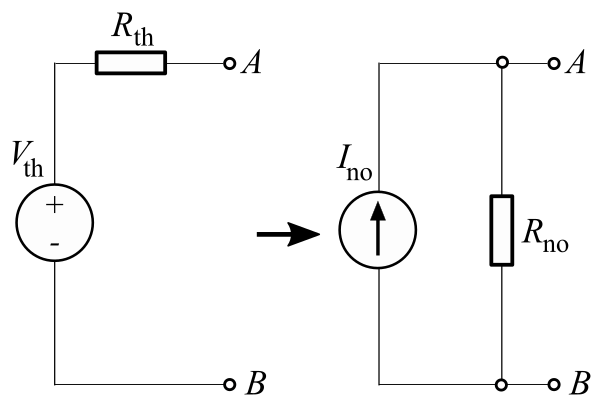
Here's how to find the equivalent values:
- Thévenin Voltage (): This is the open-circuit voltage across the two terminals of interest (terminals A and B). Simply remove the load and calculate the voltage that appears there.
- Norton Current (): This is the short-circuit current. Replace the load with a wire and calculate the current that flows through it.
- Equivalent Resistance ( or ): This is the resistance looking back into the terminals A and B with all independent sources turned off. To turn off a voltage source, replace it with a wire (a short circuit). To turn off a current source, remove it (an open circuit). and are always equal.
These equivalent circuits are related by source transformation: .
Using these systematic methods, you can confidently analyze any linear circuit, no matter how complex it first appears.
Ready to test your understanding of these analysis techniques?
Nodal analysis is a systematic circuit analysis technique based on which fundamental law?
When performing nodal analysis, what special technique must be used when a voltage source is present between two non-reference nodes?
Mastering these methods is a crucial step. They provide the foundation for understanding everything from transistor amplifiers to large-scale power grids.