Mastering Electrical Color Coding
Resistor Band Systems
Decoding the Stripes
Resistors are often too small to print their resistance value directly on their body. Instead, they use a standardized system of colored bands to indicate their resistance, tolerance, and sometimes other important characteristics. Think of it as a compact language for electronic components.
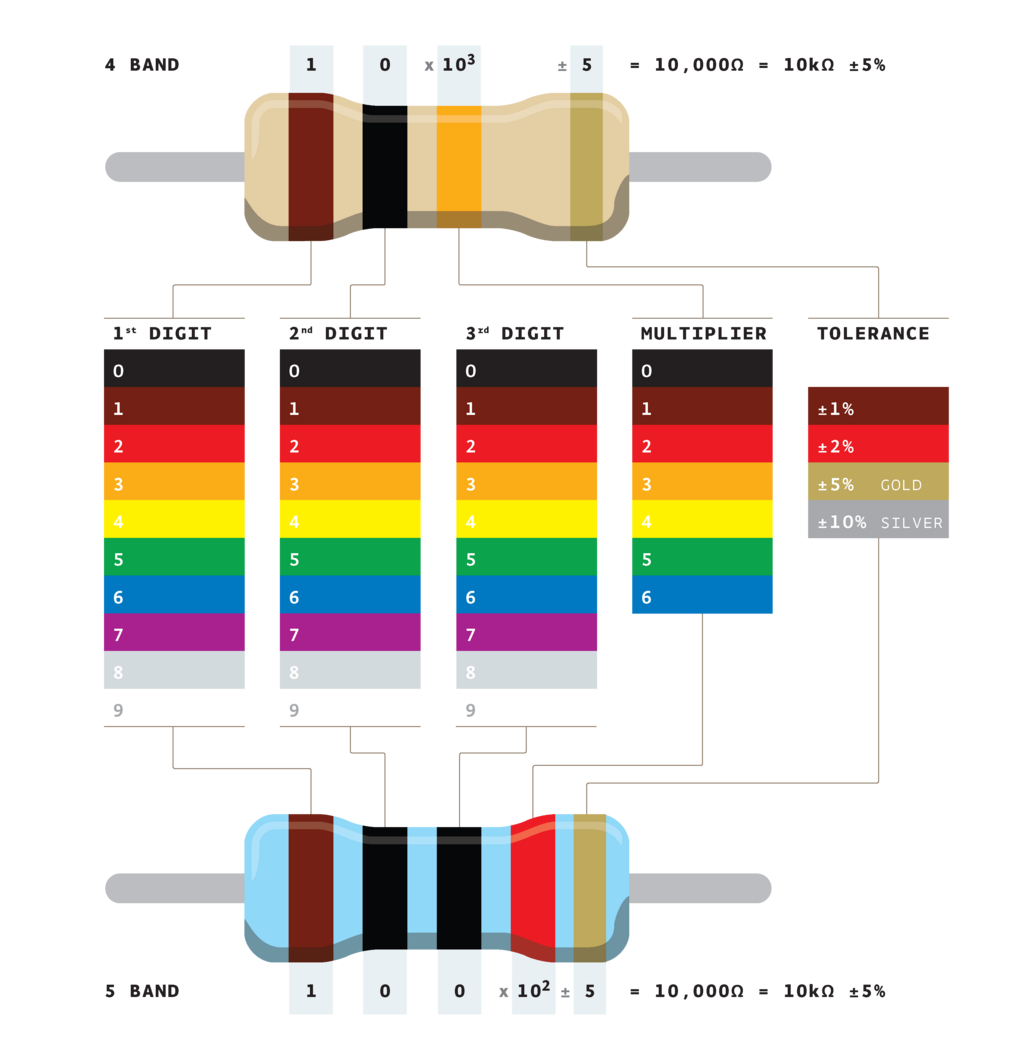
To read these bands, you first need to know the color sequence, which corresponds to the numbers 0 through 9. A common mnemonic to remember the order is: Big Boys Race Our Young Girls But Violet Generally Wins.
Here’s how the colors map to values.
| Color | Significant Digit | Multiplier | Tolerance | Temp. Coefficient (ppm/K) |
|---|---|---|---|---|
| Black | 0 | 1 | - | 250 |
| Brown | 1 | 10 | ±1% | 100 |
| Red | 2 | 100 | ±2% | 50 |
| Orange | 3 | 1k | - | 15 |
| Yellow | 4 | 10k | - | 25 |
| Green | 5 | 100k | ±0.5% | 20 |
| Blue | 6 | 1M | ±0.25% | 10 |
| Violet | 7 | 10M | ±0.1% | 5 |
| Gray | 8 | 100M | ±0.05% | 1 |
| White | 9 | 1G | - | - |
| Gold | - | 0.1 | ±5% | - |
| Silver | - | 0.01 | ±10% | - |
Common Configurations
Most resistors you'll encounter will have four or five bands. The key is knowing which band does what. First, you need to orient the resistor correctly. Usually, there's a larger gap before the tolerance band. If there's a gold or silver band, it's almost always the tolerance band and goes on the right.
In a 4-band resistor, the first two bands represent the significant digits of the resistance value. The third band is the multiplier, which tells you what power of 10 to multiply the digits by. The final, fourth band indicates the tolerance, which is the acceptable range of deviation from the stated value.
For higher precision applications, you'll see 5-band resistors. These work similarly, but add a third significant digit. So, the first three bands are digits, the fourth is the multiplier, and the fifth is tolerance. This allows for more specific resistance values. A brown tolerance band (±1%) is common on 5-band resistors.
The Precision Band
In circuits where temperature stability is critical, such as in scientific instruments or high-end audio equipment, a 6-band resistor is used. It's identical to the 5-band version but adds a sixth band on the far right. This final band indicates the (TCR).
The TCR tells you how much the resistor's value will change as the temperature fluctuates. It's measured in (ppm/K). A low TCR value means the resistance is very stable across a range of operating temperatures, which is crucial for maintaining the precision of the circuit.
A 6-band resistor provides the most complete picture: three significant digits, a multiplier, a tolerance rating, and a thermal stability profile.
A Practical Example
Let's read a real-world resistor. Imagine you have one with five bands: Yellow, Violet, Orange, Gold, Brown.
How do we determine its value? First, we need to find the reading direction. The Brown band indicates a tolerance of ±1%, which is common for 5-band resistors. The Gold band represents a multiplier of 0.1. So, we'll read it with the Brown band on the right.
| Band | Color | Value |
|---|---|---|
| 1 | Yellow | 4 |
| 2 | Violet | 7 |
| 3 | Orange | 3 |
| 4 | Gold | ×0.1 |
| 5 | Brown | ±1% |
Combining the first three digits gives us 473. We then apply the multiplier from the fourth band:
Ω
The resistor has a nominal value of 47.3 Ω. But the fifth band tells us this value has a tolerance of ±1%. To find the acceptable range, we calculate 1% of 47.3 Ω:
This means the actual resistance of this component can be anywhere between:
- Lower Bound: $47.3 - 0.473 = 46.827$ Ω
- Upper Bound: $47.3 + 0.473 = 47.773$ Ω
For most applications, this level of precision is more than enough. But knowing how to read the bands ensures you're using the right component for the job.
Let's check your understanding of these color codes.
Why are color bands used on resistors instead of printing the resistance value directly on them?
In a standard 4-band resistor, what does the third band represent?
Mastering the color code system is a fundamental skill for anyone working with electronics, turning a handful of striped components into a clear set of specifications.