Mastering Electrical Color Coding
Resistor Band Systems
Decoding Resistor Colors
Resistors are tiny, so printing their resistance value directly on them isn't always practical. To solve this, manufacturers use a standardized color-coding system. This system, defined by the international standard , allows us to quickly identify a resistor's value, tolerance, and sometimes even its temperature coefficient just by looking at a series of colored bands.
The first challenge is figuring out which way to read the bands. On most resistors, the bands are grouped closer to one end. You should start reading from that end. The tolerance band is usually at the other end, often set apart by a slightly larger gap. Gold and silver are almost always tolerance bands, which is another helpful clue.

The 4-Band System
The most common configuration is the 4-band resistor. The bands represent two significant digits, a multiplier, and the tolerance.
- Band 1: First significant digit.
- Band 2: Second significant digit.
- Band 3: Multiplier (the power of 10 to multiply the digits by).
- Band 4: Tolerance (the acceptable range of error for the resistance value).
| Color | Digit | Multiplier | Tolerance |
|---|---|---|---|
| Black | 0 | 1 | - |
| Brown | 1 | 10 | ±1% |
| Red | 2 | 100 | ±2% |
| Orange | 3 | 1k | - |
| Yellow | 4 | 10k | - |
| Green | 5 | 100k | ±0.5% |
| Blue | 6 | 1M | ±0.25% |
| Violet | 7 | 10M | ±0.1% |
| Gray | 8 | 100M | ±0.05% |
| White | 9 | 1G | - |
| Gold | - | 0.1 | ±5% |
| Silver | - | 0.01 | ±10% |
Let's use the resistor from the image above as an example. Its bands are Yellow, Violet, Orange, and Gold.
- Yellow is the first digit: 4.
- Violet is the second digit: 7.
- Orange is the multiplier: x 1,000 (or $10^3$).
- Gold is the tolerance: ±5%.
Combining the digits gives us 47. We then multiply by 1,000, resulting in 47,000 Ω, or 47 kΩ. The gold band tells us its actual resistance can be anywhere from 44,650 Ω to 49,350 Ω.
Precision and the 5-Band System
For applications requiring higher precision, such as in industrial sensors or medical equipment, a 4-band resistor isn't accurate enough. This is where 5-band resistors come in. They add a third significant digit, allowing for more specific resistance values. The tolerance bands on these are also typically smaller (2% or less).
- Band 1-3: Significant digits.
- Band 4: Multiplier.
- Band 5: Tolerance.
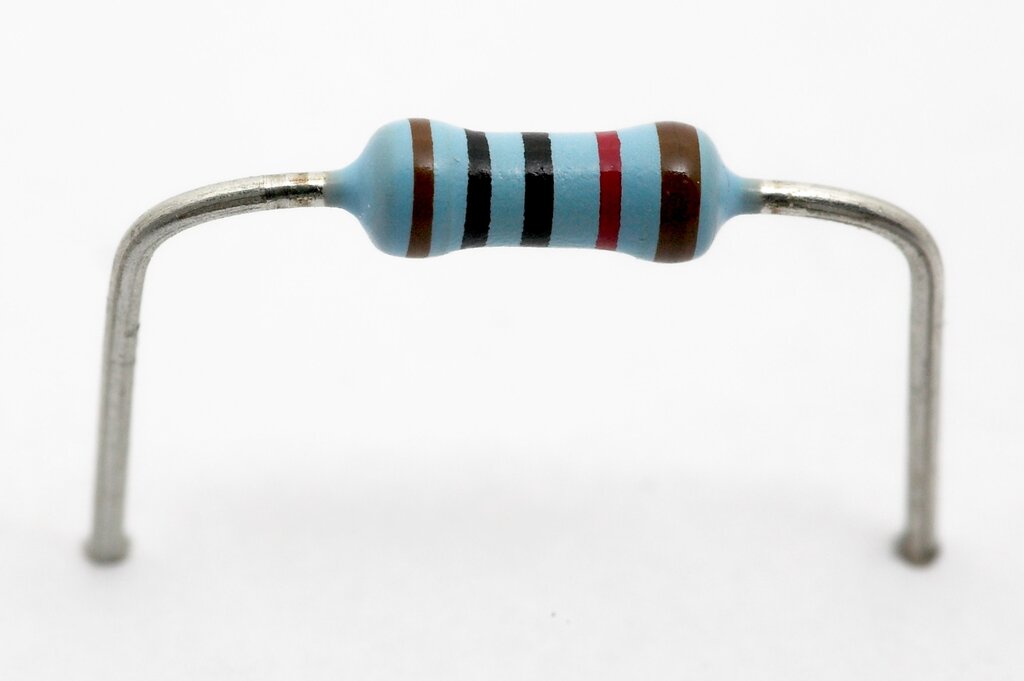
Let's decode the blue resistor shown. Its bands are Brown, Black, Black, Red, Brown.
- Brown: 1
- Black: 0
- Black: 0
- Red: x 100 (or $10^2$)
- Brown: ±1%
This gives us the digits 100. Multiplying by 100 gives 10,000 Ω, or 10 kΩ. The tolerance is a tight ±1%.
Standard Values and the E-Series
You might wonder why you can buy a 47 kΩ resistor but not a 48 kΩ one. This is because resistors are manufactured in standard values defined by the of preferred numbers. Each series corresponds to a particular tolerance.
The most common series are E12 and E24:
- E12 Series: Has 12 standard values per decade (10, 12, 15, 18, etc.). These are typically used for resistors with a 10% tolerance.
- E24 Series: Has 24 values per decade. These are used for 5% tolerance resistors.
Higher precision resistors use series with more values, like E48 (2% tolerance) and E96 (1% tolerance). The system ensures that for any given series, the tolerance range of one value touches or slightly overlaps the range of the next, providing complete coverage.
Essentially, the E-series tells you which resistor values you can actually find on the market. A 5-band resistor will almost always have a value from the E24 series or higher.
Ready to test your knowledge?
When reading the color bands on a resistor, where should you typically start?
A standard 4-band resistor has the color sequence: Brown, Green, Red, Gold. What is its resistance and tolerance?
Mastering these color codes is a fundamental skill. It turns a seemingly random collection of colored stripes into a clear specification of a component's function and precision.