Mastering Elastic Potential Energy
Hooke's Law Basics
Stretch, Squish, and Spring Back
Have you ever stretched a rubber band to flick it, or jumped on a trampoline? If so, you've seen elasticity in action. Elastic objects are special because they can change shape when you apply a force—like stretching, squishing, or bending—and then snap right back to their original form once you let go. Springs, bungee cords, and even the soles of your sneakers rely on this property.
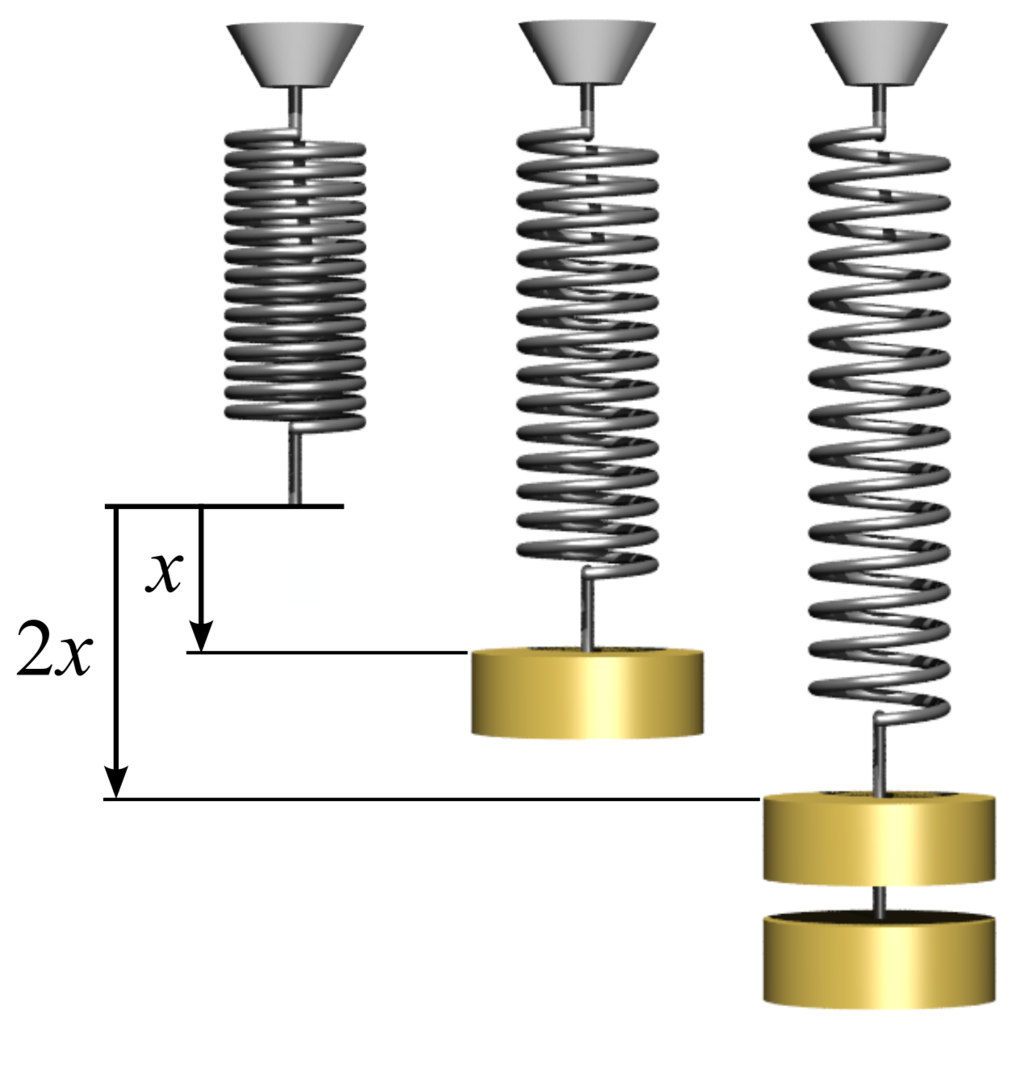
But how much force does it take to stretch a spring a certain amount? A scientist named Robert Hooke wondered the same thing back in the 1600s. He discovered a simple but powerful rule that connects the force you apply to how much an elastic object deforms. This rule is now known as Hooke's Law.
Breaking Down the Law
Let's look at each part of the formula. The force, , is simply the push or pull you exert on the object. The other two parts, and , need a closer look.
Displacement
noun
The change in an object's position or shape from its state of equilibrium, or its natural resting state. For a spring, it's how much it's stretched or compressed.
The displacement, , is not the total length of the spring. It's the change in length from its happy, relaxed state, which we call the s. If a spring is 10 cm long when it's just sitting there, and you stretch it to 15 cm, the displacement is 5 cm.
Next is the spring constant, . This is a measure of stiffness. A high value means the spring is very stiff and hard to stretch, like the suspension springs in a car. A low value means the spring is flimsy and easy to stretch, like a Slinky.
Think of as the spring's personality. A stubborn, stiff spring has a big . A flexible, easy-going spring has a small .
The Spring's Reaction
When you pull on a spring, the spring pulls back on you. This pull-back is called the restoring force. It's the force that tries to return the spring to its equilibrium position. According to Newton's Third Law, this restoring force is equal in strength and opposite in direction to the force you apply.
Because of this, you'll sometimes see Hooke's Law written with a negative sign:
Don't Stretch Too Far
Hooke's Law is fantastic, but it has its limits. If you pull a spring too far, it won't return to its original shape. Think about stretching a Slinky until it's just a long, useless wire. When this happens, the material has been pulled past its s. Beyond this point, the deformation becomes permanent, and Hooke's Law no longer applies.
So, as long as you stay within the material's elastic range, the relationship between force and displacement is beautifully linear and predictable.
According to Hooke's Law, what is the relationship between the force applied to an elastic object and its displacement from its equilibrium position?
A spring has a natural length of 20 cm. You stretch it to a total length of 28 cm. What is the value of the displacement, 'x', used in Hooke's Law?
You've now learned the key components of Hooke's Law and how it describes the behavior of elastic objects. It's a fundamental principle in physics and engineering, explaining everything from tiny springs in a watch to the massive shock absorbers in a building.