Mastering Edge AI Architecture and Deployment
Architecting Edge Workflows
The Three-Tier Architecture
When designing an AI system that spans from local devices to a central data center, the most critical question isn't if you should process data at the edge, but what you should process at the edge. A well-architected system doesn't make an all-or-nothing choice between the device and the cloud. Instead, it strategically partitions the workload across a three-tier architecture: the edge, the fog, and the cloud.
Each tier has distinct advantages. The edge offers near-instantaneous response times. The cloud provides massive computational power and vast storage. The fog acts as an intermediary, balancing local needs with centralized resources. The art of edge architecture is deciding which computations belong on which tier. This decision hinges on a careful trade-off between four key factors: latency, bandwidth, privacy, and cost.
The first step in partitioning is a for every task in your workflow. An autonomous car's collision avoidance system cannot tolerate a round trip to the cloud; that decision must be made on the vehicle in milliseconds. Conversely, training a new driving model based on data from thousands of vehicles is a computationally intensive task that is not time-sensitive and belongs in the cloud. The goal is to map each function to the tier that best meets its response-time requirements.
Fog Computing's Crucial Role
Fog computing occupies the space between the edge devices and the central cloud. It consists of decentralized compute resources, like local servers or gateways, that are physically closer to the data sources. This middle layer is not just a smaller version of the cloud; it's a critical architectural component for bridging the gap between immediate, local needs and long-term, global analysis.
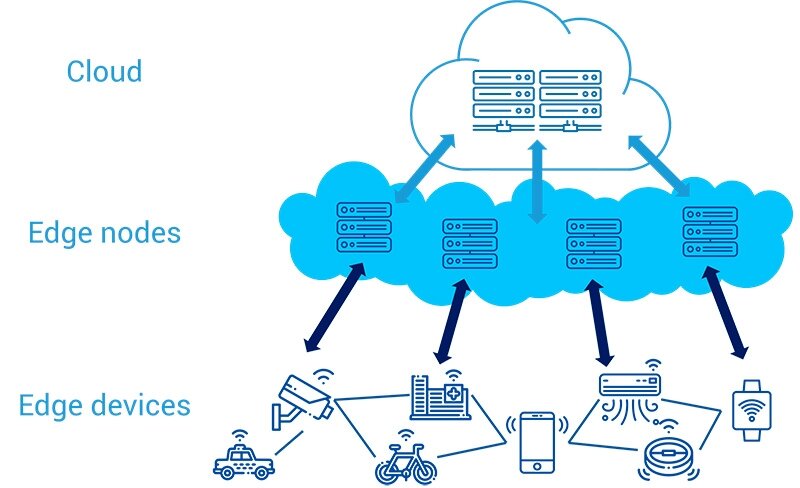
Think of a smart factory with thousands of sensors on its assembly lines. Sending a constant stream of raw sensor data to the cloud would be incredibly expensive and quickly overwhelm the factory's internet connection. This is a classic bandwidth constraint.
A fog node, perhaps a server located on the factory floor, can solve this. It ingests the raw data from all nearby sensors, performs initial processing to filter out noise, aggregates the data into meaningful summaries, and detects anomalies in real time. Only the processed insights or critical alerts are then sent to the cloud. The fog layer dramatically reduces bandwidth consumption and allows the cloud to focus on higher-level analysis.
By distributing computing tasks away from centralized servers and closer to the user or device, edge computing can significantly reduce latency, improve bandwidth utilization, enhance security, and reduce costs.
Coordinating Intelligent Agents
In many advanced systems, the edge isn't just a collection of dumb sensors. It's a network of intelligent agents that must coordinate their actions. Consider a fleet of autonomous delivery drones operating in a single neighborhood. Each drone is an agent responsible for its own navigation, but they must work together to avoid collisions and optimize delivery routes.
This requires a distributed multi-agent coordination strategy. A central cloud controller would be too slow to manage real-time collision avoidance. Instead, a fog node at a local distribution center could serve as a regional traffic controller. It would maintain a real-time map of all drones in the area, assign routes, and resolve conflicts. The drones could also communicate directly with each other (peer-to-peer) for immediate, hyperlocal adjustments, a practice known as .
Finally, architecture must address privacy and data sovereignty. In fields like healthcare, regulations may prohibit patient data from leaving the hospital premises. In this scenario, the architectural choice is made for you. All processing of personally identifiable information must happen on edge or fog nodes located within the facility. Anonymized, aggregated data can then be sent to the cloud for research, but the raw data stays local. This ensures compliance and protects sensitive information by keeping it close to the source.
In a three-tier AI architecture, what is the primary function of the 'fog' layer?
A factory deploys thousands of high-frequency sensors on its assembly line. To avoid overwhelming its internet connection, a server on the factory floor filters and summarizes the sensor data before sending only critical alerts and daily reports to a central data center. This on-premise server is an example of what?