Mastering Dynamic Football Dribbling
Dynamic Weight Distribution
The Body as the Engine
Great dribbling isn't just about fast feet. It's about using your entire body as a finely tuned machine. When you move with the ball at high speed, your body's position dictates everything. The secret to fluid, athletic dribbling lies in mastering your , the invisible point where your body's weight is perfectly balanced.
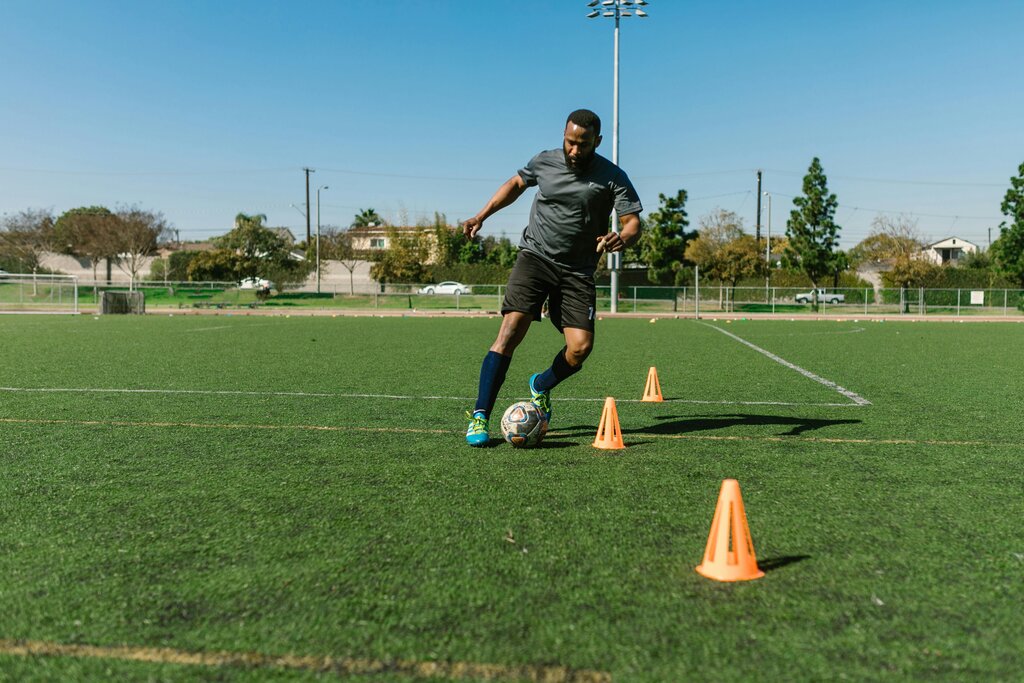
By consciously lowering your center of gravity, you gain immense stability. Bend your knees, keep your back relatively straight, and stay on the balls of your feet. This athletic stance is your foundation. From here, you can explode in any direction, absorb challenges from defenders, and make sharp turns without losing your balance or momentum.
The Power of the Plant Foot
Your non-kicking foot, often called the plant foot, is more than just a support leg. It's the anchor and pivot that unlocks explosive power. When you want to change direction quickly, you plant this foot firmly into the ground. This action creates a point of leverage. The force you drive into the turf is returned, propelling your body in the new direction.
Think of it like pushing off a wall to change direction in a pool. The plant foot is your wall on the field.
The placement is critical. Plant it too close to the ball, and you'll feel cramped and slow. Too far, and you'll be off-balance and lose power. The ideal spot is slightly to the side and just behind the ball. This positioning gives you a solid base to push off from while allowing your hips and kicking foot the space to move freely and execute the next touch.
Leading with the Hips
In dribbling, your hips lead and your feet follow. The direction your hips are facing often signals your next move, which makes them a powerful tool for deception. To execute a sharp turn, you don't just move the ball; you rotate your hips decisively into the space you want to attack. This rotation brings your entire body mass into the turn, making the movement quick and powerful.
Lowering your hips sinks your center of gravity, providing the stability we discussed earlier. This is especially crucial in tight spaces. When a defender is close, sinking your hips allows you to create a low, powerful base, making it harder for them to push you off the ball. You can then use quick hip swivels to change direction, leaving the defender flat-footed. This is the foundation of many famous moves, like ., which relies entirely on a rapid weight shift and hip turn to navigate past an opponent.
The weight transfer should be initiated by the hips with the legs, knees, ankles to follow.
This principle of leading with the hips is also the core of deceptive movement. By faking a turn with your hips—a sudden dip or swivel in one direction—you can send a defender the wrong way. As they commit to your fake, you can push the ball into the space they've just vacated. This isn't just a trick; it's a calculated manipulation of the defender's balance, initiated from your core.
What is the primary benefit of consciously lowering your center of gravity while dribbling?
Where is the ideal placement for your non-kicking (plant) foot when preparing to change direction?
Mastering dynamic weight distribution transforms dribbling from a series of ball touches into a fluid, whole-body movement. It's the physical foundation that allows you to be both powerful and deceptive on the ball.