Mastering Drum Fills and Transitions
Subdivision Mastery
The Anatomy of a Fill
You've got the basic rock beat down. Your right hand is keeping steady time on the hi-hat, and your kick and snare are locking into a solid groove. But how do you move from one section of a song to another? That's where the drum fill comes in. A fill is a short rhythmic phrase that breaks from the main pattern to create a transition.
The secret to powerful, precise fills isn't just speed or flashiness; it's understanding subdivision. By breaking down each beat into smaller pieces, you create an internal grid that keeps you perfectly in time, even when the rhythm gets complex.
The Eighth Note Grid
Let's start with the most common subdivision: the eighth note. In a standard 4/4 measure, there are four main beats. Eighth notes split each of those beats in half, giving you eight evenly spaced notes per measure.
To internalise this rhythm, we count it out loud: "1 & 2 & 3 & 4 &". The numbers fall on the main beats (the downbeats), and the "&"s fall exactly in between (the upbeats). This counting system is your map for navigating the rhythm.
For most fills, you'll use hand-to-hand alternate sticking, which simply means your hands alternate striking the drum: Right, Left, Right, Left. This technique is crucial for building speed, consistency, and control.
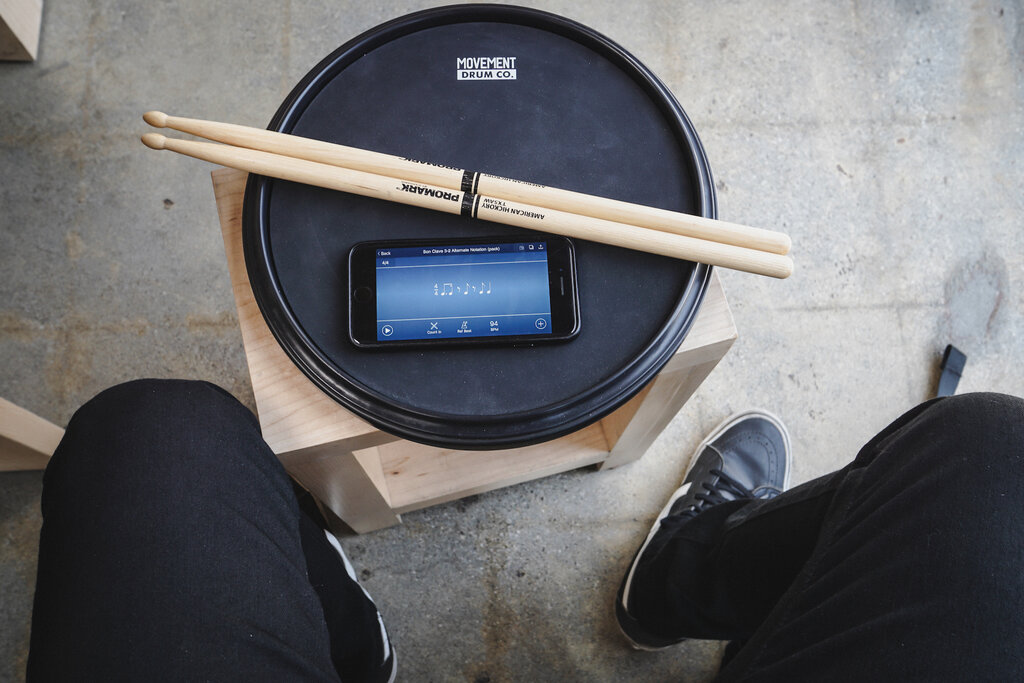
Try this: set a to a slow tempo, like 60 BPM. For three measures, play a basic rock beat. On the fourth measure, play eight consecutive notes on the snare drum, counting "1 & 2 & 3 & 4 &" and using alternate sticking. Then, seamlessly transition back to the rock beat on the next measure. The goal is to make the transition smooth and keep the timing flawless.
Increasing the Density
Once you're comfortable with eighth notes, it's time to double the speed and introduce sixteenth notes. These split each beat into four equal parts, giving you sixteen notes per measure. This higher note density is what creates fast, rolling fills that build excitement.
The counting system expands accordingly: "1 e & a 2 e & a 3 e & a 4 e & a".
- 1: On the beat (downbeat)
- e: The second sixteenth note
- &: The eighth note mark (upbeat)
- a: The fourth sixteenth note
This might feel like a mouthful at first, but counting it aloud is the fastest way to feel the rhythm. As with eighth notes, you'll rely on strict alternate sticking (R-L-R-L) to play these cleanly.
Practice slowly. Speed is a byproduct of accuracy. If you can't play it clean at 60 BPM, you can't play it clean at 120 BPM.
Let's apply this. Set your metronome back to a slow tempo. Play your beat for three measures. On the fourth measure, play sixteen notes on your snare, counting "1 e & a 2 e & a 3 e & a 4 e & a". Notice how your hands have to move twice as fast as before to fit all the notes in. The challenge is to keep every note evenly spaced and at a consistent volume.
Devoting time to honing these fundamental techniques can establish a firm foundation for mastering intricate rhythms and cultivating better musicality with your drumming.
The real fun begins when you start moving these subdivisions around the kit. Instead of playing a fill only on the snare, try playing the first four sixteenth notes on the snare, the next four on the high tom, the next four on the mid tom, and the final four on the floor tom. This creates a classic 'around the kit' fill.
The counting and sticking remain the same. The only thing that changes is your target. This is how you build a vocabulary of fills, not by memorising patterns, but by understanding the underlying grid and applying it creatively.
Now, let's test your understanding of these rhythmic building blocks.
What is the primary purpose of a drum fill in a song?
How do you correctly count a full measure of eighth notes in 4/4 time?
Mastering these subdivisions is a gateway to rhythmic freedom. By internalising the eighth and sixteenth note grids, you can play precisely, creatively, and with confidence.