Mastering Divide and Conquer for Modular Exponentiation
Introduction to Divide and Conquer
A Smarter Way to Solve Problems
How do you tackle a massive, overwhelming task? Whether it's organizing a huge library or cleaning a cluttered house, you probably don't try to do it all at once. Instead, you break it down. You organize one shelf at a time, or clean one room at a time. Once all the small parts are done, the entire task is complete.
Computer scientists use this same powerful strategy to solve complex problems. It's called divide and conquer.
The divide and conquer approach is a three-step process for designing algorithms.
| Step | Action | Example (Sorting a Deck of Cards) |
|---|---|---|
| 1. Divide | Break the problem into smaller, independent subproblems. | Split the deck in half, then split those halves in half, and so on, until you have 52 single-card piles. |
| 2. Conquer | Solve the subproblems. If they're small enough, you solve them directly. | A single card is already sorted. This is the easy part. |
| 3. Combine | Merge the solutions from the subproblems to solve the original problem. | Merge two sorted piles into a new, larger sorted pile. Repeat this process until all the cards are back in one sorted deck. |
This isn't just a neat trick; it's a fundamental paradigm that leads to some of the most efficient algorithms ever created.
Divide and Conquer in Action
Sorting is a classic computer science problem. You have a list of items—numbers, names, anything—and you need to put them in order. A simple, brute-force way might be to compare every item with every other item, which is incredibly slow for large lists.
Divide and conquer offers a much faster way. Let's look at one of the most famous examples: Merge Sort.
Merge Sort follows the divide and conquer recipe perfectly.
It starts by repeatedly splitting an unsorted list in half until it's left with a bunch of lists containing only one item each. At that point, the "conquer" step is trivial—a list with one item is inherently sorted.
The real magic happens in the "combine" step. The algorithm merges these small, sorted lists back together. It takes two sorted lists of one item, compares them, and creates a new sorted list of two items. Then it takes two sorted lists of two, and merges them into a sorted list of four. This continues until all the pieces are reassembled into a single, fully sorted list.
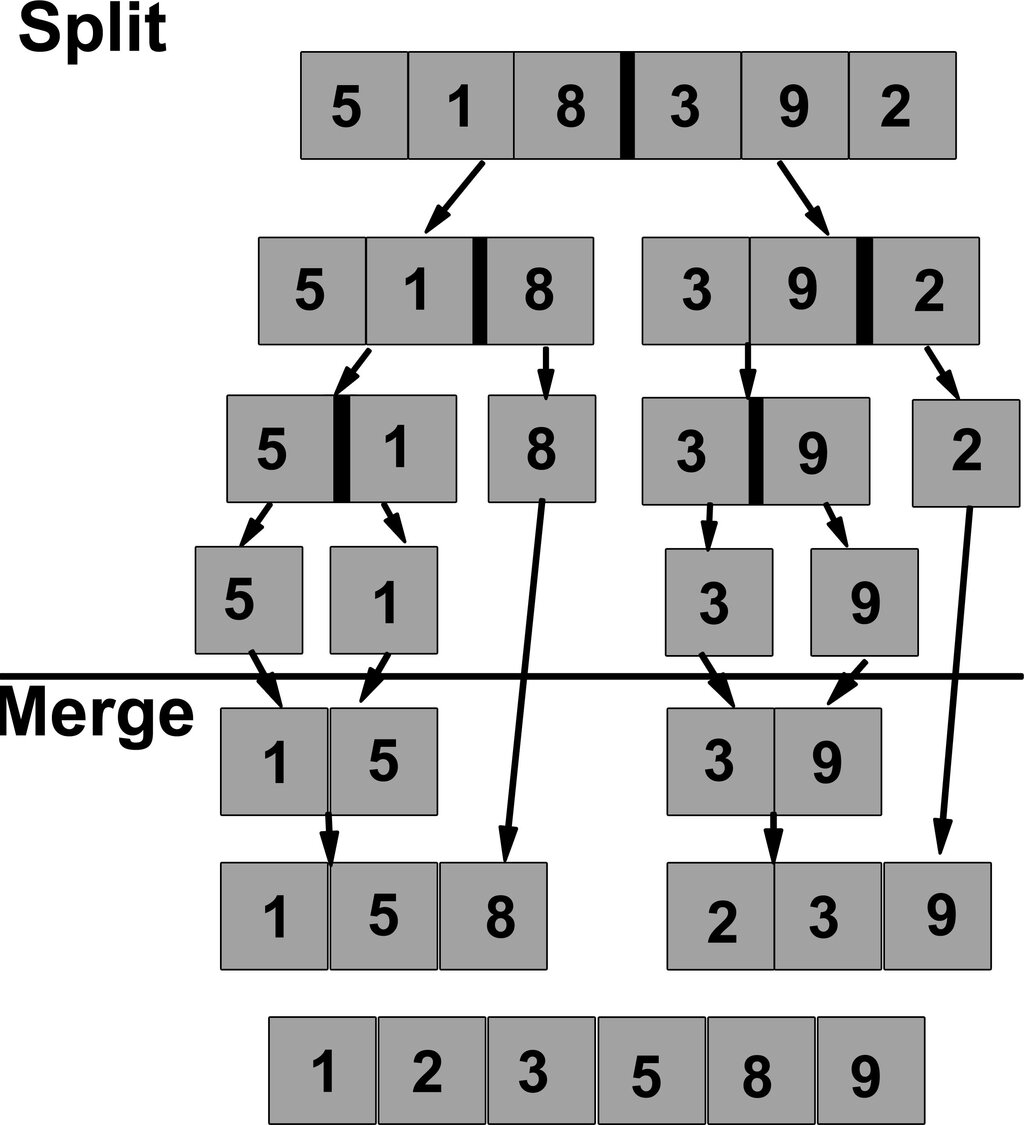
Another well-known sorting algorithm, Quicksort, also uses a divide and conquer strategy. Instead of splitting the list in half, it picks a "pivot" element and rearranges the list so that all smaller items come before the pivot and all larger items come after. It then recursively applies the same logic to the sub-lists on either side of the pivot. The core idea is the same: break a big problem into smaller, more manageable ones.
Why Bother?
The main advantage of divide and conquer is speed. For many problems, this approach dramatically reduces the total number of operations needed. Algorithms like Merge Sort can turn a problem that would take hours with a simple method into one that takes seconds. This efficiency is a game-changer when dealing with large datasets.
Another key benefit is that the subproblems are often independent. This makes divide and conquer algorithms a natural fit for parallel processing. Multiple processor cores can work on different subproblems at the same time, solving the overall problem even faster.
Break down complex mathematical problems into smaller, manageable components to enhance understanding and problem-solving skills.
Of course, there are trade-offs. The logic can be more complex to implement than a straightforward brute-force approach. Since it often relies on recursion—a function calling itself on smaller and smaller inputs—there's a risk of running into memory issues if the problem is divided into too many levels of subproblems.
Despite these challenges, the power and efficiency of this paradigm make it an essential tool for programmers and computer scientists.
Now that you understand the general idea of breaking down problems, let's see how it can be used for more than just sorting.