Mastering Distributed Message Queues for System Design Interviews
Distributed Message Queues
The System's Post Office
In a distributed system, different services need to talk to each other. One way is through direct, synchronous communication, like a phone call. Service A calls Service B and waits for an answer before it can do anything else. This works, but it creates tight coupling. If Service B is slow or offline, Service A is stuck waiting.
A message queue offers a different approach: asynchronous communication. Think of it like a post office. Service A doesn't call Service B directly. Instead, it drops off a message at a central queue and immediately moves on to its next task. Later, when Service B is ready, it picks up the message from the queue and processes it. This simple change has profound implications for system design.
A message queue is a form of asynchronous service-to-service communication.
This method introduces two key roles.
Producer
noun
A component or service that creates a message and sends it to the queue.
The producer is the sender. Its only job is to formulate a message and put it in the correct mailbox. It doesn't know or care who reads the message, or when.
Consumer
noun
A component or service that connects to the queue, retrieves messages, and processes them.
The consumer is the receiver. It works at its own pace, pulling messages from the queue whenever it has the capacity. There can be one or many consumers for a single queue.
The Benefits of Decoupling
The primary advantage of using a message queue is decoupling. Producers and consumers operate independently, without direct knowledge of each other. This separation is the foundation for several key benefits in distributed systems.
Decoupling allows different parts of a system to evolve independently and fail without causing a domino effect across the entire application.
First, it enhances scalability. Imagine an e-commerce site during a flash sale. The order service (a producer) might receive thousands of orders per minute. The shipping and notification services (consumers) might not be able to keep up. With a message queue, the orders are safely stored. You can scale the number of consumers up or down based on the number of messages in the queue, without ever touching the producer. This is a powerful form of load balancing.
Second, it improves fault tolerance and reliability. If a consumer service crashes, the messages simply wait in the queue. Once the service is back online, it can pick up right where it left off. No data is lost. The producer can continue accepting new orders, completely unaware that a downstream service was temporarily unavailable.
Common Use Cases
Message queues are not a niche tool; they are a fundamental component in modern distributed architectures. You'll find them in many scenarios:
-
Background Jobs: When a user uploads a video, you don't want them to wait while it's being processed and transcoded into different formats. The web server (producer) can just add a 'transcode video' job to a queue. Worker servers (consumers) will pick up the job and do the heavy lifting in the background.
-
Order Processing: As in our e-commerce example, a queue can buffer incoming orders. This ensures that even during massive traffic spikes, every order is captured and eventually processed.
-
Data Streaming: Services can produce events or logs that multiple other systems might be interested in. A central message bus (a type of queue system) can distribute these events to services responsible for analytics, monitoring, and archiving.
-
Microservice Communication: In a microservices architecture, queues are a common way for services to communicate asynchronously. This prevents a chain of dependencies where one slow service can bog down many others.
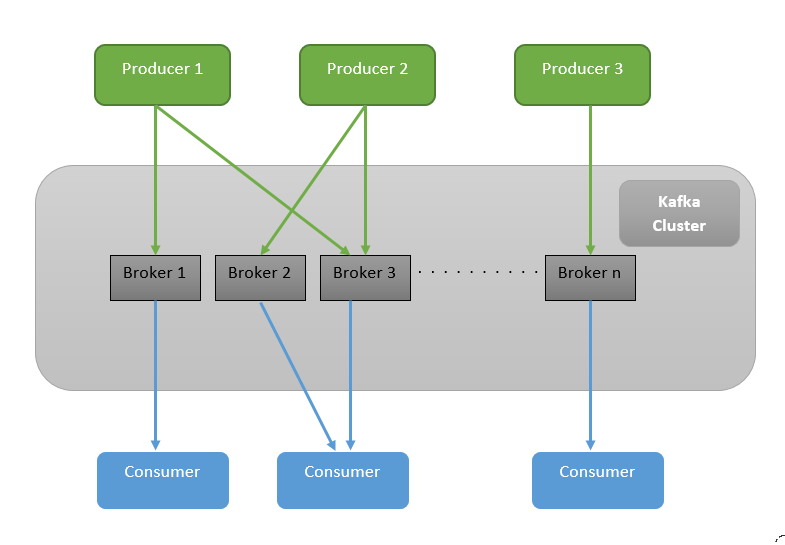
By acting as an intermediary, a message queue allows a system to be more resilient, scalable, and easier to maintain. It shifts the communication pattern from an immediate, blocking phone call to a patient, non-blocking postal system.
Time to check your understanding.
What is the primary advantage of using a message queue in a distributed system?
In the context of a message queue, which component is responsible for creating a message and sending it to the queue?
By understanding the roles of producers and consumers and the benefits of decoupling, you can better design systems that are both robust and flexible.