Mastering Direct Proofs
Introduction to Mathematical Proofs
What is a Proof?
In everyday life, we use “proof” to mean strong evidence. A detective finds fingerprints as proof a suspect was at the scene. But in mathematics, a proof is something much more powerful. It’s a logical argument that demonstrates a statement is true, without any doubt, in all possible cases.
Why does this matter? Because mathematics is a subject where every new idea is built directly on top of older ones. A proof ensures that our foundation is solid rock, not sand. Once a statement is proven, it becomes a theorem, a reliable tool we can use to build even more complex and beautiful mathematical structures.
A proof isn't just about showing something is true; it's about understanding why it's true.
The Building Blocks of a Proof
Every mathematical proof, no matter how complex, is constructed from three basic parts. Think of it like a recipe: you have ingredients, a set of instructions, and a final dish.
1. Premises: These are the starting ingredients. Premises are statements we assume to be true for the purpose of our argument. They might be axioms, which are fundamental truths accepted without proof, or previously proven theorems.
2. Logical Reasoning: This is the core of the proof, the step-by-step instructions. Each step must follow logically from the one before it, using established rules of logic and mathematical operations. It's a chain of deductions where every link is unbreakable.
3. Conclusion: This is the final result—the statement we wanted to prove. If our premises were true and our logical reasoning was flawless, then our conclusion is guaranteed to be true.
A Few Ways to Prove a Point
Just as a carpenter has different tools for different jobs, a mathematician has several techniques for building a proof. The method you choose depends on the statement you're trying to prove. Here’s a quick look at three common strategies.
Direct Proof
noun
A method of showing the truth of a given statement by a straightforward combination of established facts, without making any further assumptions.
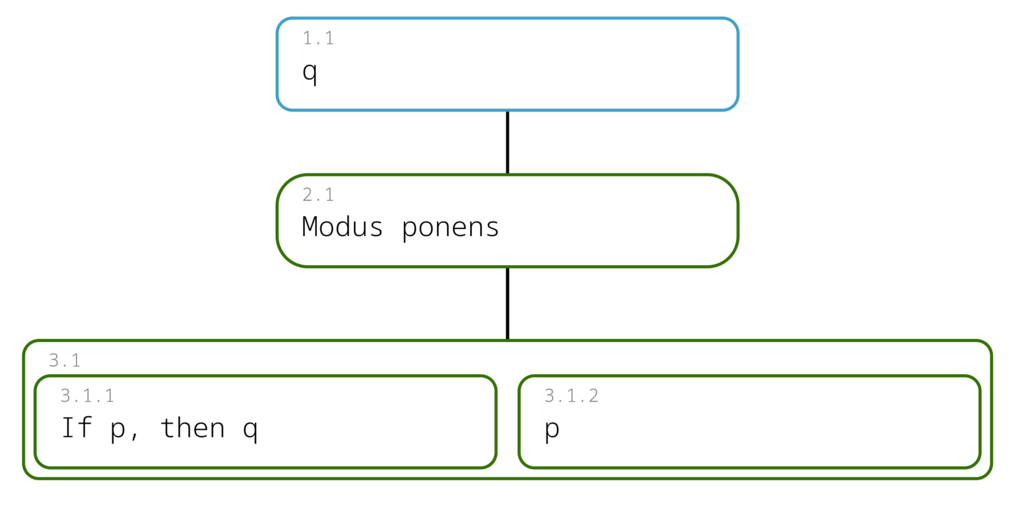
This is the most straightforward approach. You start with your premises and take logical steps that lead you straight to the conclusion. It's like walking a direct path from point A to point B. You prove that if P is true, then Q must also be true.
Imagine a simple statement: If it is raining (P), then the ground is wet (Q). A direct proof would start with the fact that it's raining and logically conclude that the ground must be wet.
Next is proof by contrapositive. This one is a bit clever. Instead of proving "If P, then Q," we prove an equivalent statement: "If Q is not true, then P is not true." Sometimes this is much easier to work with.
For our rain example, the contrapositive is: "If the ground is not wet, then it is not raining." This makes perfect sense, and proving it is just as good as proving the original statement.
Finally, there's proof by contradiction. This is a powerful, indirect method. You begin by assuming the opposite of what you want to prove. Then, you use logical steps to show that this assumption leads to something impossible—a contradiction.
It’s like a detective who assumes the butler is innocent, but then finds evidence that proves the butler had to be in two places at once. That's a contradiction! The initial assumption (that the butler was innocent) must be false. In the same way, if assuming a mathematical statement is false leads to a logical absurdity, the statement must have been true all along.
Understanding these basic structures is the first step toward reading, understanding, and eventually writing your own proofs. In the next section, we'll dive into the direct proof method with a concrete example.