Mastering DGPS Mechanics
Atmospheric and Timing Errors
An Imperfect Journey
A GPS signal's journey from a satellite 20,000 kilometers away to your receiver seems straightforward. In reality, it's a trip through an atmospheric obstacle course and a race against tiny timing discrepancies. Since GPS calculates distance using the formula , any change in the signal's speed or any error in measuring its travel time directly translates into a positioning error on the ground.
These errors are not random noise. They arise from specific physical phenomena in the atmosphere and tiny imperfections in the satellite's orbit and internal clock. Understanding these sources is the first step toward correcting them.
The Atmospheric Gauntlet
The biggest source of error for a GPS signal is Earth's atmosphere. As the radio wave travels through different layers, its speed changes, introducing a delay. This delay is split into two main types, based on the atmospheric layer responsible.
First, the signal passes through the ionosphere, a layer of the upper atmosphere from about 60 to 1,000 km altitude that is full of charged particles called ions and free electrons. This plasma interacts with the GPS radio signal, slowing it down. The magnitude of this delay depends on the signal's frequency and the density of electrons along its path, a measure known as (TEC). TEC varies significantly with the time of day, season, and the 11-year solar cycle, making the ionospheric delay the largest and most variable error source.
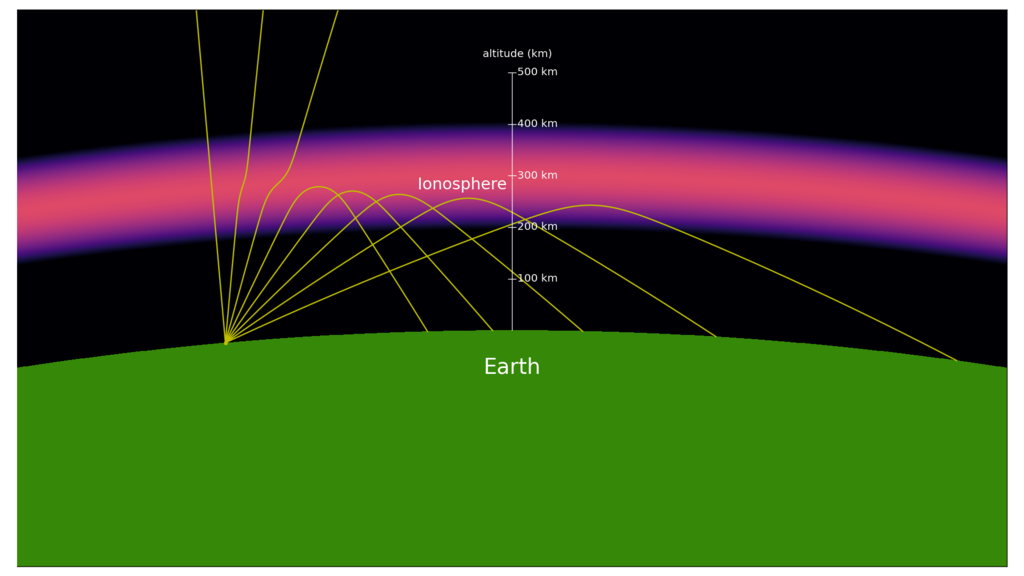
After the ionosphere, the signal travels through the troposphere, the lowest layer of the atmosphere where we live and where weather occurs. Unlike the ionosphere, the troposphere is electrically neutral. Here, the delay is caused by variations in temperature, pressure, and especially water vapor. The "wet" component of the delay, caused by humidity, is highly variable and difficult to model, though it's a much smaller error source than the ionosphere.
Clocks and Orbits
Beyond the atmosphere, errors can creep in from the satellites themselves. Each GPS satellite carries multiple that are incredibly precise, but they aren't perfect. They can drift by a few nanoseconds per day relative to the master GPS time. Since light travels about 30 centimeters in one nanosecond, even this tiny drift can cause a position error of about a meter.
The Global Positioning System (GPS) must account for time dilation due to both the satellites' high-speed motion and their position in a weaker gravitational field than Earth's surface.
Another issue is that a satellite might not be exactly where we think it is. The data describing a satellite's orbit is called its ephemeris. This information is broadcast by the satellite and used by your receiver in its calculations. However, the ephemeris data can be slightly inaccurate. Gravitational pulls from the Sun and Moon, along with the gentle pressure of solar radiation, cause slight deviations in a satellite's orbit that aren't perfectly modeled.
The Error Budget
When you add up all these potential problems, you get an "error budget" that explains why standard GPS has its limits. The table below shows the typical contribution of each error source under normal conditions. Other factors, like signals bouncing off buildings (multipath error) and receiver-internal noise, also add to the total.
| Source of Error | Typical Error (meters) |
|---|---|
| Ionospheric Delay | 5.0 |
| Ephemeris Errors | 2.5 |
| Satellite Clock Errors | 1.5 |
| Multipath Effects | 1.0 |
| Tropospheric Delay | 0.5 |
| Receiver Noise | 0.3 |
Summing these up gives a typical positioning error of 5 to 10 meters. This is accurate enough for many applications, but for high-precision tasks like land surveying or automated farming, it's not good enough. This is where correction techniques, which are designed to mitigate these very errors, come into play.
What is the single largest and most variable source of error for a GPS signal?
The data that describes a satellite's precise orbit, which is broadcast to your receiver, is known as its __________.