Mastering Determinants and Matrix Scaling
Geometric Scaling
How Transformations Scale Space
You've seen how a matrix can represent a linear transformation, a rule for moving vectors around. But these transformations do more than just reposition individual points. They stretch, skew, and rotate the entire space they act upon. The determinant of a matrix is a single number that tells us the geometric story of that transformation.
The determinant simply tells us how T changes area and whether or not it reverses orientation.
Imagine a simple 1x1 unit square in a 2D plane, with corners at (0,0), (1,0), (1,1), and (0,1). Its area is 1. When we apply a linear transformation, this square gets mapped to a new shape, usually a parallelogram. The determinant of the transformation matrix is precisely the area of this new parallelogram. If the determinant is 2, the area has doubled. If it's 0.5, the area has been cut in half.
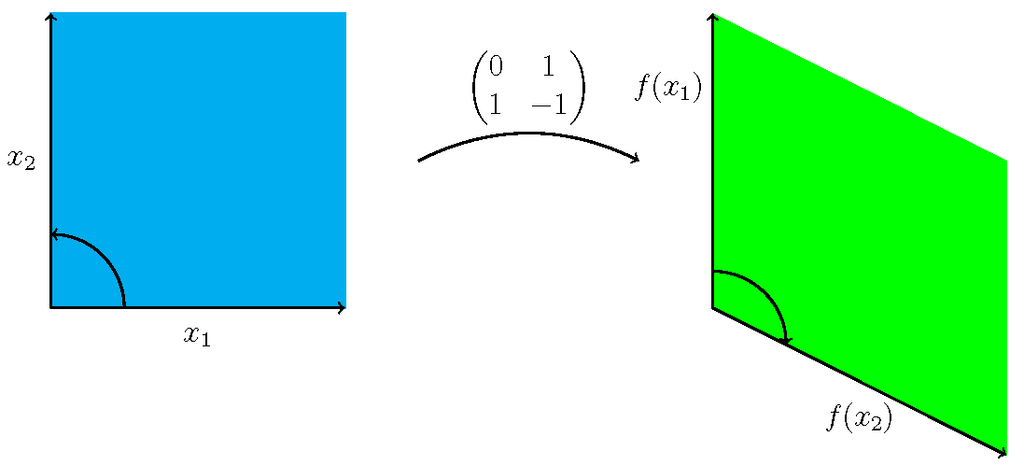
This idea extends to any number of dimensions. In 3D space, the determinant tells you how the volume of a 1x1x1 unit cube changes. In an n-dimensional space, it measures the scaling factor of the n-dimensional volume of a unit hypercube. This single number captures the essence of how the transformation expands or contracts space as a whole.
Signed Volume and Orientation
You might notice that determinants can be negative. How can an area or volume be negative? It can't, but the sign tells us something crucial about the transformation's effect on —the geometric arrangement of the space.
A positive determinant means the transformation is orientation-preserving. It might stretch or rotate space, but it doesn't flip it. Think of spinning a globe on its axis. The continents stretch near the poles, but their relative arrangement stays the same.
A negative determinant means the transformation is orientation-reversing. It reflects the space, like looking in a mirror. The volume or area is scaled by the absolute value of the determinant, but the space itself has been turned inside out.
When Volume Collapses
What does it mean if the determinant is exactly zero? A scaling factor of zero implies that the volume of the transformed shape is zero. This happens when the transformation squishes the space into a lower dimension.
For example, a 3D transformation with a determinant of zero might project a cube onto a flat plane or even a single line. A 2D transformation with a zero determinant maps a square onto a line or a single point. The output is 'flat'; it has no volume in the original sense.
This collapse is why matrices with a determinant of zero are called or non-invertible. If you've squashed a 3D space into a 2D plane, there's no way to undo that transformation. You've lost a dimension's worth of information. You can't possibly know if a point on the plane came from the top or bottom of the original cube. The transformation is a one-way street.
Before you move on, take a moment to test your understanding of how determinants relate to geometric transformations.
What does the determinant of a 2x2 matrix geometrically represent?
A 3D linear transformation has a determinant of -4. What does this imply about the transformation?