Mastering Determinants and Linear Transformations
Geometric Scaling Factor
The Geometry of a Number
You've likely calculated determinants before, maybe using methods like Sarrus's rule or cofactor expansion. It's easy to get lost in the arithmetic and see the determinant as just a number you compute from a matrix. But its true meaning is geometric.
A linear transformation warps space. It can stretch, compress, shear, or rotate the coordinate system. The determinant is the single number that tells you by what factor the transformation scales areas (in 2D) or volumes (in 3D).
This special scaling factor, the factor by which a linear transformation changes areas, is called the “determinant” of that transformation.
Think about the standard basis vectors, and . They form a unit square with an area of 1. When you apply a transformation matrix, say , these basis vectors get sent to new locations. The vector lands on , and lands on .
These two new vectors form the sides of a parallelogram. The determinant of matrix , which is , is precisely the area of this new parallelogram.
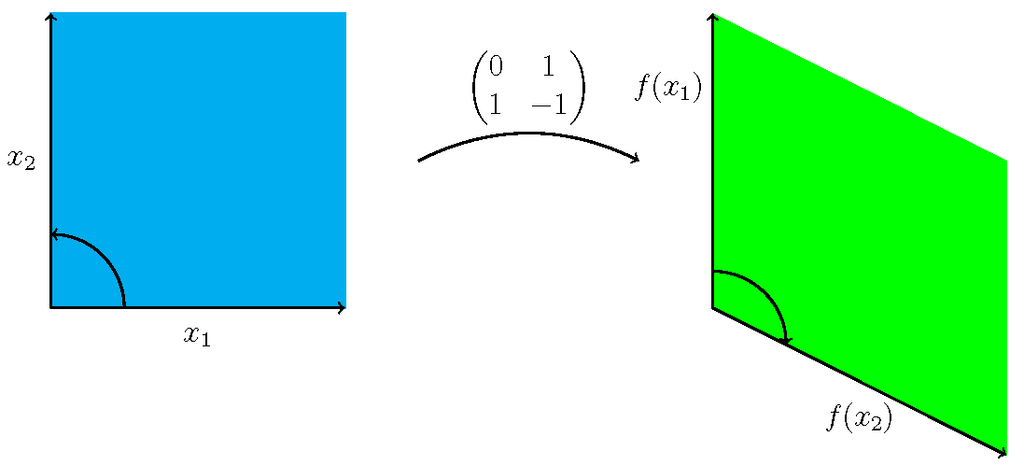
This isn't just true for the unit square. Every area in the plane is scaled by this same factor. If a transformation has a determinant of 3, it triples the area of any shape you apply it to.
A Matter of Orientation
But wait, determinants can be negative. How can an area be negative? It can't. The sign of the determinant tells us something different: whether the transformation flips the orientation of space.
In a standard 2D coordinate system, is 90 degrees counter-clockwise from . If the determinant is positive, the transformed version of maintains this relative position to the transformed . The transformation might stretch and rotate space, but it doesn't flip it inside out.
If the determinant is negative, the orientation is reversed. The transformation flips space over, like turning a piece of paper over. The transformed will be on the 'wrong' side of the transformed . This is why we talk about the determinant as representing signed area.
What happens if the determinant is exactly zero? This means the transformation squishes space into a lower dimension. In 2D, the parallelogram flattens into a line or even a single point. Its area is zero. This tells you the transformation is not invertible, as you can't un-flatten a line back into a plane.
Scaling Up to 3D and Beyond
This idea extends perfectly to higher dimensions. In 3D, the three basis vectors , , and form a unit cube with a volume of 1. After a 3x3 transformation matrix is applied, these vectors are mapped to three new vectors that form a parallelepiped (a slanted box).
The determinant of the 3x3 matrix is the signed volume of this parallelepipeds. The absolute value gives the scaling factor for volume, and the sign indicates whether the transformation preserves or reverses orientation (the 'right-hand rule').
The determinant tells us how a transformation changes area or volume, and whether it reverses orientation.
This geometric view is powerful. It connects the abstract calculation of a determinant to the tangible effect a matrix has on space. It's not just a number, it's the measure of a transformation's scale.
What does the absolute value of the determinant of a 2x2 matrix represent geometrically?
A linear transformation in 3D space is represented by a matrix with a determinant of -2. What does this imply?