Mastering Determinants and Linear Transformations
Geometric Scaling Factors
The Geometry of Scaling
A linear transformation stretches, squishes, and rotates space. But by how much? There's a single number that tells you the exact scaling factor of any transformation: the determinant.
Think of a 2x2 matrix. It transforms a 2D plane. We can measure its effect by seeing what it does to a simple shape. The most fundamental shape is the unit square, a 1x1 square defined by the basis vectors and . Its area is 1.
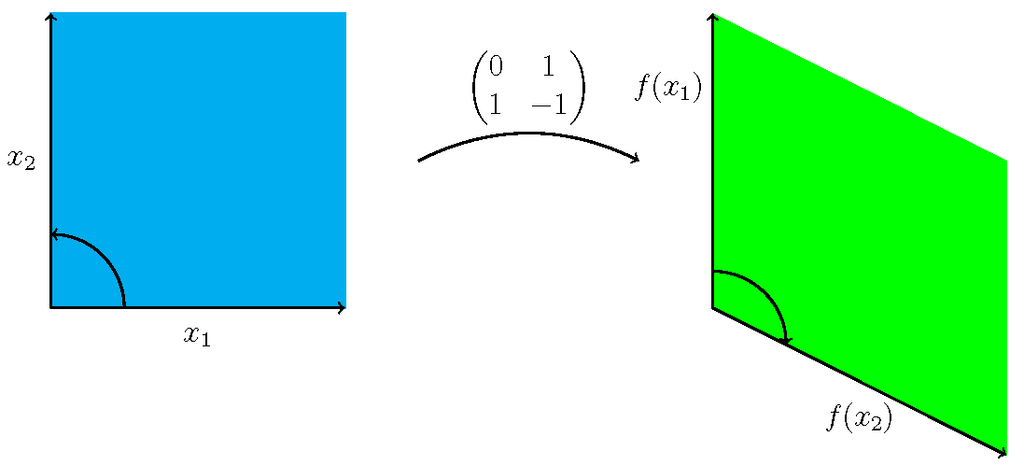
When we apply a , those basis vectors get moved. Since the columns of a matrix tell you where the basis vectors land, the unit square morphs into a parallelogram. The determinant of that matrix is the area of this new parallelogram.
For a general 2x2 matrix, the formula for the determinant directly calculates this area.
This special scaling factor, the factor by which a linear transformation changes areas, is called the “determinant” of that transformation.
A Matter of Orientation
But what if the determinant is negative? Area can't be negative, but the sign tells us something crucial about the transformation: it tells us about orientation.
Imagine the basis vectors and . In their standard positions, is 90 degrees counter-clockwise from . If a transformation results in a positive determinant, this relative orientation is preserved. The new vectors might be stretched and skewed, but the second vector will still be generally counter-clockwise from the first.
If the determinant is negative, the orientation of space has been flipped. It's like looking at the plane in a mirror. The transformation has inverted the space, causing to land on the clockwise side of . This is an .
A positive determinant preserves orientation (rotation/stretch). A negative determinant reverses it (a flip).
What about a determinant of zero? This means the transformation squishes all of 2D space onto a single line, or even a single point. The resulting parallelogram is completely flat and has an area of zero.
Scaling into 3D
This idea extends perfectly into higher dimensions. For a 3x3 matrix, the three basis vectors (\{\hat{i}, \hat{j}, \hat{k}}\}) form a unit cube with a volume of 1.
A 3x3 [{
The concept of orientation also applies. In 3D, orientation is usually defined by the "right-hand rule." If you can point your index finger along the first transformed basis vector, your middle finger along the second, and your thumb naturally points along the third, the orientation is preserved (positive determinant).
If you have to use your left hand to make it work, the orientation has been flipped (negative determinant). The space has been mirrored. A determinant of zero means the 3D space has been collapsed into a 2D plane or a 1D line, resulting in zero volume.
So, the determinant is far more than a computational tool. It's a fundamental geometric quantity that captures the essence of how a linear transformation impacts the area or volume of the space it acts on.
What does the absolute value of the determinant of a 2x2 matrix represent geometrically?
A 2D linear transformation has a determinant of -2. If you apply this transformation to a circle with an area of 5, what is the area of the resulting ellipse?