Mastering Decision Making
Introduction to Decision-Making
What Makes a Decision?
At its core, a decision is a choice between two or more possibilities. We make hundreds of them every day, from hitting the snooze button to picking a career path. While some are trivial, others shape our lives. The goal isn't to make perfect decisions every time—that's impossible. The goal is to make better decisions by understanding what goes into them.
Thinking clearly about a choice helps you move forward with confidence. It transforms a messy, stressful situation into a structured problem you can solve. A good process won't guarantee a good outcome, but it dramatically increases your odds.
The Building Blocks of a Decision
Every decision, whether you realize it or not, has four key components. Breaking a problem down into these parts makes it much easier to tackle.
1. Objectives: This is what you're trying to accomplish. It’s your goal. A clear objective is your compass. If you want to buy a new laptop, your objective isn't just "buy a laptop." It might be "buy a lightweight laptop for travel with at least 10 hours of battery life."
2. Alternatives: These are your different courses of action. For the laptop, your alternatives might be a MacBook Air, a Dell XPS, or a Microsoft Surface. If you only have one option, you don't have a decision to make.
3. Consequences: Every alternative has a set of outcomes. The MacBook might be expensive but user-friendly. The Dell could be powerful but heavy. The Surface offers a touchscreen but may have less processing power. You need to forecast the likely consequences of each choice.
4. Trade-offs: This is the heart of decision-making. You can't have it all. To get one thing you value, you often have to give up something else. Choosing the lightest laptop might mean trading away screen size or performance. Understanding what you are willing to sacrifice is crucial.
A trade-off is an exchange. You are accepting a negative consequence in one area to gain a positive outcome in another.
Common Stumbling Blocks
If decision-making is so straightforward, why is it often so hard? A few common challenges get in our way.
One major issue is information overload. With endless options and reviews, it’s easy to get paralyzed, endlessly researching instead of choosing. Another is emotional bias. We might stick with a familiar but bad option out of fear of the unknown, or we might be overly optimistic about a favorite alternative.
Finally, there's uncertainty. The future is unpredictable, and the consequences of our choices are never guaranteed. This can make any decision feel like a gamble.
Why Structure Matters
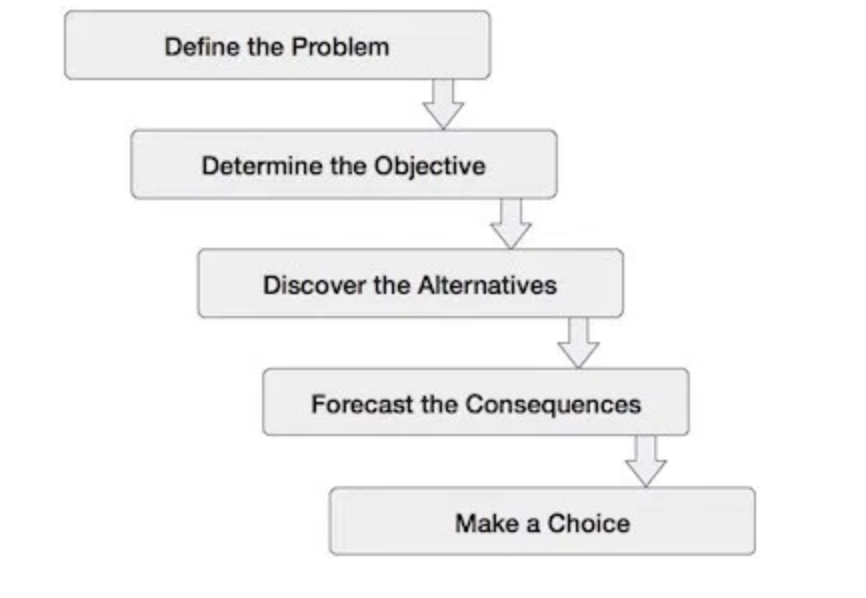
A structured approach helps cut through these challenges. By breaking a decision into its components—objectives, alternatives, consequences, and trade-offs—you create clarity. Instead of a big, scary decision, you have a series of smaller, more manageable questions to answer.
This process forces you to be deliberate. You have to define what you really want, look for creative options, and think realistically about the outcomes. It separates the facts from your feelings, helping you avoid choices based purely on emotion.
It offers a framework to evaluate trade-offs, reduce stress, and make complex decisions feel more manageable.
Using a framework also makes your reasoning visible. You can explain to yourself—and others—exactly why you made a particular choice, which builds confidence and makes it easier to learn from your experiences, good or bad.
According to the text, what are the four key components of every decision?
You are choosing a vacation destination. You can go to the beach, which is relaxing but expensive, or you can go camping, which is affordable but less comfortable. The process of weighing these competing factors is an example of what?
Understanding these fundamental pieces is the first step toward making consistently better decisions. It gives you a reliable map for navigating any choice, no matter how complex.