Mastering DBSCAN Clustering
DBSCAN Fundamentals
Clustering by Density
Most clustering algorithms you might have encountered, like k-means, work by finding a center point, or centroid, for each cluster and grouping data points based on their proximity to these centers. This approach is effective when clusters are spherical and evenly sized.
But what happens when clusters are oddly shaped, like intertwined spirals or long, thin arcs? Centroid-based methods struggle with this kind of data. That's where density-based clustering comes in. Instead of looking for a central point, these algorithms define clusters as dense regions of data points separated by areas of lower density.
DBSCAN is a density-based clustering algorithm that groups together points that are closely packed (points with many nearby neighbors), while marking points that lie alone in low-density regions as outliers.
DBSCAN (Density-Based Spatial Clustering of Applications with Noise) is the most popular algorithm of this type. It doesn't need to know the number of clusters beforehand and excels at finding non-linear shapes and identifying outliers.
Core Concepts
DBSCAN's logic revolves around two key parameters: epsilon (ε) and min_samples.
Epsilon (ε) is a distance measure. It defines the radius of a neighborhood around each data point.
Min_samples is the minimum number of data points (including the point itself) required to be within a point's ε-neighborhood for it to be considered a dense region.
Using these two parameters, DBSCAN classifies every point in the dataset into one of three types.
The algorithm starts by picking an arbitrary point. If it's a core point, it creates a new cluster and adds all reachable points (both core and border) to it. If it's a border point, it does nothing for now but may be assigned to a cluster later. If it's a noise point, it's marked as an outlier. This process repeats until every point has been visited.
Arbitrary Shapes and Noise
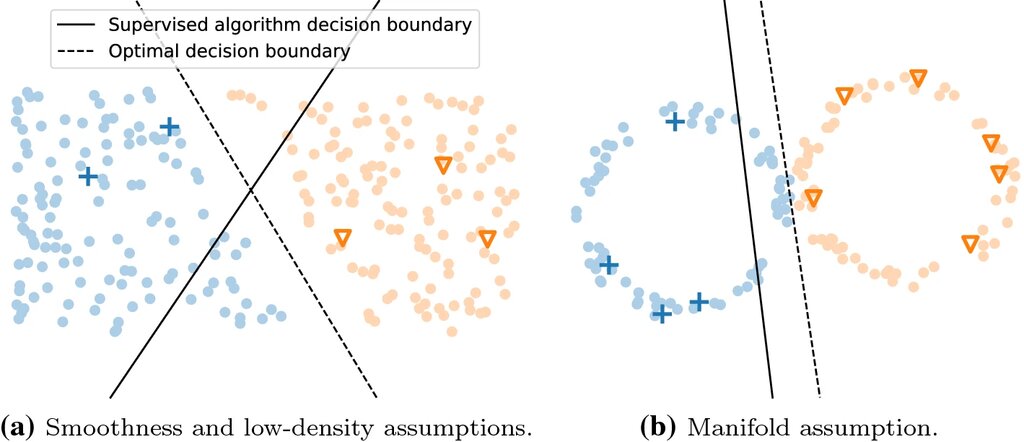
The power of this core-border-noise approach is that clusters can grow in any direction. As long as points are density-reachable from a core point, they become part of the same cluster. This allows DBSCAN to discover clusters of arbitrary shapes, a significant advantage over methods that assume clusters are convex or spherical.
Furthermore, DBSCAN has a built-in mechanism for handling noise. Points that don't belong to any dense region are simply left unassigned to a cluster. This is different from algorithms like k-means, which force every single point into a cluster, even if it's a clear outlier. This makes DBSCAN particularly robust for real-world datasets, which are often messy and contain anomalous data.
What is the primary advantage of DBSCAN over centroid-based algorithms like k-means?
In the DBSCAN algorithm, what two key parameters are used to define the density of a region?
Understanding these core concepts is the first step to effectively applying DBSCAN to find meaningful patterns in complex datasets.