Mastering Data Structures in C
Introduction to Data Structures
Organizing Information
Think about a library. If all the books were just thrown in a giant pile, finding the one you want would be a nightmare. Libraries organize books by genre, author, and title so you can find things quickly. In programming, we need to do the same with our data.
A data structure is simply a way of organizing and storing data in a computer so that it can be accessed and used efficiently.
Choosing the right way to arrange information can be the difference between a program that runs in a flash and one that takes forever. It's not just about storing data, but about storing it smartly. This affects how much memory the program uses and how fast it can perform its tasks, like searching for an item, adding new data, or deleting old information.
Structures and Instructions
Data structures and algorithms go hand-in-hand. An algorithm is a set of steps for accomplishing a task. If your task is to bake a cake (the algorithm), your kitchen setup (the data structure) matters. If your ingredients are organized and easy to reach, you can follow the recipe much faster.
In the same way, an algorithm operates on data, and the data structure determines how efficiently that can happen. A well-designed data structure makes the algorithm's job easier, leading to better program performance.
Data structures are formats for the organization, management, and storage of data that enable efficient access and modification.
A Tour of Common Structures
There isn't one perfect data structure for every job. Different problems call for different ways of organizing data. Let's look at a few of the most common types.
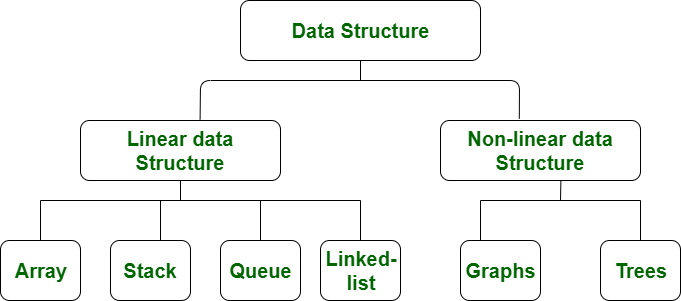
An Array is like a row of numbered boxes. Each box holds one piece of data, and you can instantly access any box just by knowing its number (or index). This makes them great for quick lookups. The main catch is that you usually have to decide the number of boxes you need ahead of time.
A Linked List is more like a scavenger hunt. Each piece of data contains a clue that points to the next piece. This forms a chain. Unlike arrays, linked lists can easily grow or shrink as you add or remove items, making them more flexible.
A Stack follows the "Last-In, First-Out" (LIFO) principle. Imagine a stack of plates. You put a new plate on top, and when you need a plate, you take the one from the top. The last plate you added is the first one you remove. The 'Undo' function in a text editor is a perfect example of a stack.
A Queue is the opposite. It's "First-In, First-Out" (FIFO), just like a line at a checkout counter. The first person to get in line is the first person to be served. Queues are often used in computing to manage tasks, like print jobs sent to a printer.
Finally, we have structures that represent connections.
A Tree is a hierarchical structure, like a family tree or an organizational chart. It starts with a single 'root' node at the top, which branches out into 'child' nodes, which can have their own children, and so on. File systems on your computer are often organized as a tree.
A Graph is a more general structure made of nodes (or vertices) connected by edges. Think of a social network, where each person is a node and a 'friendship' is an edge connecting two nodes. A road map is another great example of a graph, with cities as nodes and roads as edges.
Understanding these basic building blocks is the first step toward writing powerful and efficient C programs. Each one offers a different set of trade-offs, and learning when to use each is a key skill for any developer.
Why is choosing the right data structure crucial when writing a program?
You are designing a system to manage print jobs. The first job sent to the printer should be the first one to be printed. Which data structure is best suited for this task?