Mastering Data in Ruby on Rails
MVC and ORM Basics
Organizing Your Code
When building an application, it’s easy for code to become a tangled mess. Ruby on Rails prevents this by using a design pattern called Model-View-Controller, or MVC. It’s a way of separating your code into three distinct jobs, making everything easier to build, debug, and update.
Think of it like a restaurant.
-
Model: This is the kitchen. It handles all the data and the business logic. It talks to the database, processes information, and enforces the rules of the application. The kitchen doesn't care what the food looks like on the plate; it just prepares it correctly.
-
View: This is the plated meal presented to the customer. It’s what the user sees and interacts with—the user interface (UI). The view’s only job is to display the data it receives. It doesn’t do any heavy thinking or data processing.
-
Controller: This is the waiter. When a customer (user) makes a request, the waiter takes the order and passes it to the kitchen (Model). Once the food is ready, the waiter brings the plated meal (View) back to the customer. The controller acts as the intermediary, directing traffic between the Model and the View.
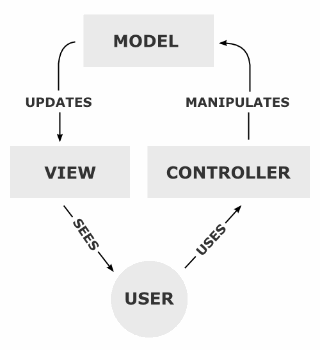
This separation keeps your code organized. If you need to change how data is stored, you look in the Model. If you want to change a button's color, you go to the View. This clarity is a core strength of Rails.
Talking to the Database
So, the Model is in charge of data. But there's a small problem: our application is written in Ruby, and databases traditionally speak a different language called SQL. How do we bridge this communication gap without forcing our Ruby code to write raw SQL?
Rails uses a technique called Object-Relational Mapping (ORM). An ORM is like a translator that allows us to interact with database tables as if they were simple Ruby objects. The specific ORM that Rails uses is called .
With Active Record, you don't write SQL queries. You call methods on your Ruby objects, and Rails translates them into SQL behind the scenes.
Databases as Spreadsheets
The easiest way to think about a database table is as a simple spreadsheet. Each table is a sheet, each row is a unique item, and each column is a specific attribute of that item.
For example, if we have a users table to store information about our app's users, it would look like this:
| id | username | |
|---|---|---|
| 1 | alice | alice@example.com |
| 2 | bob | bob@coolmail.com |
| 3 | charlie | charlie_p@domain.net |
In Rails, the entire users table would be represented by a User model. A single user, like Alice (row 1), would be a Ruby object. You could access her email with simple code like user.email instead of writing a database query.
This works because of a core Rails philosophy called .
Rails automatically links a singular class name (like User) to its pluralized database table name (users). You don't have to write any code to connect them; it just works. This saves a lot of setup time and makes the code predictable.
Time to check your understanding of these core concepts.
In the MVC pattern, which component is responsible for handling user requests and acting as an intermediary between the other two components?
If a developer needs to change the color of a button on a webpage, in which part of the MVC structure would they make the change?
Understanding MVC, Active Record, and Convention over Configuration is the first big step. These ideas form the foundation for everything else you'll build in Rails.