Mastering Curriculum Design
Defining Niche and Objectives
Finding Your Niche
A great course doesn't just teach a topic; it solves a specific problem for a specific group of people. The first step is to find where your expertise meets an unmet need. This process is often called , but it’s less about spreadsheets and more about listening.
Start by looking at existing courses in your field. What topics are covered repeatedly? What questions are learners asking in forums, social media groups, or comment sections that aren't being answered well? These unanswered questions are your entry points. Instead of creating another general "Introduction to Graphic Design" course, you might notice a flood of questions about creating compelling infographics for non-profits. That's a niche.
Your niche is the specific, high-value problem you are uniquely positioned to solve for a defined audience.
A strong niche has three components:
- A specific audience: Who are you teaching? (e.g., freelance writers, not just "writers").
- A specific problem: What pain point are you solving? (e.g., how to write effective sales copy, not just "how to write better").
- A specific outcome: What will they be able to do? (e.g., land their first three copywriting clients).
Writing Actionable Objectives
Once you've defined your niche, you need to translate it into clear goals. Vague objectives like "understand marketing" are useless for both you and the learner. Instead, we write measurable learning outcomes that describe what a student will be able to do after completing a lesson or the entire course.
The best tool for this is , a framework that classifies cognitive skills into different levels of complexity. Instead of using weak verbs like "know" or "learn," you'll use strong, action-oriented verbs that correspond to these levels.
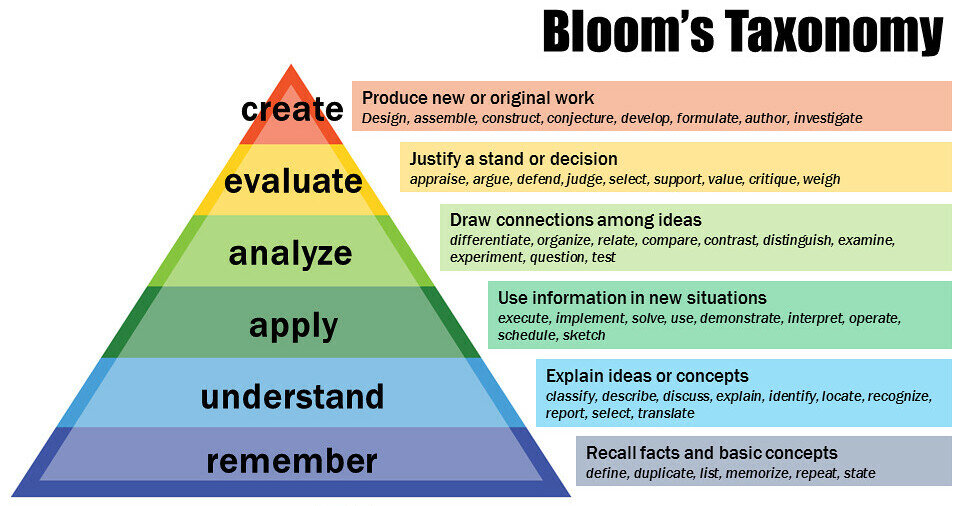
Let's apply this. Imagine your broad topic is "project management." You've narrowed your niche to "helping small business owners implement their first project management system." Now, let's write a few learning outcomes using Bloom's verbs (in bold).
| Level (Bloom's) | Weak Objective | Measurable Learning Outcome |
|---|---|---|
| Remembering | Know project management terms. | List the five phases of the project lifecycle. |
| Applying | Understand how to use tools. | Implement a basic project plan using a Trello board template. |
| Analyzing | See how projects succeed or fail. | Differentiate between tasks on the critical path and non-critical tasks. |
| Creating | Be good at project planning. | Design a project communication plan for a remote team. |
Well-defined learning objectives are the foundation of any successful online course.
Mapping Outcomes to Competencies
The final step is to ensure your learning outcomes connect directly to real-world, skills-based competencies. A competency is the combination of knowledge, skills, and abilities needed to perform a job or task effectively. Your course isn't just transferring information; it's building capability.
Map each learning outcome to a tangible skill that would be valuable in the workplace or a personal project. This not only clarifies the value of your course for potential students but also helps you design relevant activities and assessments. If your outcome is "Critique a marketing campaign's effectiveness," the corresponding competency is 'Marketing Performance Analysis'.
By linking outcomes to competencies, you move from an academic exercise to a practical training plan. Your course becomes a bridge that takes learners from where they are to where they want to be, equipped with skills they can immediately apply.
What is the primary purpose of a "market gap analysis" in the context of course creation?
Which of the following best represents a well-defined course niche, according to the three components mentioned in the text?