Mastering Creator Taxes and Business Compliance
Defining Your Creator Business
From Hobby to Business
When your creative passion starts earning money, the IRS takes notice. The key question they ask is whether you're running a business or a hobby. The difference determines how you report income and, more importantly, whether you can deduct your expenses. The answer hinges on your intent, or what the IRS calls “profit motive.”
If you operate with the intention of making a profit, you have a business. If you don't, it's a hobby.
The IRS uses a few factors to gauge your intent. You don't need to meet all of them, but they paint a picture of how seriously you're treating your creator activities. Behaving like a business is the best way to prove you are one.
| Factor | What It Means |
|---|---|
| Businesslike Manner | Do you keep separate, accurate books and records? Do you have a business bank account? |
| Time and Effort | Do you spend significant personal time and effort on the activity to make it profitable? |
| Dependence on Income | Do you rely on the income from this activity for your livelihood? |
| Losses | Are your losses due to circumstances beyond your control, or are they normal for the startup phase of your business? |
| Changing Methods | Do you change your methods of operation to improve profitability? |
| Expertise | Do you or your advisors have the knowledge needed to run the activity as a successful business? |
| Expectation of Profit | Do you expect to make a profit in the future from the appreciation of assets used in the activity? |
| Past Success | Have you been successful in making a profit in similar activities in the past? |
| History of Income | Does the activity have a history of making a profit? An activity is presumed for-profit if it made a profit in at least three of the last five tax years. |
If you're running a business, you'll report your income and expenses on a Schedule C, “Profit or Loss from Business.” This is where the work of keeping clean records pays off. The first step is to treat your business like a separate entity.
Open a separate bank account and get a credit card used only for business income and expenses. This separation is non-negotiable for clear record-keeping and tax preparation.
Understanding Your 1099s
As a business owner, you'll receive tax forms from platforms and clients that paid you. These are called 1099s, and they report your non-employee income to both you and the IRS.
However, the rules for when these forms must be sent have been in flux. For 2025 and beyond, the reporting landscape has stabilized.
One of the most common forms for creators is the 1099-K. This is sent by third-party payment networks like PayPal, Stripe, or Patreon. For the 2025 tax year (the return you file in 2026), the threshold for receiving a 1099-K reverts to the previous standard: you'll only get one if you received over $20,000 and had more than 200 transactions through a platform.
Crucially, you must report all income, whether you receive a 1099-K or not. If you earned 💲5,000 from a platform, that is taxable income. The 1099-K is just a reporting mechanism; it doesn't define what's taxable.
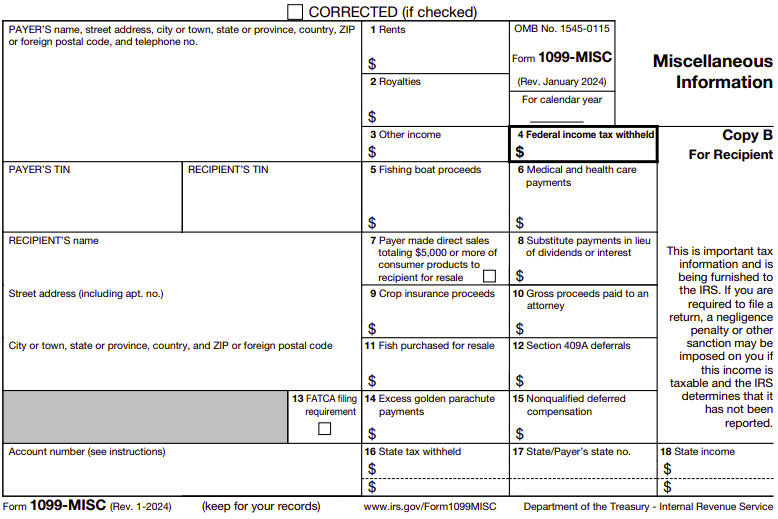
Other forms you might see are the 1099-NEC and 1099-MISC. The 1099-NEC is for nonemployee compensation, like a one-off payment from a brand for a sponsorship deal. The 1099-MISC is for other income like rents or royalties.
Beginning in 2026, the reporting threshold for both of these forms is set to increase to $2,000, up from the long-standing $600 threshold. This change accounts for inflation, but the rule remains the same: even if a client pays you $1,500 and doesn't send a 1099-NEC, you are still required to report that income.
Your business bank account is your source of truth. By tracking every dollar that comes in and goes out, you'll have the accurate records needed to file your Schedule C correctly, regardless of which 1099s you do or do not receive.
What is the primary factor the IRS uses to determine if your creative passion is a business or a hobby?
If your creative work is classified as a business, which IRS form is used to report your income and expenses?
Treating your creative work like a business from day one sets you up for financial clarity and helps you legally minimize your tax burden.