Mastering Core Concepts and Dimensions
Fundamental Physical Quantities
The Building Blocks of Measurement
In physics, we measure everything. From the stretch of a rubber band to the speed of light. But all these countless measurements can be broken down into just a few fundamental ingredients. These are called fundamental physical quantities.
Think of them as the primary colors of the physical world. By mixing them in different ways, we can describe any physical property.
To make sure a measurement means the same thing to a scientist in Tokyo as it does to one in Toronto, a global standard was created. It's called the International System of Units, or SI for short (from the French Système International d'Unités). This system defines a standard unit for each fundamental quantity. There are seven of them in total.
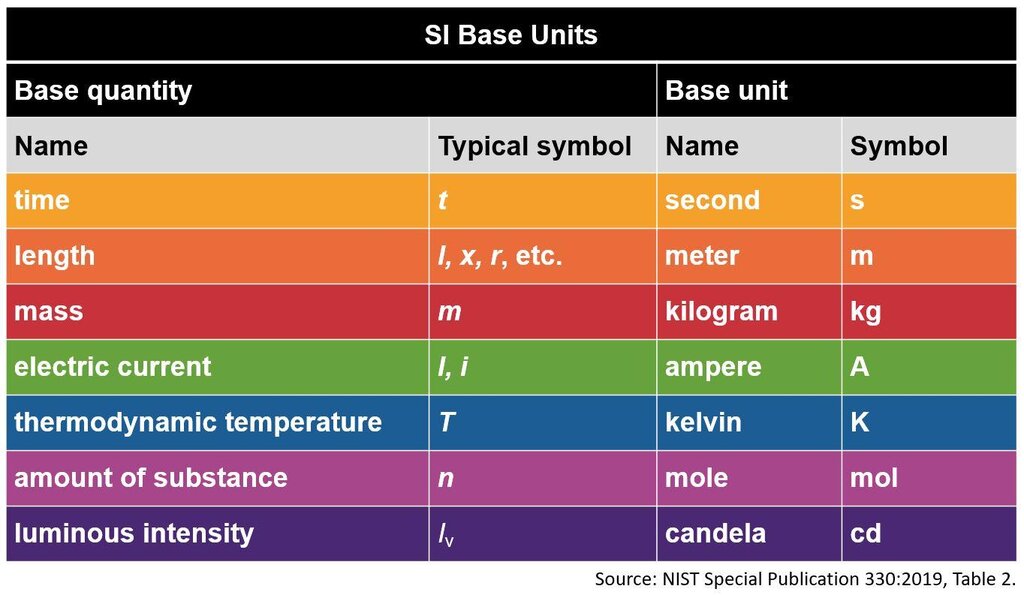
The Seven Fundamentals
Let's walk through each of these core concepts. Each one is independent and can't be expressed as a combination of the others.
Length
noun
A measure of distance or the extent of something from end to end.
This is the one we're most familiar with. How tall are you? How far away is the store? Both are questions of length. The standard unit is the meter (m).
Mass
noun
The amount of matter or "stuff" in an object.
Mass isn't the same as weight. Your mass is the same whether you're on Earth or the Moon. Your weight, which depends on gravity, would change. The base unit for mass is the kilogram (kg).
Time
noun
The indefinite continued progress of existence and events in the past, present, and future regarded as a whole.
Time measures the duration between two events. Its base unit is the second (s). Everything from a chemical reaction to a planet's orbit is measured in seconds or multiples of them.
Electric Current
noun
The rate of flow of electric charge.
Imagine water flowing through a pipe. Electric current is similar, but instead of water, it's the flow of tiny charged particles, like electrons. The unit for this is the ampere (A), often just called an "amp."
Temperature
noun
A measure of the average kinetic energy of the particles in a system.
In physics, temperature is about how much the atoms and molecules in something are moving or vibrating. The hotter something is, the faster its particles are moving. The SI unit is the kelvin (K). Unlike Celsius or Fahrenheit, the Kelvin scale starts at absolute zero ( K), the point where all particle motion theoretically stops.
Amount of Substance
noun
A measure of the number of elementary entities (like atoms or molecules) in an object or sample.
This can be tricky. It's not about mass or volume, but about counting particles. Just as a "dozen" always means 12, a mole (mol) always means the same number of particles: about . This is incredibly useful in chemistry.
Luminous Intensity
noun
The quantity of visible light that is emitted by a point source per unit of solid angle.
This is a measure of how bright a light source is in a particular direction. Think of it as the brightness of a single candle, which is where the name of its unit, the candela (cd), comes from.
Putting It All Together
These seven quantities form the bedrock of physics. Every other quantity we use, like speed (length divided by time) or force (mass times length divided by time squared), is derived from this basic set. Here is a quick summary:
| Fundamental Quantity | SI Base Unit | Symbol |
|---|---|---|
| Length | meter | m |
| Mass | kilogram | kg |
| Time | second | s |
| Electric Current | ampere | A |
| Thermodynamic Temperature | kelvin | K |
| Amount of Substance | mole | mol |
| Luminous Intensity | candela | cd |
Understanding these fundamentals is the first step toward describing the physical world accurately and consistently.