Mastering Computer Networking
Networking Basics
What is a Network?
At its core, a computer network is just a group of two or more computers linked together so they can communicate and share things. Think of it like a conversation. If you and a friend are in the same room, you can talk directly. If you want to include more friends, you need a way for everyone to hear each other and share information.
Networks exist for the same reason: to share. This could mean sharing a file, a printer, or an internet connection. Without networks, each computer would be an isolated island. With them, we can send emails, stream videos, and collaborate on projects from opposite sides of the world. The goal is always to make communication and resource sharing efficient and possible.
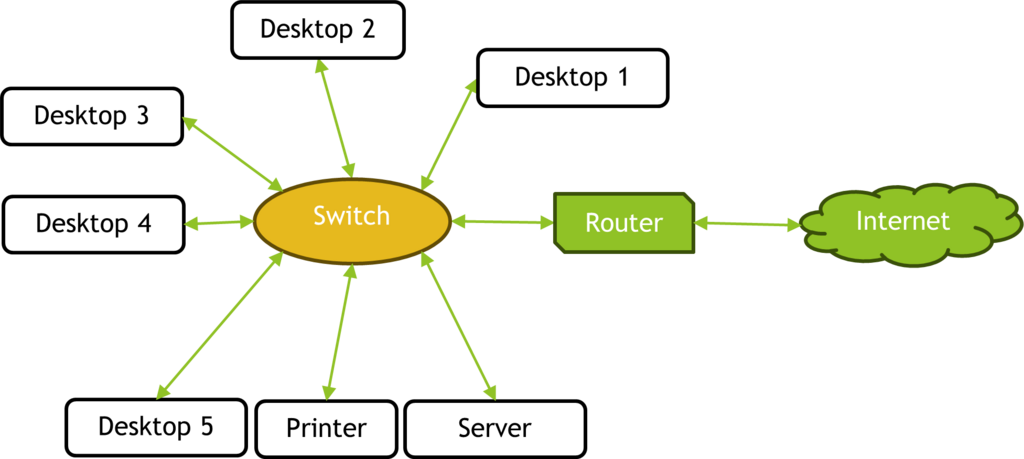
A network connects computers so they can share resources and information.
The Core Hardware
To make these connections happen, we need specialized hardware. While you might just see an ethernet cable or a Wi-Fi symbol, there are key devices working behind the scenes to direct the flow of information. Let's look at the three most common ones: hubs, switches, and routers.
Hub
noun
A simple networking device that connects multiple devices in a network. It broadcasts any data it receives to all connected devices, regardless of the intended recipient.
A hub is the most basic and least intelligent of these devices. Imagine a small room where one person shouts a message. Everyone in the room hears it, even if it was only meant for one person. A hub does the same with data. It takes an incoming message from one device and simply repeats it to every other device connected to it. This creates a lot of unnecessary traffic and can slow things down, which is why hubs are rarely used in modern networks.
A switch is a smarter version of a hub. Instead of shouting a message to everyone, a switch is like a postal worker in an office building. It knows which device lives at which port, so when a message comes in for a specific computer, the switch delivers it directly to that computer only. It doesn't bother the other devices on the network. This direct delivery makes the network much faster and more efficient than one using a hub.
Finally, we have the router. While switches create a network, routers connect networks. The most common job for a router is to connect your home or office network to the internet, which is itself a giant network of networks. A router acts as a dispatcher, looking at the destination of data and deciding the best path for it to take to get to another network. It’s what lets your computer talk to a server on the other side of the world.
Types of Networks
Networks also come in different sizes, depending on the area they cover.
LAN
noun
Stands for Local Area Network. It's a network that covers a small physical area, like a home, a single office building, or a school campus.
You likely interact with a LAN every day. If you have multiple devices connected to a single Wi-Fi router at home, you have a LAN. Because the devices are physically close, LANs are typically very fast and are privately owned and managed.
WAN
noun
Stands for Wide Area Network. It's a network that spans a large geographical area, such as a city, country, or even the entire globe.
A WAN is essentially a collection of interconnected LANs. The internet is the largest WAN in the world. Businesses also use WANs to connect their different office locations. If a LAN is like the road system within a single city, a WAN is the national highway system that connects all the cities together.
And what about wireless networks? A wireless local area network, or WLAN, is simply a LAN that uses radio waves (like Wi-Fi) to connect devices instead of physical cables. It offers the convenience of connecting without being tethered by wires, but it serves the same function as a wired LAN within a limited area.
Now let's check your understanding of these fundamental networking concepts.
What is the primary function of a router in a computer network?
A network device that receives a data packet from one computer and broadcasts it to every other computer on the network is called a ____.
Understanding these building blocks—the purpose of networks, the hardware that runs them, and the different scales they operate on—is the first step to seeing how our digital world is connected.