Mastering Complex Analysis
Complex Numbers
Beyond the Number Line
For a long time, mathematicians were stumped by a simple question: what is the square root of -1? On the familiar number line, there's no answer. Squaring a positive number gives a positive result, and squaring a negative number also gives a positive result. There's no real number that, when multiplied by itself, equals -1.
So, mathematicians invented one. They called it .
imaginary unit
noun
The number , defined as the principal square root of -1. It has the property that .
This new number, , doesn't live on the number line with numbers like 2, -5, or . It's something different. By combining this imaginary unit with the real numbers we already know, we create a new set of numbers called complex numbers.
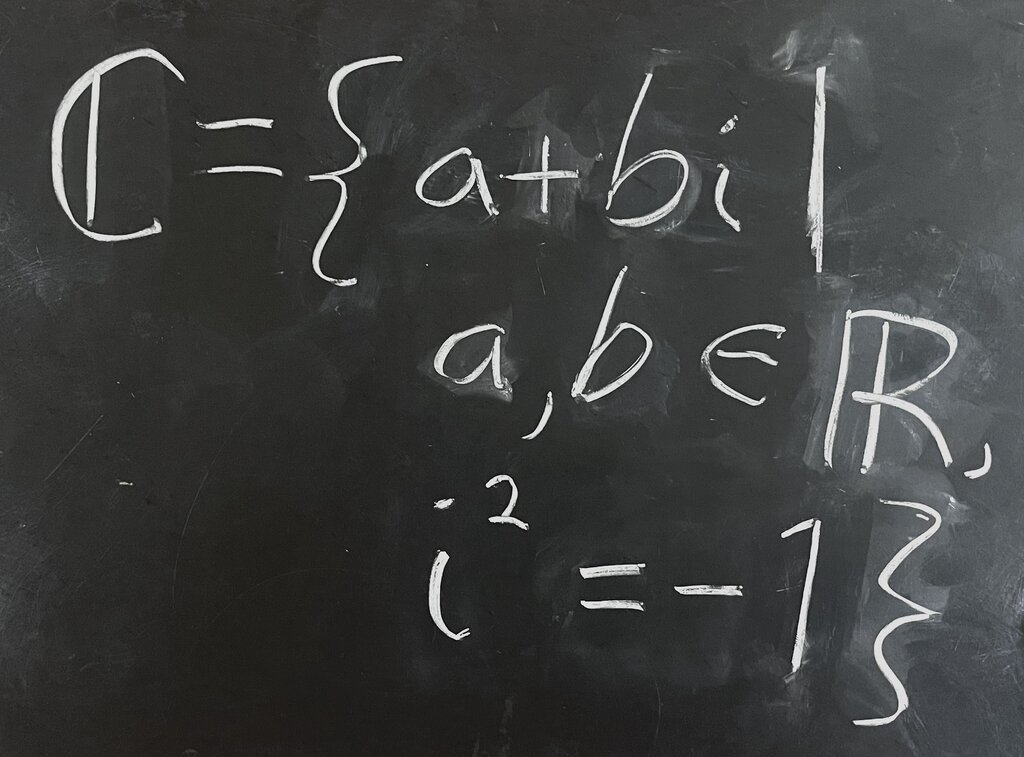
A complex number, typically written as , has the standard form:
Here, is the real part and is the imaginary part. Both and are just regular real numbers. For example, in the complex number , the real part is 3 and the imaginary part is 4.
Working with Complex Numbers
Doing arithmetic with complex numbers is straightforward. For addition and subtraction, you just combine the real parts and the imaginary parts separately. Think of as a variable like .
Addition: Subtraction:
For example, to add and , you add the real parts () and the imaginary parts (). The result is .
Multiplication works like multiplying two binomials in algebra, with one extra step: whenever you see an , you replace it with -1.
Division is a bit more clever. To divide complex numbers, we want to remove the imaginary part from the denominator. We do this by multiplying the top and bottom of the fraction by the complex conjugate of the denominator.
complex conjugate
noun
The complex conjugate of a complex number is . It is denoted as .
Let's see it in action. To compute , we multiply the numerator and denominator by the conjugate of the denominator, which is .
A New Perspective
Since a complex number has two parts (real and imaginary), we can't place it on a simple number line. Instead, we use a two-dimensional plane called the complex plane, also known as an Argand diagram. The horizontal axis is the real axis, and the vertical axis is the imaginary axis.
A complex number is plotted as the point .
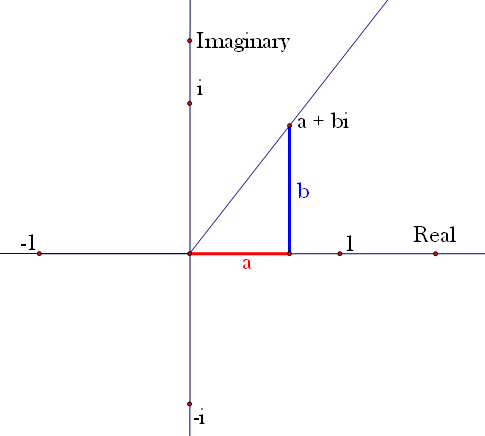
Looking at the number on a plane opens up a new way to describe it. Instead of using rectangular coordinates , we can use polar coordinates .
- is the distance from the origin to the point, called the modulus or magnitude. It's calculated using the Pythagorean theorem: .
- is the angle the line from the origin to the point makes with the positive real axis, called the argument.
This gives us the polar form of a complex number: .
This polar form is made even more elegant by a stunning relationship discovered by Leonhard Euler.
Euler's Formula:
This incredible formula connects the exponential function , trigonometric functions, and the imaginary unit. Using it, we can write any complex number in a very compact exponential form: .
This form is especially powerful for multiplication and division. To multiply two complex numbers, you multiply their moduli and add their arguments. To divide, you divide their moduli and subtract their arguments.
Let's check your understanding of these new numbers.
What fundamental problem in mathematics led to the invention of the imaginary unit, ?
What is the sum of the complex numbers and ?
Complex numbers provide a richer mathematical landscape, allowing us to solve problems that are impossible using only real numbers. They are a fundamental tool in fields like engineering, physics, and signal processing.