Mastering Competitive Analysis
Competitive Analysis Basics
What is Competitive Analysis?
Competitive analysis is the process of identifying your competitors and evaluating their strategies. Think of it like a sports team studying game film of their opponents. They're not just watching for fun; they're looking for patterns, strengths, and weaknesses they can use to their advantage in the next match. Similarly, businesses use competitive analysis to understand the market landscape and find their own unique edge.
Competitive analysis, the process of evaluating your rivals to uncover strengths, weaknesses, and opportunities, lays the foundation for strategic positioning.
The main goal isn't to copy what others are doing. It's to gather intelligence. This information helps you spot gaps in the market, anticipate moves your competitors might make, and discover threats before they become problems. By understanding what everyone else offers, you can better define what makes your business special.
A Cornerstone of Strategy
Without understanding the competition, a business is flying blind. Strategic planning requires a clear view of the entire playing field. Competitive analysis provides the context needed to make smart, informed decisions. It influences nearly every part of a business plan, from product development and pricing to marketing and customer service.
For example, if you find that all your competitors serve a high-end market, you might see an opportunity to offer a more affordable alternative. Or, if you notice a competitor has poor customer reviews, you can make superior customer service a central part of your strategy. This process transforms guesswork into a calculated plan for positioning your business to win.
Key Components
A good competitive analysis is built on a few core activities. Each one provides a different piece of the puzzle.
Market Research: This is the big picture. Before you can analyze individual competitors, you need to understand the market as a whole. This includes identifying industry trends, understanding customer needs, and sizing up the total market opportunity.
Competitor Profiling: Once you know the landscape, you can zoom in on the other players. This involves creating profiles for your key competitors. Who are they? What products or services do they sell? What are their prices? How do they market themselves? Answering these questions helps you compare your business directly against others.
| Feature | Competitor A | Competitor B | Our Company |
|---|---|---|---|
| Pricing | High-end | Budget | Mid-range |
| Target Audience | Businesses | Students | Families |
| Key Feature | Speed | Simplicity | Customer Support |
| Marketing | Social Media Ads | Campus Events | Content Marketing |
SWOT Analysis: After gathering all this information, you need a way to organize it. A SWOT analysis is a simple framework for doing just that. It stands for Strengths, Weaknesses, Opportunities, and Threats.
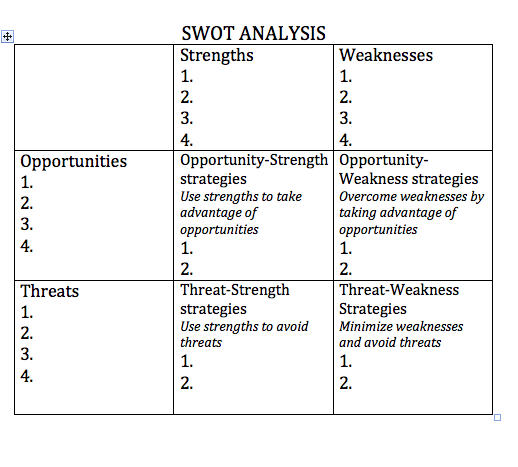
Strengths and weaknesses are internal factors, things you can control. For example, a strong brand reputation is a strength, while an outdated website is a weakness. Opportunities and threats are external factors, things happening in the market. A new technology could be an opportunity, while a new competitor entering the market is a threat. This framework helps you turn raw data into actionable insights.
Now that you understand the basics, let's test your knowledge.
What is the primary purpose of conducting a competitive analysis?
In a SWOT analysis, a competitor launching a new, innovative product would be classified as a(n) __________.
Understanding these core concepts is the first step toward building a powerful business strategy.