Mastering Close-Quarters Boxing Combat
Advanced Stances
Beyond the Basics
Your stance is your home base in the ring. It's the platform for every punch, block, and step you take. While the orthodox stance provides a solid, all-around foundation, elite fighters fluidly adjust their base to suit the situation. Mastering advanced stances and the transitions between them adds a new layer of strategy to your game.
Your stance is the foundation of your power, defense, and movement.
Let's explore two key variations: the bladed stance and the square stance. Each offers distinct advantages and trade-offs, and knowing when to use them can give you a crucial edge.
The Bladed Stance
Imagine turning your body sideways to an opponent, presenting the smallest possible target. That's the essence of the bladed stance. This stance emphasizes defense and mobility. By turning your lead shoulder and hip much further toward your opponent, you create a narrow profile that's difficult to hit cleanly. Your centerline, protecting your chin and torso, is much less exposed.
The bladed stance is perfect for an outside fighter. It enhances the reach of your jab, turning it into an even more effective tool for controlling distance. Your lead hand acts like a fencer's foil, probing and disrupting your opponent's rhythm. Because your feet are more in-line, it also promotes quick in-and-out movement. The downside? It can compromise your balance slightly and makes it harder to generate maximum power in your rear hand, as your hips are already turned.
The Square Stance
Now, let's look at the opposite approach. The square stance involves opening your hips and shoulders more toward your opponent. Your feet are positioned wider, more parallel to each other than in a standard stance. This provides a supremely stable base. Think of a brawler who wants to plant their feet and trade powerful punches.
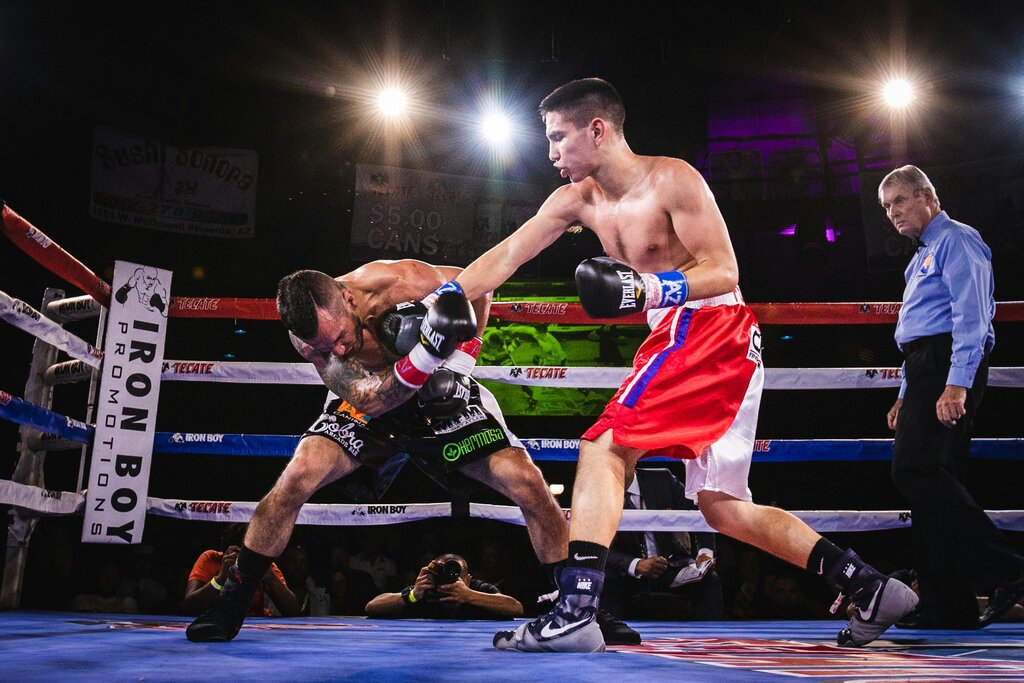
The main advantage is power generation. With your hips already open, you can rotate into hooks and uppercuts with explosive force. This stance is ideal for infighting, where mobility is less important than the ability to deliver devastating shots in tight spaces. You have more balance and are harder to push around.
Of course, there's a trade-off. A square stance presents a much larger target. Your centerline and entire torso are more exposed, making you more vulnerable to straight punches and body shots. It also makes linear, in-and-out movement more cumbersome.
Seamless Transitions
The true art lies not in picking one stance, but in flowing between them. A fight is dynamic. You might start in a bladed stance from a distance, using your jab to control the pace. If your opponent crashes inside, you can't stay bladed; you'd be off-balance and unable to punch effectively.
This is where you transition. With a subtle pivot of your feet and rotation of your hips, you shift from a bladed stance to a more square, stable base. Now you're in a position to fight on the inside, unleashing hooks and uppercuts. As you create space again, you can pivot back into a bladed stance to re-establish distance and defense.
Think of it like shifting gears in a car. You use different stances for different speeds and terrains. The goal is to make these transitions smooth, reflexive, and purposeful.
Practicing these shifts is key. Drill pivoting from one stance to another. Shadowbox while consciously changing your stance as you imagine different combat scenarios. This adaptability will make you a far more versatile and unpredictable fighter, able to control the engagement no matter where it takes place.
Ready to test your knowledge?
What is the primary defensive advantage of a bladed stance?
Which stance is most suitable for a fighter who wants to generate maximum power for hooks and uppercuts, especially in close range?
By incorporating these advanced stances and, more importantly, the transitions between them, you elevate your ringcraft from simple punching to strategic positioning.