Mastering Claude for Code Enhancement
Advanced Prompt Engineering
Moving Beyond Basic Instructions
You already know how to give an AI code assistant basic instructions. Now, it's time to elevate that conversation. Advanced prompting is less about giving commands and more about guiding the AI to reason, learn from examples, and adopt specific perspectives. This turns the AI from a simple tool into a proactive, expert-level partner.
Chain-of-Thought Prompting
Chain-of-Thought (CoT) prompting encourages the AI to break down a problem and explain its reasoning process before giving a final answer. Instead of just asking for a solution, you ask it to "think out loud." This forces a more logical, step-by-step approach, which often leads to more accurate and reliable code.
By seeing the AI's reasoning, you can spot flawed logic early and guide it back on track. It's like asking a colleague to walk you through their thought process.
Consider a situation where you need to refactor a Python function for better performance. A basic prompt might just ask for the final code.
# Basic Prompt
# Refactor this function to be more efficient.

def process_data(data_list):
    new_list = []
    for item in data_list:
        if item not in new_list:
            new_list.append(item)
    return new_list
This might work, but it doesn't give you any insight. A CoT prompt asks for the how and why.
# CoT Prompt
# Refactor the following function for better performance.
# First, identify the primary performance bottleneck and explain why it's inefficient.
# Then, suggest a more suitable data structure and explain your choice.
# Finally, provide the refactored code with comments.

def process_data(data_list):
    new_list = []
    for item in data_list:
        if item not in new_list:
            new_list.append(item)
    return new_list
This approach compels the AI to analyse the in operator's inefficiency with lists (an O(n) operation inside a loop, leading to O(n²) complexity) and suggest using a set for its O(1) average time complexity for lookups. The resulting code is not only better, but you also get a clear explanation of the improvement.
Few-Shot Learning
Few-shot learning is a technique where you provide the AI with several examples of what you want it to do. By showing it a few input-output pairs, you guide it to recognise a pattern and apply it to new inputs. This is incredibly useful for formatting tasks or adhering to specific coding styles where you need consistency.
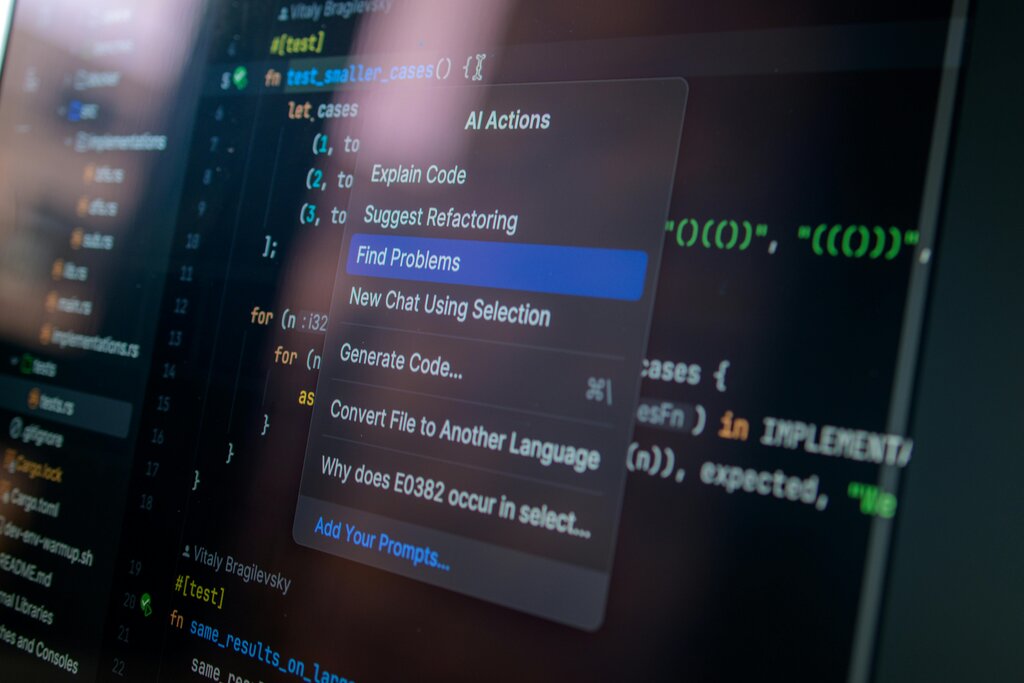
Imagine you want to standardise your function documentation from a simple comment to a specific docstring format. You can provide a few examples to teach the AI the pattern.
# Convert the following function comments to Google-style docstrings.

# Example 1
# Input:
# calculates the sum of two numbers
def add(a, b):
    return a + b

# Output:
"""Calculates the sum of two numbers.

Args:
    a: The first number.
    b: The second number.

Returns:
    The sum of a and b.
"""

# Example 2
# Input:
# splits a string by a delimiter
def split_string(text, delimiter):
    return text.split(delimiter)

# Output:
"""Splits a string by a delimiter.

Args:
    text: The string to split.
    delimiter: The character to split on.

Returns:
    A list of substrings.
"""

# Now, convert this one:
# Input:
# finds the largest element in a list
def find_max(elements):
    # implementation here
By providing these examples, the AI learns the structure you expect—the summary line, the Args section, and the Returns section. Its output for the find_max function will now reliably follow the same pattern.
Role and Recursive Prompting
Role prompting involves assigning a specific persona to the AI to tailor its output. Instead of a generic code assistant, you can ask it to act as an expert in a particular field. This primes the model to use specific terminology, prioritise certain concerns (like security or performance), and generate code that aligns with a professional standard.
You are a senior database administrator focused on query optimisation. Review this SQL query and suggest improvements for performance on a large dataset.
This prompt will yield a more specialised response than simply asking to "improve this query." The AI will likely focus on index usage, join strategies, and avoiding full table scans.
Recursive prompting takes this a step further by using the AI's output as the input for a subsequent prompt. It's a method for iterative refinement. You can start with a broad request and progressively narrow down and improve the result.
This iterative loop allows you to build complex, high-quality code. You might first generate a function, then ask the AI to write unit tests for it, then ask it to add documentation, and finally ask it to refactor everything for clarity. Each step builds upon the last, leading to a more polished final product.
What is the primary goal of using Chain-of-Thought (CoT) prompting when asking an AI to solve a coding problem?
You need to convert several code snippets from one documentation style to another, very specific format. Which technique is best suited for teaching the AI this exact format?
These advanced techniques transform your interaction with AI from simple question-and-answer to a collaborative design process. By mastering them, you can guide the AI to produce code that is not just functional, but also robust, efficient, and well-documented.