Mastering Classical Arabic
Arabic Script
The Arabic Script
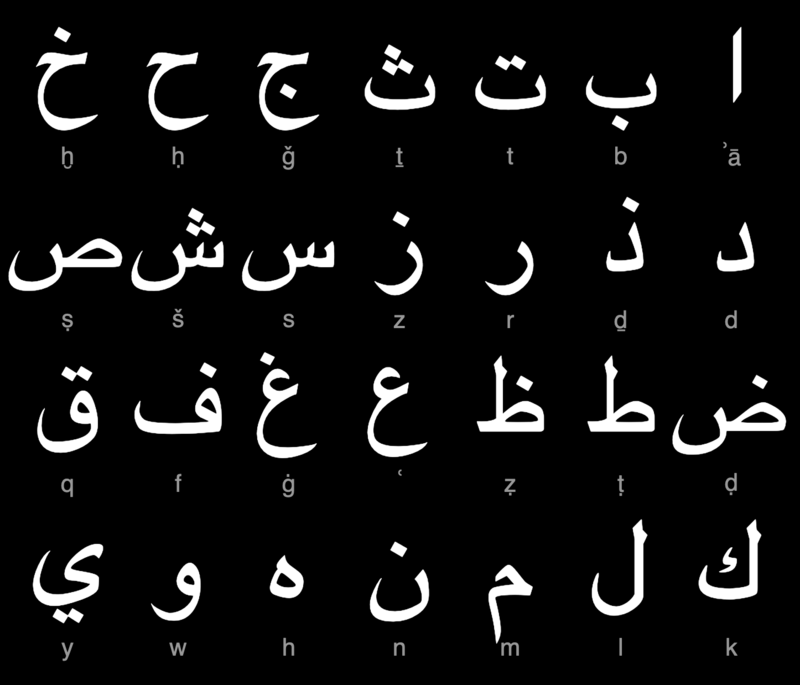
The Arabic script is the foundation of the language. It consists of 28 letters and is written from right to left. Unlike the Latin alphabet, Arabic is an abjad, which means that each letter primarily represents a consonant. Vowels are typically marked with small symbols above or below the letters, though they are often omitted in everyday writing.
Letters Change Shape
One of the most important features of Arabic script is that the shape of a letter changes depending on its position in a word. Most letters connect to the one following them, creating a flowing, cursive style. Because of this, each letter has up to four distinct forms:
- Isolated: When the letter stands alone.
- Initial: When it's at the beginning of a word.
- Medial: When it's in the middle of a word.
- Final: When it's at the end of a word.
Let's look at the letter Bā' (ب) as an example. It's a simple curve with a dot below it. Notice how it adapts to connect to its neighbors.
| Form | Shape | Example Word | Meaning |
|---|---|---|---|
| Isolated | ب | أَب (ab) | father |
| Initial | بـ | بَيْت (bayt) | house |
| Medial | ـبـ | كَبِير (kabīr) | big |
| Final | ـب | كِتَاب (kitāb) | book |
While most letters connect on both sides, a small group of six letters only connect to the letter before them. They never connect to the letter that follows. These are often called "one-way connectors."
The six one-way connectors are: ا (alif), د (dāl), ذ (dhāl), ر (rā’), ز (zāy), and و (wāw).
When one of these letters appears in a word, it creates a break in the connection, and the next letter starts in its initial form.
Marking the Vowels
So, if the alphabet is all consonants, how do you know which vowels to use? Arabic uses small diacritical marks called ḥarakāt (حَرَكَات) to indicate short vowels. These are essential for beginners and are always included in the Qur'an and children's books to ensure correct pronunciation.
ḥarakāt
noun
The diacritical marks used in Arabic to represent short vowels and other phonetic features.
There are three main short vowel marks:
| Mark | Name | Sound | Example | Pronunciation |
|---|---|---|---|---|
| ◌َ | fatḥah | 'a' | بَ (ba) | /ba/ |
| ◌ُ | ḍammah | 'u' | بُ (bu) | /bu/ |
| ◌ِ | kasrah | 'i' | بِ (bi) | /bi/ |
Another important mark is the sukūn (◌ْ), which indicates the absence of a vowel after a consonant. For example, in the word بَيْت (bayt), the sukūn would be placed over the ي (y) to show it makes a 'y' sound and not 'ya', 'yu', or 'yi'.
Special Combinations
Sometimes, two letters combine to form a special shape called a ligature. The most common ligature in Arabic involves the letter Lām (ل) followed by Alif (ا). Instead of being written as لـا, they merge into a single, unique character: لا.
This is the only mandatory ligature. While other letter combinations can have stylistic variations, the Lām-Alif is a fundamental part of writing Arabic correctly.
Now, let's test your understanding of these core concepts.
The Arabic script is described as an abjad. What does this primarily mean?
What is the primary reason that most Arabic letters have up to four different shapes?
Mastering the script is the first major step in learning Arabic. With practice, recognizing the letter forms and vowel marks will become second nature.