Mastering Class 9 Computer Systems
Von Neumann Architecture
The Blueprint of Modern Computers
At the heart of nearly every computer, smartphone, and tablet is a fundamental design principle known as the Von Neumann architecture. Proposed by the brilliant mathematician in the 1940s, this model revolutionised computing by introducing one core idea: program instructions and the data they use should be stored in the same memory. Before this, changing a computer's task often meant physically rewiring it!
This architecture breaks a computer down into a few essential components that work together. Think of it as a logical map rather than a physical one.
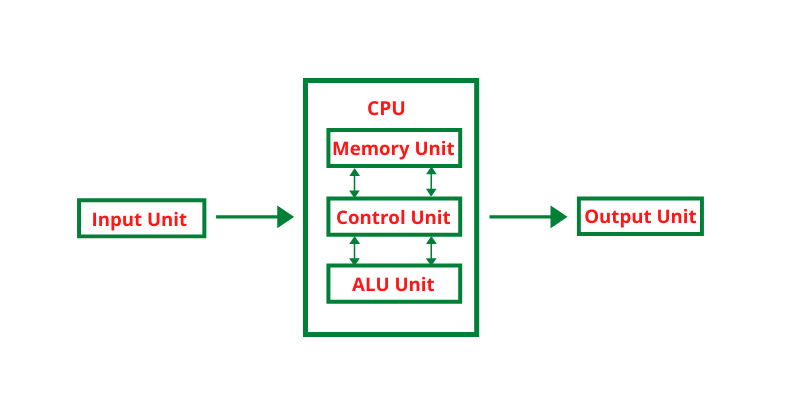
The main parts are:
- Input Unit: How we give the computer information (keyboard, mouse).
- Output Unit: How the computer gives us information back (monitor, speakers).
- Memory Unit: Where both instructions and data are stored.
- Central Processing Unit (CPU): The brain of the operation, which does the actual thinking.
Inside the CPU
The CPU itself is not a single entity. It's made up of two primary components: the Control Unit (CU) and the Arithmetic Logic Unit (ALU). They are connected by a series of electrical pathways called a , which acts like a highway system for data.
The Control Unit (CU) is the director. It doesn't perform any calculations itself. Instead, it fetches instructions from memory and tells the other parts of the computer what to do. It manages the flow of data, ensuring everything happens in the right order and at the right time.
The Arithmetic Logic Unit (ALU) is the calculator and decision-maker. It handles two types of operations:
- Arithmetic: All the basic maths like addition, subtraction, multiplication, and division.
- Logic: Comparisons, such as determining if one number is greater than, less than, or equal to another. These logical operations are the foundation of all decision-making in programs.
The CU directs the symphony, while the ALU plays the notes.
To manage its tasks, the CPU uses a small number of extremely fast memory locations called registers. Each register has a specific job.
| Register | Full Name | Purpose |
|---|---|---|
| PC | Program Counter | Holds the memory address of the next instruction to be executed. |
| MAR | Memory Address Register | Holds the address of the memory location to be accessed (read from or written to). |
| MDR | Memory Data Register | Temporarily stores data being transferred to or from memory. |
| AC | Accumulator | Stores the results of calculations made by the ALU. |
| IR | Instruction Register | Holds the current instruction while it is being decoded and executed. |
The Fetch-Decode-Execute Cycle
So how do all these parts work together to run a program? They follow a relentless, fundamental process called the fetch-decode-execute cycle. This cycle is the heartbeat of the CPU, repeating millions or even billions of times per second. The speed at which it repeats is determined by the computer's ..
This process has three main steps:
-
Fetch: The Control Unit gets the next instruction from the memory location pointed to by the Program Counter (PC). It puts this instruction into the Instruction Register (IR). After fetching, the PC is updated to point to the next instruction.
-
Decode: The CU examines the instruction in the IR. It figures out what operation needs to be performed and what data is needed. It's like a translator, turning the program's code into actions the CPU can understand.
-
Execute: The instruction is finally carried out. This might involve the ALU performing a calculation, data being moved from one place to another, or a decision being made. The result of any calculation is often stored in the Accumulator.
This simple, elegant cycle is the engine that drives all software, from the operating system that boots your computer to the most complex video game you play.
Let's check your understanding of these core concepts.
What is the defining principle of the Von Neumann architecture?
Which component of the CPU is responsible for performing mathematical calculations like addition and subtraction?
This architectural model forms the basis of how we've built computers for over 70 years, providing a powerful and flexible way to turn simple instructions into complex tasks.