Mastering Class 11 Hydrocarbons
Alkane Structure and Isomerism
The Architecture of Alkanes
Alkanes are the simplest family of organic compounds, consisting only of carbon and hydrogen atoms connected by single bonds. This simple fact has profound consequences for their shape. Each carbon atom in an alkane is bonded to four other atoms. To achieve this, it uses a process you might recall called hybridization.
Specifically, alkanes exhibit , where one s orbital and three p orbitals on the carbon atom blend to form four identical hybrid orbitals. These orbitals arrange themselves in a tetrahedral geometry to be as far apart as possible, creating bond angles of approximately 109.5°. This tetrahedral arrangement is the fundamental building block of all alkanes, from the simplest methane molecule () to complex branched structures.
Naming the Family
As alkane chains get longer and acquire branches, we need a systematic way to name them. The International Union of Pure and Applied Chemistry, or IUPAC, provides the rules. The core idea is to identify the longest continuous chain of carbon atoms and name any branches attached to it.
The IUPAC system follows a simple logic: parent chain + substituents. Everything else is just detail.
Let's break down the process:
-
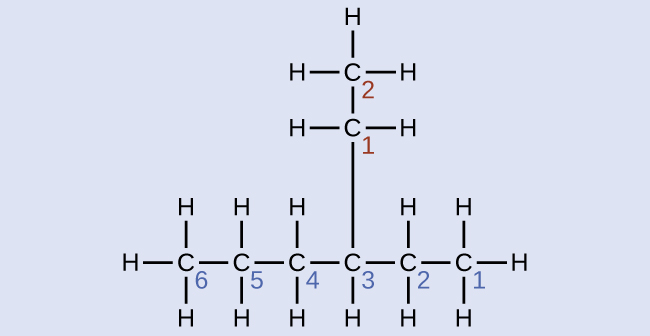
Find the Parent Chain: Identify the longest continuous chain of carbon atoms. This chain gives the base name of the alkane (e.g., hexane for 6 carbons, heptane for 7).
-
Number the Chain: Number the carbons in the parent chain starting from the end that gives the substituent groups the lowest possible numbers.
-
Name the Substituents: Name the branches, which are called alkyl groups. These are named by replacing the "-ane" ending of the corresponding alkane with "-yl" (e.g., methane becomes methyl, ethane becomes ethyl).
-
Assemble the Name: List the substituents alphabetically, preceded by their position number. If the same substituent appears more than once, use prefixes like di-, tri-, or tetra-. These prefixes are ignored for alphabetization.
| Alkane | Formula | Alkyl Group | Formula |
|---|---|---|---|
| Methane | Methyl | ||
| Ethane | Ethyl | ||
| Propane | Propyl | ||
| Propane | Isopropyl | ||
| Butane | Butyl |
Same Formula, Different Shapes
Things get interesting when a single molecular formula can represent more than one distinct compound. These compounds are called isomers—they share the same number and types of atoms but have different arrangements. Alkanes exhibit a type of isomerism called structural isomerism.
isomer
noun
Compounds that have the same molecular formula but different arrangements of atoms in space.
There are two main types you'll encounter with alkanes:
- Chain Isomerism: This occurs when the carbon skeleton is arranged differently. For example, can be a straight chain (butane) or a branched chain (2-methylpropane, also known as isobutane).
- Position Isomerism: This happens when a functional group or substituent is attached at a different position on the same carbon chain. For example, in 1-chloropropane the chlorine is on an end carbon, while in 2-chloropropane it's on the middle carbon.
Rotation and Energy
The single bonds (sigma bonds) in alkanes allow for free rotation around the carbon-carbon axis. This means a molecule like ethane () isn't static; it can exist in many different rotational arrangements, called conformations. We can visualize these using Sawhorse and Newman projections.
A Sawhorse projection views the C-C bond from an oblique angle, showing all the atoms and their spatial arrangement.
A Newman projection is more abstract. It views the molecule directly down the C-C bond axis. The front carbon is a dot, and the back carbon is a circle. The bonds attached to each are shown as lines originating from the dot or the edge of the circle.
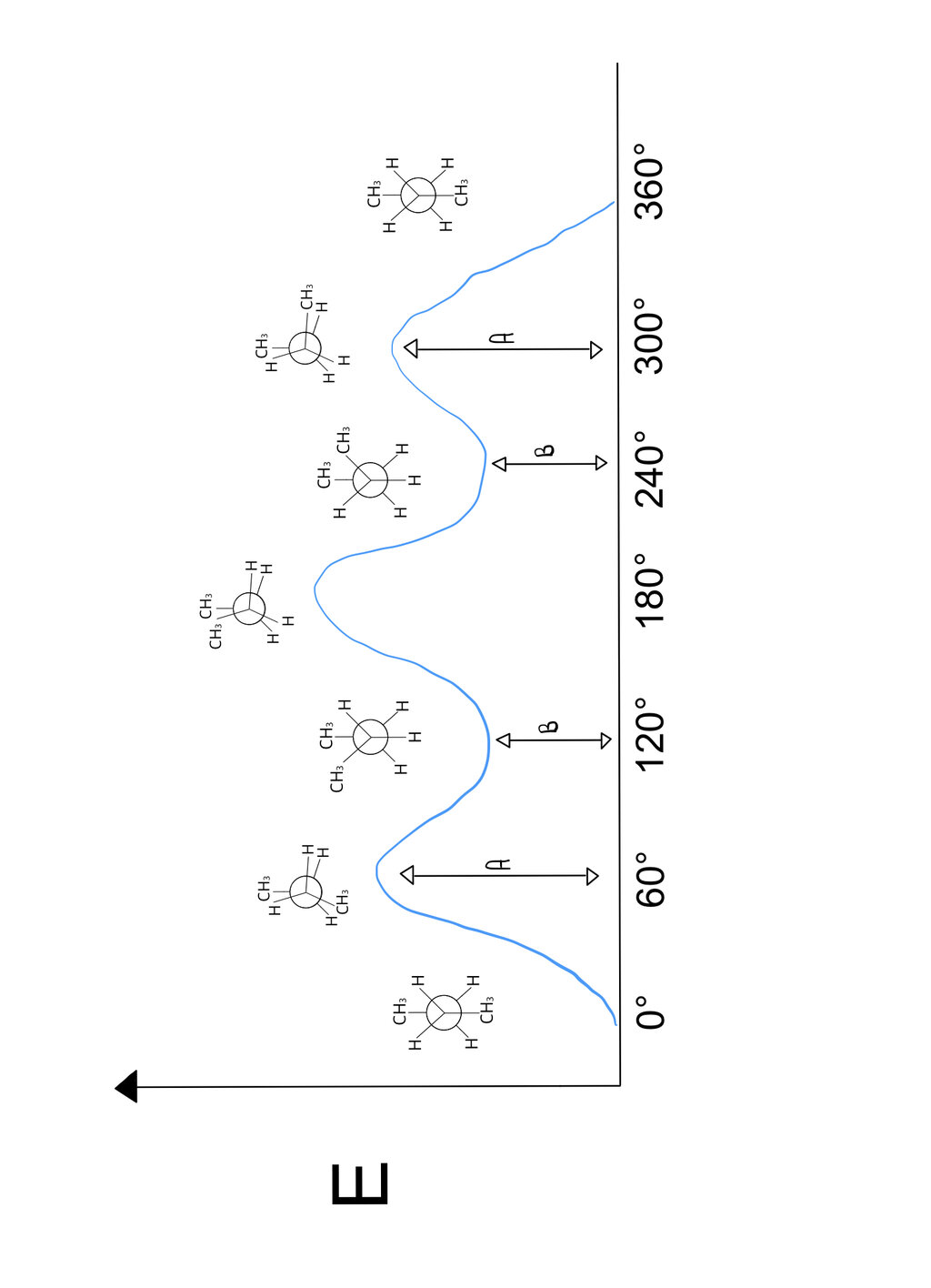
Not all conformations are created equal. The two most important are:
-
Staggered: The hydrogen atoms on the front carbon are positioned exactly between the hydrogen atoms on the back carbon. This is the most stable, lowest-energy conformation.
-
Eclipsed: The hydrogen atoms on the front carbon are directly in front of the hydrogen atoms on the back carbon. This is the least stable, highest-energy conformation.
The energy difference arises from torsional strain, which is the repulsion between the electron clouds of the C-H bonds on adjacent carbons. In the eclipsed conformation, these bonds are as close as possible, maximizing repulsion and raising the energy of the molecule. The staggered form minimizes this repulsion. The energy barrier to rotate from one staggered form to the next is small, about 12 kJ/mol, so at room temperature, ethane molecules are constantly rotating.
What type of hybridization do carbon atoms in alkanes exhibit, and what is the resulting molecular geometry around each carbon?
According to IUPAC rules, what is the first step when naming a branched alkane?
Understanding these basic principles of structure, naming, and conformation is the key to mastering the chemistry of hydrocarbons.