Mastering Class 10 NCERT Science
Chemical Reactions
The Language of Reactions
Chemical reactions are happening all around you, constantly. They are the processes that cook your food, power your phone, and even keep you alive. To understand and control these processes, we need a way to describe them precisely. We use chemical equations for this. They are like recipes, showing the ingredients (reactants) and the final dish (products).
Consider the combustion of methane, the main component of natural gas. You start with methane () and oxygen () and end up with carbon dioxide () and water (). But just listing the ingredients isn't enough. We must account for every single atom. This is because of a fundamental rule: the . It states that matter cannot be created or destroyed in a chemical reaction. The atoms you start with must all be present at the end, just rearranged.
Here's the initial, unbalanced equation for methane combustion:
Let's balance it. We have one carbon atom on each side, which is good. But we have four hydrogen atoms on the left (in ) and only two on the right (in ). To fix this, we place a coefficient of 2 in front of , giving us two water molecules () and a total of four hydrogens.
Now, let's count the oxygen atoms. The left has two, but the right has two in and two more in , for a total of four. So, we place a 2 in front of the on the left side. The equation is now balanced.
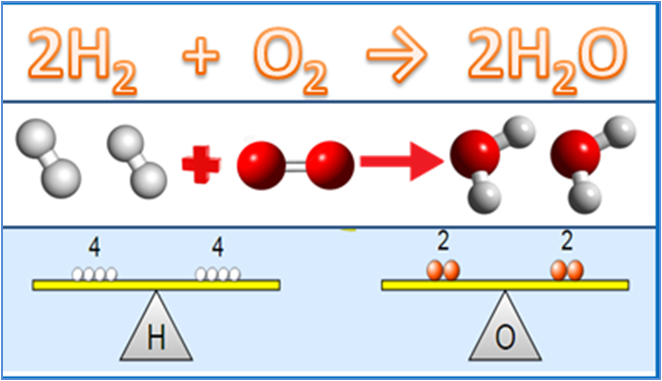
The coefficients in a balanced equation represent the ratio of moles, not the ratio of mass. So, 1 mole of methane reacts with 2 moles of oxygen.
Classifying Reactions
While there are countless reactions, most fall into a few main categories. Understanding these patterns helps us predict what will happen when substances are mixed.
Combination
noun
A reaction where two or more simple substances combine to form a single, more complex product.
A simple example is the burning of carbon to form carbon dioxide. Here, two elements join to create one compound.
Decomposition reactions are the reverse. A single compound breaks down into two or more simpler substances. This breakdown usually requires an input of energy, such as heat (thermal decomposition) or electricity (electrolytic decomposition).
For example, passing electricity through water breaks it down into hydrogen and oxygen gas.
Moving on, Displacement reactions occur when a more reactive element takes the place of a less reactive element in a compound. Think of it as someone cutting in on a dance. For this to happen, the element 'cutting in' must be higher on the activity series.
When a piece of iron is dropped into a copper sulphate solution, the iron displaces the copper.
Finally, Double Displacement reactions are like two dancing couples swapping partners. Two ionic compounds in a solution exchange ions, often forming an insoluble solid called a precipitate.
Energy and Electrons
Every chemical reaction involves changes in energy. Exothermic reactions release energy into the surroundings, usually as heat and light. Combustion is a classic example – burning wood warms you up because the reaction is releasing stored chemical energy.
Endothermic reactions do the opposite; they absorb energy from their surroundings, making them feel cold. An instant cold pack for sports injuries works because of an endothermic reaction inside it.
Beyond energy, many reactions involve the transfer of electrons. These are called reactions, a shorthand for reduction-oxidation. This is a crucial concept that explains everything from batteries to rusting.
A handy mnemonic is OIL RIG: Oxidation Is Loss (of electrons), Reduction Is Gain (of electrons).
In the displacement reaction we saw earlier, iron is oxidised (it loses electrons to become ) and copper is reduced (the ions gain electrons to become solid ).
Chemistry in Daily Life
Redox reactions are responsible for many familiar, and often undesirable, processes.
Corrosion is the gradual destruction of metals due to chemical reactions with their environment. The most common example is the rusting of iron, which is the slow oxidation of iron in the presence of air and water.
Another everyday example is rancidity. This is the oxidation of fats and oils in food when they are exposed to air, leading to unpleasant smells and flavours. It's why crisps go stale and cooking oil can go bad. To prevent this, food manufacturers often flush bags of crisps with nitrogen gas, removing the oxygen that would cause rancidity.
Let's check your understanding of these reaction types.
What fundamental principle requires that chemical equations be balanced?
The reaction is an example of which type of reaction?
By classifying reactions and understanding the flow of energy and electrons, we can better predict and control chemical changes, from cooking a meal to designing a battery.