Mastering Circles in Geometry
Circle Basics
The Anatomy of a Circle
A circle is a simple, yet profound shape. It's the set of all points on a flat surface that are the same distance away from a single, central point. This fundamental property gives rise to all of a circle's key features.
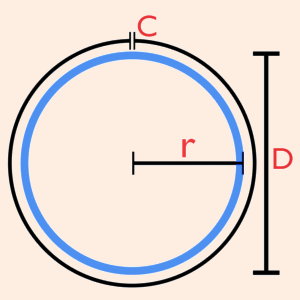
The two most basic measurements of a circle are its radius and diameter. The radius is the distance from the center to any point on the circle's edge.
Radius
noun
A straight line from the center of a circle or sphere to any point on the outer edge.
The diameter cuts across the circle, passing directly through the center. It connects two points on the circle's edge. Because it spans the entire width, the diameter is always exactly twice the length of the radius.
Measuring the Edge
The distance around the outside of a circle is called the circumference. It's like the perimeter of a polygon, but for a curved shape.
Circumference
noun
The enclosing boundary of a curved geometric figure, especially a circle.
What's fascinating is the relationship between a circle's circumference and its diameter. If you divide the circumference of any circle—no matter how big or small—by its diameter, you always get the same number. This constant is known as pi, represented by the Greek letter .
Pi () is the ratio of a circle's circumference to its diameter. Its value is approximately 3.14159.
This constant relationship gives us a straightforward way to calculate the circumference if we know the diameter or the radius.
Since the diameter is twice the radius, we can also express this formula using the radius.
Let's test your understanding of these core concepts.
What is the defining characteristic of a circle?
If a circle's diameter is 10 units, what is its radius?
These building blocks—center, radius, diameter, and circumference—are the foundation for understanding everything else about circles.