Mastering Circle Theorems
Circle Basics
The Perfect Shape
A circle is a shape you see every day, from the wheels on a car to the face of a clock. But what exactly makes a shape a circle? It's all about one simple rule: every point on the edge is the exact same distance from the center.
Circle
noun
A two-dimensional shape made up of all points that are the same distance from a given point, called the center.
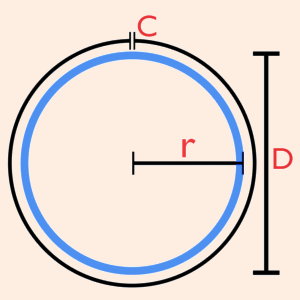
Let's break down the basic parts of a circle. The center is the middle point. The distance from the center to any point on the circle is called the radius.
If you draw a straight line that goes from one side of the circle to the other, passing through the center, you've drawn the diameter. You might notice that the diameter is just two radii put together. This gives us a simple relationship:
Here, stands for diameter and stands for radius.
Measuring a Circle
Now that we know the parts, how do we measure a circle? Two key measurements are its circumference and its area.
The circumference is the distance all the way around the outside of the circle. Think of it as the circle's perimeter. To find it, we use a special number called pi ($\[pi]\$). Pi is the ratio of a circle's circumference to its diameter. It's an irrational number, which means its decimal representation goes on forever without repeating. We usually round it to 3.14.
The formula for circumference is , or since the diameter is twice the radius, .
The area is the amount of space inside the circle. To calculate it, you only need to know the radius.
Notice that the area formula uses the radius squared (), not the diameter. It's a common mistake to mix them up!
Angles and Arcs
A full circle contains 360 degrees. We can measure portions of a circle using angles that start from the center point. This is called a central angle.
A central angle cuts off a piece of the circumference, which we call an arc. The measure of an arc is the same as the measure of its central angle. So, if a central angle is 45 degrees, the arc it intercepts is also 45 degrees.
For example, a 90-degree central angle cuts off a 90-degree arc, which is a quarter of the entire circle (since $360 / 4 = 90$).
Understanding these basic building blocks is the first step to mastering the geometry of circles.
Ready to test your knowledge?
What is the defining characteristic of a circle?
If a circle's diameter is 12 inches, what is its radius?
With these fundamentals, you're ready to explore more complex ideas about circles.