Mastering Chinese Reading
Introduction to Chinese Characters
Characters from Pictures
At first glance, Chinese characters might look like complex squiggles. But many of the oldest characters started as simple pictures of the world around us. These are called pictographs.
Imagine trying to draw a mountain. You might sketch a few peaks. The ancient Chinese did the same, which eventually became the character 山. Or a person, which started as a stick figure and evolved into 人.
Other characters, called ideographs, represent abstract ideas. They don't depict a physical object but rather a concept. For example, a single horizontal line represents the number one: 一. A line above another line means 'up' (上), and a line below another means 'down' (下). These characters convey meaning through simple, symbolic drawings.
Combining Ideas
Most Chinese characters are not simple pictures. They are compound characters, made by combining simpler components. Think of them like tiny puzzles where the pieces give you clues.
One common type is the compound ideograph, where two or more pictographs are merged to create a new meaning. For example, combining the character for 'woman' (女) and 'child' (子) creates a new character: 好. A woman with her child was seen as a good and happy thing, so 好 means 'good'.
女 (woman) + 子 (child) = 好 (good)
Even more common are semantic-phonetic compounds. These characters have two parts: one that hints at the meaning (the semantic component) and one that hints at the sound (the phonetic component).
Let's look at the character for 'mother', 妈 (mā). It's made of two parts: 女 (nǚ), the 'woman' radical, which tells you the character is related to a female. The other part is 马 (mǎ), which means 'horse'. The character has nothing to do with horses, but the pronunciation mǎ is very close to mā. The 'woman' part gives you the meaning, and the 'horse' part gives you the sound.
The Role of Radicals
The components that give clues to a character's meaning are called radicals. They are the fundamental building blocks of most characters. There are over 200 radicals, but learning the most common ones will dramatically speed up your ability to learn new characters.
Radicals are the building blocks of Chinese characters, providing clues to their meaning and pronunciation.
For instance, the radical 氵 is a simplified version of the character for water (水). When you see this 'three drops of water' radical on the left side of a character, you can bet it has something to do with water or liquids.
| Radical | Pinyin | Meaning | Example Characters |
|---|---|---|---|
| 氵 | shuǐ | Water | 河 (river), 湖 (lake), 汤 (soup) |
| 木 | mù | Wood | 树 (tree), 林 (forest), 椅 (chair) |
| 人 (亻) | rén | Person | 他 (he), 你 (you),们 (plural marker) |
| 口 | kǒu | Mouth | 吃 (eat), 喝 (drink), 叫 (to call) |
Recognizing radicals helps you categorize characters and make educated guesses about their meaning, even when you've never seen them before. It turns memorization into a logical process of deduction.
Writing It Right
Finally, every character is written with a specific stroke order. This isn't just about being neat; following the correct order helps with memorization and makes your handwriting legible. While there are several rules, a few basic principles will guide you most of the time:
- Top to bottom: Write the strokes at the top before the strokes at the bottom.
- Left to right: Write the strokes on the left before the strokes on the right.
- Horizontal before vertical: Write horizontal strokes before crossing vertical strokes.
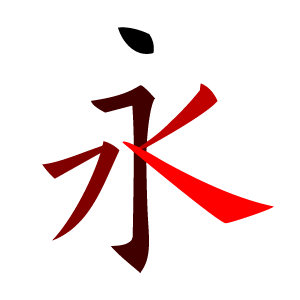
By understanding these fundamental principles—pictographs, compound characters, radicals, and stroke order—you're no longer just memorizing shapes. You're learning the internal logic of the Chinese writing system.
The character 山 (shān) is a classic example of which type of Chinese character, as it originally looked like a drawing of its meaning, 'mountain'?
In the character 妈 (mā), meaning 'mother', the component 马 (mǎ) provides a clue to the character's...
Now you have the foundational knowledge to start recognizing and understanding the building blocks of written Chinese.