Mastering Chess from Scratch
Chess Basics
The Playing Field
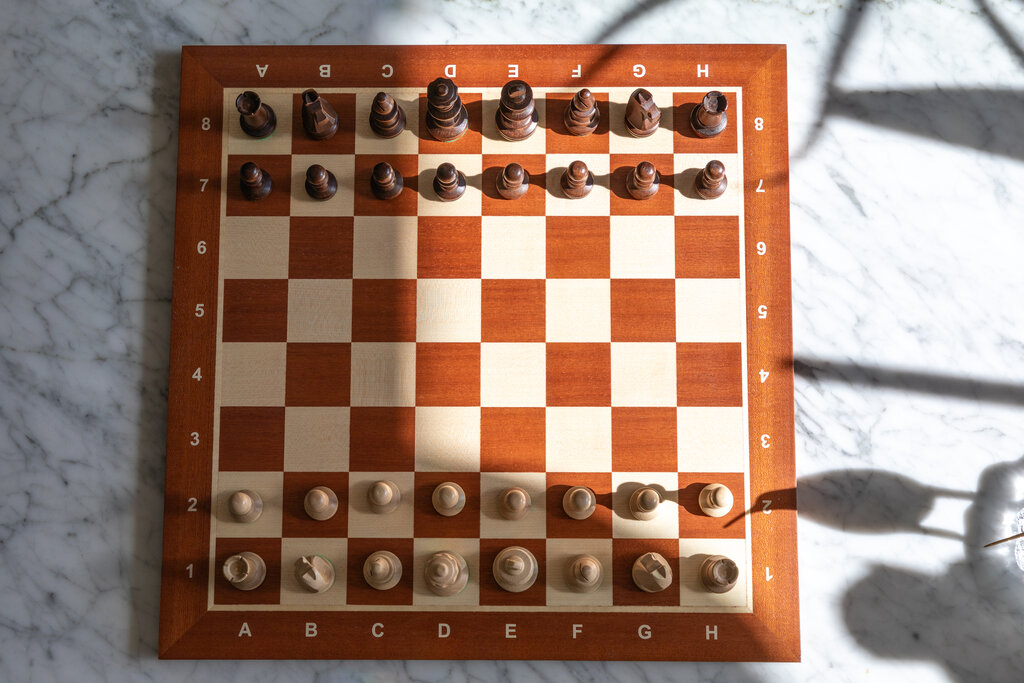
The game of chess is played on a square board with 64 alternating light and dark squares, arranged in an eight-by-eight grid. Think of it like a map. The horizontal rows are called ranks and are numbered 1 through 8. The vertical columns are called files and are labeled 'a' through 'h'.
This grid system gives every square a unique coordinate, just like in Battleship. The square in the bottom-left corner is 'a1', and the one in the top-right is 'h8'. When setting up the board, always make sure each player has a light-colored square on their bottom-right corner.
The Pieces and How They Move
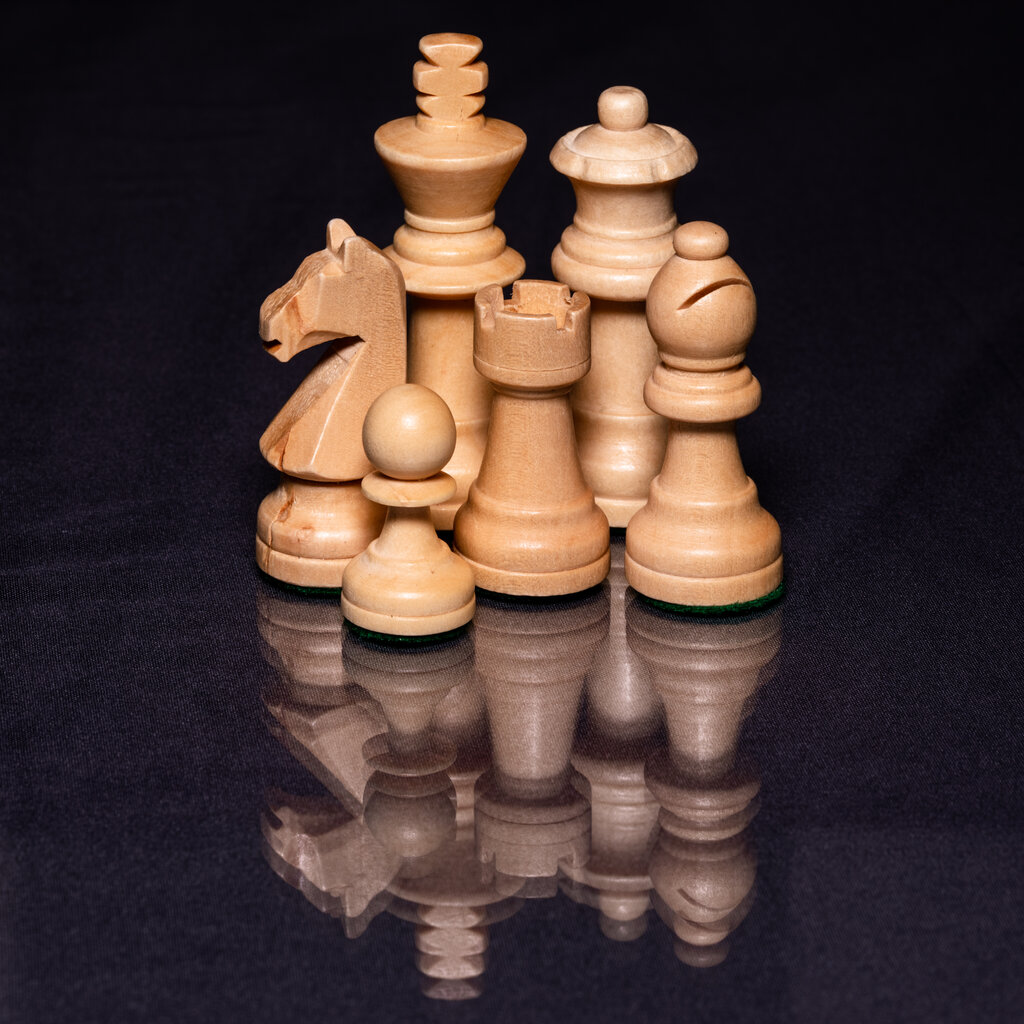
Each player starts with an army of 16 pieces: one king, one queen, two rooks, two bishops, two knights, and eight pawns. Each type of piece has its own unique way of moving around the board.
Pawn
noun
Moves one square forward. On its first move, it has the option to move two squares forward. Pawns capture one square diagonally forward.
Pawns are the soul of the game. They may seem weak, but they have special abilities we'll cover later that can change everything.
Knight
noun
Moves in an 'L' shape: two squares in one direction (horizontally or vertically) and then one square perpendicular to that. The knight is the only piece that can jump over other pieces.
Knights are excellent for surprise attacks because of their unique hopping ability.
Bishop
noun
Moves any number of squares diagonally. Each player starts with two bishops, one that moves on light squares and one that moves on dark squares.
Since a bishop is confined to squares of one color, having both of your bishops on the board is a big advantage.
Rook
noun
Moves any number of squares horizontally or vertically. Rooks are powerful in open files and ranks.
Often called 'castles', rooks are strong pieces, especially towards the end of the game when the board is less crowded.
Queen
noun
The most powerful piece. It can move any number of squares horizontally, vertically, or diagonally, combining the moves of a rook and a bishop.
The queen is the star player, able to control a huge portion of the board at once.
King
noun
The most important piece, but not the most powerful. It can move one square in any direction: horizontally, vertically, or diagonally.
How to Win
The objective of chess is to trap your opponent's king so that it cannot escape capture. This is called checkmate.
When a king is under attack by an opponent's piece, it is in check. The player whose king is in check must make a move to get it out of check. There are three ways to do this:
- Move the king to a safe square.
- Block the attack with another piece.
- Capture the attacking piece.
If a player is in check and cannot make any of these moves, their king is in checkmate, and the game is over. It's also possible for a game to end in a draw. The most common type of draw is a stalemate, where a player is not in check but has no legal moves to make.
The goal isn't to capture the king, but to trap it. Once the king is checkmated, the game ends immediately.
Special Moves
There are a few special rules that add depth to the game. First is castling. This is the only move where you can move two pieces at once: your king and one of your rooks. The king moves two squares towards a rook, and that rook then hops over the king to the adjacent square.
You can only castle if:
- Neither the king nor the rook has moved yet.
- The squares between the king and the rook are empty.
- The king is not in check and does not pass through or land on a square that is under attack.
Next is pawn promotion. If you manage to move one of your pawns all the way to the other side of the board (the 8th rank for White, or the 1st rank for Black), it gets a promotion! You can transform it into a queen, rook, bishop, or knight of the same color. Most of the time, players choose to promote to a queen since it's the most powerful piece.
Finally, there's a special pawn capture called en passant, which is French for 'in passing'. This move can only happen immediately after a pawn moves two squares forward from its starting position and lands right next to an opponent's pawn.
The opponent's pawn can then capture the two-square-moving pawn as if it had only moved one square forward. This special capture must be done on the very next turn, or the chance is lost.
These rules form the foundation of chess. Now let's test what you've learned.
In chess terminology, what are the horizontal rows on the board called?
What is the ultimate objective of a game of chess?
Understanding how the pieces move and what the goal is are the first steps on a long and rewarding journey in chess. With these basics, you're ready to start playing.