Mastering Chemical Reactivity and Stoichiometry
Chemical Bonding Theories
The Electron Tug-of-War
Atoms form bonds to become more stable, usually by achieving a full outer shell of electrons. But not all atoms share equally. Some are more electron-greedy than others. This greediness is called electronegativity—an atom's ability to attract shared electrons in a chemical bond.
Think of it as a tug-of-war. When two identical atoms bond, like in an oxygen molecule (), they pull on the electrons with equal force. The electrons are shared perfectly evenly, creating a nonpolar covalent bond. It's a stalemate.
But when two different atoms bond, like hydrogen and chlorine (HCl), the situation changes. Chlorine is more electronegative than hydrogen, so it pulls the shared electrons closer to itself. This unequal sharing creates a polar covalent bond, with a slight negative charge on the chlorine atom () and a slight positive charge on the hydrogen atom ().
If the electronegativity difference is huge, one atom doesn't just pull the electrons closer—it steals them entirely. This happens between a metal like sodium and a nonmetal like chlorine. Chlorine yanks sodium's valence electron away, forming ions ( and ). The electrostatic attraction between these opposite charges is an ionic bond. The chemist developed the most commonly used scale to quantify this property, helping us predict the type of bond that will form.
| Electronegativity Difference | Bond Type |
|---|---|
| 0 - 0.4 | Nonpolar Covalent |
| 0.5 - 1.7 | Polar Covalent |
| > 1.7 | Ionic |
This spectrum from nonpolar covalent to ionic is a continuum. There's no sharp cutoff, but these ranges provide a useful guide for classifying the character of a bond.
Drawing Molecular Blueprints
To visualize how valence electrons are arranged in a molecule, we use Lewis dot structures. These simple diagrams show atoms and their valence electrons as dots, with lines representing shared pairs in covalent bonds. While straightforward for simple molecules like methane (), they become more interesting with polyatomic ions—charged molecules like the nitrate ion ().
Let's draw the Lewis structure for nitrate:
- Count total valence electrons. Nitrogen has 5. Each of the three oxygens has 6. The negative charge means there's one extra electron. Total = valence electrons.
- Arrange the atoms. The least electronegative atom, nitrogen, goes in the center, surrounded by the three oxygen atoms.
- Draw single bonds. Connect each oxygen to the nitrogen with a single bond. This uses electrons. We have electrons left.
- Complete the octets. Distribute the remaining 18 electrons as lone pairs around the oxygen atoms first. Each oxygen gets 6 dots (3 lone pairs), using up all 18 electrons.
- Check the central atom. The oxygen atoms now have full octets, but the central nitrogen only has 6 electrons (three single bonds). It needs two more. To fix this, we take a lone pair from one of the oxygen atoms and turn it into a double bond with the nitrogen. The structure is then placed in brackets with its charge shown.
But which oxygen forms the double bond? In reality, it doesn't matter. The true structure is an average of all three possibilities, a concept called resonance. For now, any of the three valid drawings is correct. The key is that the process works for ions just as it does for neutral molecules, as long as you account for the charge.
Assigning Charges
Sometimes, you can draw multiple valid Lewis structures for a molecule. To figure out which one is the most stable and likely to exist, we use a tool called calculations. Formal charge is the hypothetical charge an atom would have if all bonding electrons were shared equally.
The goal is to find the structure where the formal charges are minimized, meaning they are as close to zero as possible. Any negative formal charges should ideally be on the most electronegative atoms.
A structure with formal charges of 0, 0, and 0 is more stable than one with charges of +1, 0, and -1.
Let's apply this to our nitrate ion. In the structure we drew:
- Double-bonded Oxygen: $6 - 4 - (4/2) = 0$
- Single-bonded Oxygens (each): $6 - 6 - (2/2) = -1$
- Nitrogen: $5 - 0 - (8/2) = +1$
The sum of the formal charges ($0 - 1 - 1 + 1 = -1$) equals the overall charge of the ion, which is a good sanity check. This distribution of charges is the most stable arrangement for the nitrate ion.
Unusual Bonds
In a typical covalent bond, each atom contributes one electron to the shared pair. But in a coordinate covalent bond, one atom provides both electrons. This often happens when a molecule with a lone pair (a Lewis base) encounters an atom that is short of an octet (a Lewis acid).
A classic example is the formation of the ammonium ion (). Ammonia () has a lone pair on the nitrogen atom. A hydrogen ion (), which is just a proton with no electrons, is electron-deficient. The nitrogen in ammonia donates its entire lone pair to form a bond with the hydrogen ion. Once formed, this bond is indistinguishable from the other three N-H bonds.
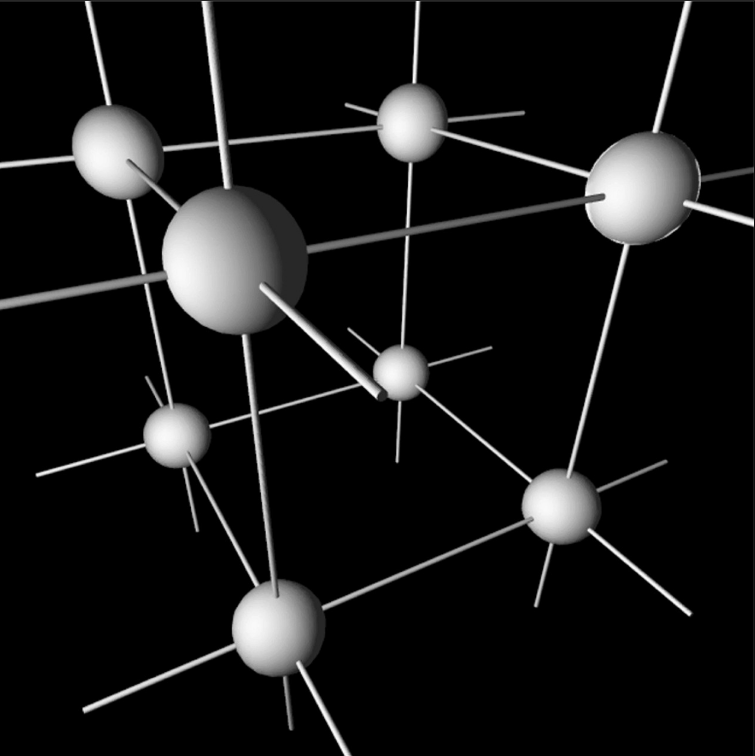
Finally, we have metallic bonding, which explains the properties of metals like copper and gold. In a metal, the valence electrons aren't held by any single atom. Instead, they are delocalized, forming a mobile "sea" of electrons that surrounds a fixed lattice of positive metal cations.
This elegantly explains why metals are excellent conductors of electricity and heat—the free-flowing electrons can easily carry charge and thermal energy through the material. It also explains why they are malleable and ductile; the layers of cations can slide past one another without breaking the bonds, as the electron sea simply adjusts around them.
So, from the unequal pull of electronegativity to the communal sharing in a sea of electrons, the way atoms bond dictates the world around us. These theories provide the framework for understanding why salt dissolves in water, why diamonds are hard, and why copper wires can power our homes.
Ready to test your knowledge?
What is the primary factor that determines whether a covalent bond between two atoms will be polar or nonpolar?
When drawing the Lewis dot structure for the nitrate ion (), what is the first step?
Understanding these models of bonding is key to predicting how different substances will behave and interact.