Mastering Chemical Equation Balancing
Equation Inventory Method
Keeping the Books Balanced
A chemical reaction is like a dance where atoms switch partners. No atoms are ever created or destroyed; they just rearrange themselves into new molecules. This fundamental rule is the Law of Conservation of Mass—what you start with is what you end with, just in a different form. Our job in balancing an equation is to act as accountants for the atoms, ensuring the books balance on both sides.
Balancing a chemical equation involves adjusting the coefficients (the numbers in front of chemical formulas) to make sure there are the same number of each type of atom on both sides of the equation.
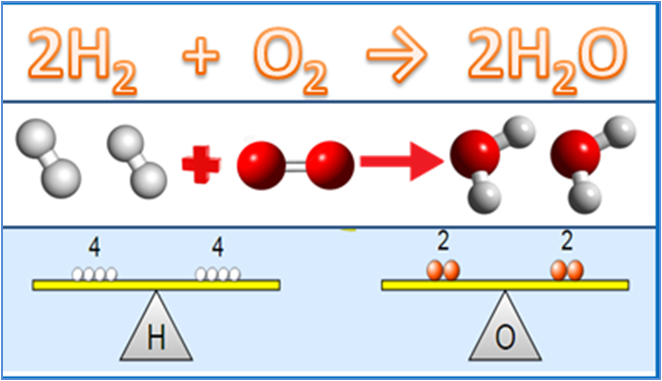
Think of it this way: to make water (H₂O), you need hydrogen (H₂) and oxygen (O₂). The initial, unbalanced equation looks like this:
On the left (reactants), we have two hydrogen atoms and two oxygen atoms. On the right (products), we have two hydrogen atoms but only one oxygen atom. The books don't balance. An oxygen atom seems to have vanished, which violates our fundamental law.
Coefficients vs. Subscripts
To fix this, we can only change the numbers in front of the chemical formulas. These are called coefficients. They tell us how many of each molecule we have.
The small numbers within a formula are called subscripts, like the '2' in H₂O. Subscripts define the molecule itself. Changing H₂O to H₂O₂ would balance the oxygen atoms, but it would also change the product from water to hydrogen peroxide, a completely different substance. Subscripts are off-limits.
Rule #1: Only change coefficients. Never, ever change subscripts.
The Inventory Method
Instead of just guessing, we can use a systematic inventory to track our atoms. This is often called a RAP table, for Reactants, Atoms, and Products. It’s a simple but powerful tool.
Let’s try balancing the combustion of methane (CH₄), the main component of natural gas. When it burns, it reacts with oxygen (O₂) to produce carbon dioxide (CO₂) and water (H₂O).
The unbalanced, or skeleton, equation is:
First, we set up our inventory table. We list every element involved in the reaction and count the atoms on both the reactant and product sides.
| Atom | Reactants | Products |
|---|---|---|
| C | 1 | 1 |
| H | 4 | 2 |
| O | 2 | 3 |
Our table shows that Carbon (C) is balanced, but Hydrogen (H) and Oxygen (O) are not. We need to fix this.
A good strategy is to balance elements that appear in only one reactant and one product first. Metals often fall into this category. Save elements that appear in multiple places, like oxygen in this example, for last.
Let's balance the hydrogen atoms. We have 4 on the left and 2 on the right. We can place a coefficient of 2 in front of H₂O on the product side. This gives us 2 x 2 = 4 hydrogen atoms.
Now, let's update our inventory. Remember, that new coefficient also changes the oxygen count on the product side.
| Atom | Reactants | Products |
|---|---|---|
| C | 1 | 1 |
| H | 4 | 4 |
| O | 2 | 4 (2 from CO₂ + 2 from 2H₂O) |
Carbon and hydrogen are now balanced, but oxygen is not. We have 2 oxygen atoms on the left and 4 on the right. To fix this, we can place a coefficient of 2 in front of O₂ on the reactant side.
Let's do one last check of the inventory.
| Atom | Reactants | Products |
|---|---|---|
| C | 1 | 1 |
| H | 4 | 4 |
| O | 4 | 4 |
Everything matches. The equation is now balanced. We've successfully accounted for every atom, satisfying the Law of Conservation of Mass. This systematic method, sometimes called balancing by , turns a puzzle into a straightforward process.
Ready to test your accounting skills?
What fundamental law requires that chemical equations be balanced?
When balancing a chemical equation, why must you only change coefficients and never subscripts?