Mastering Chemical Compounds and Molecular Bonding
Chemical Bonding Mechanics
Why Atoms Bond
Atoms form chemical bonds for one simple reason: to reach a more stable, lower-energy state. Think of it like a ball rolling downhill. A lone, high-energy atom is like a ball at the top of a hill; forming a bond is the process of rolling to the bottom where it's more stable. This stability is usually achieved by rearranging the atom's outermost electrons, its valence electrons.
The driving force behind bonding is the decrease in overall energy. When atoms bond, the resulting molecule or compound is more stable (has lower potential energy) than the individual atoms were.
You might recall the octet rule, which states that atoms tend to bond in such a way that they each have eight electrons in their valence shell, mimicking the configuration of a noble gas. While this is a useful guideline, especially for main-group elements, it's more of a suggestion than a strict law. Many stable compounds feature atoms with expanded shells, holding more than eight valence electrons. This often occurs with elements in the third period and below, like sulfur in sulfur hexafluoride (SF₆) or phosphorus in phosphorus pentachloride (PCl₅), because they have accessible d-orbitals that can accommodate extra electrons.
A Spectrum of Sharing
The way atoms achieve this stable state isn't always the same. The process depends on an atom's electronegativity, which is a measure of its ability to attract shared electrons in a chemical bond. Instead of a strict division, think of bonding as a continuous spectrum. On one end, we have a pure covalent bond, where electrons are shared equally. On the other, an ionic bond, where one atom effectively donates an electron to another. Most bonds fall somewhere in between.
The difference in electronegativity (ΔEN) between two bonding atoms dictates the bond's character. A small difference leads to a nonpolar covalent bond, where electrons are shared almost equally. As the difference grows, the bond becomes polar covalent; the more electronegative atom pulls the shared electrons closer, creating a slight negative charge (δ-) on that atom and a slight positive charge (δ+) on the other. When the difference is very large, an electron is effectively transferred, creating ions and an ionic bond. This concept was quantified by Linus Pauling in his development of the electronegativity scale.
| Electronegativity Difference (ΔEN) | Bond Type | Example |
|---|---|---|
| 0 - 0.4 | Nonpolar Covalent | H-H, Cl-Cl |
| 0.4 - 1.7 | Polar Covalent | H-Cl, H₂O |
| > 1.7 | Ionic | NaCl, MgF₂ |
Ionic Bonds and Lattice Energy
In ionic compounds, the story doesn't end with a simple pair of ions. The strong electrostatic attraction between positive and negative ions organizes them into a highly ordered, three-dimensional crystal lattice. This structure maximizes attractions and minimizes repulsions, resulting in a very stable, low-energy arrangement.
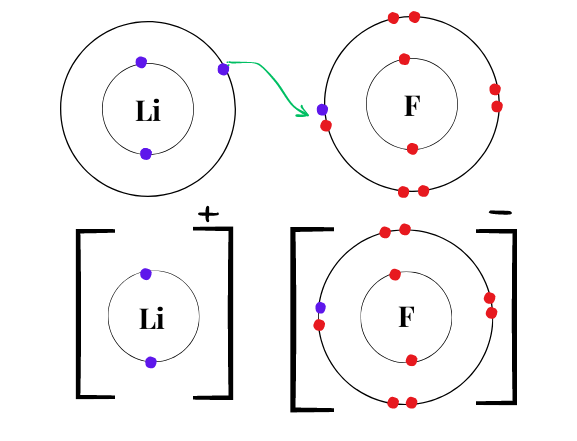
The stability of this lattice is measured by its lattice energy (), defined as the energy required to completely separate one mole of a solid ionic compound into its gaseous ions. A higher lattice energy means a more stable crystal and a stronger ionic bond. Direct measurement is impossible, so chemists use an indirect method based on Hess's Law called the Born-Haber cycle. It breaks down the formation of an ionic solid into a series of steps for which the enthalpy changes are known, allowing for the calculation of the unknown lattice energy.
Covalent Bonds and Strength
In a covalent bond, atoms share one or more pairs of valence electrons. The strength of this bond is measured by its bond enthalpy (or bond-dissociation energy). This is the energy required to break one mole of a specific bond in the gas phase. A higher bond enthalpy means a stronger bond, as more energy is needed to pull the atoms apart.
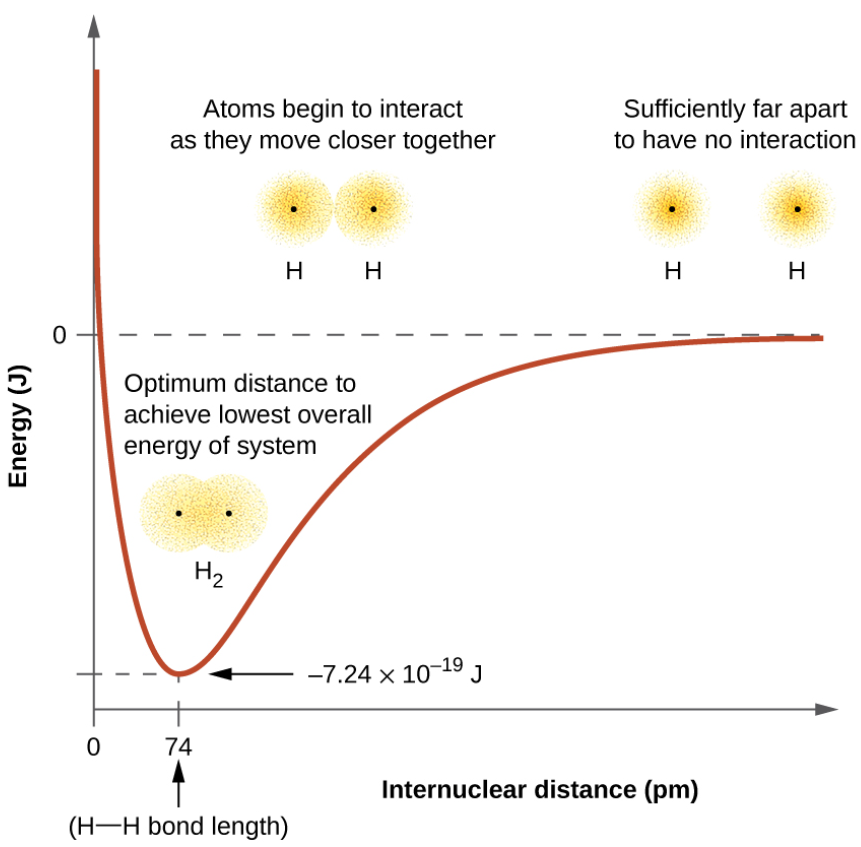
For example, breaking the H-H bond in hydrogen gas requires 436 kJ/mol. Multiple bonds are stronger than single bonds between the same two atoms. A carbon-carbon triple bond is stronger and shorter than a double bond, which is in turn stronger and shorter than a single bond.
| Bond | Bond Enthalpy (kJ/mol) | Bond Length (pm) |
|---|---|---|
| C-C | 348 | 154 |
| C=C | 614 | 134 |
| C≡C | 839 | 120 |
These values are averages, as the exact energy can vary slightly depending on the specific molecule. However, they are incredibly useful for estimating the overall enthalpy change of a chemical reaction. By summing the energy required to break the bonds in the reactants and subtracting the energy released when forming the bonds in the products, we can determine if a reaction is exothermic (releases energy) or endothermic (absorbs energy).
What is the primary reason atoms form chemical bonds?
The stability of an ionic crystal lattice is measured by its lattice energy. What does lattice energy () represent?
Understanding these energetic principles is the key to predicting how atoms will interact to form the vast array of substances that make up our world.